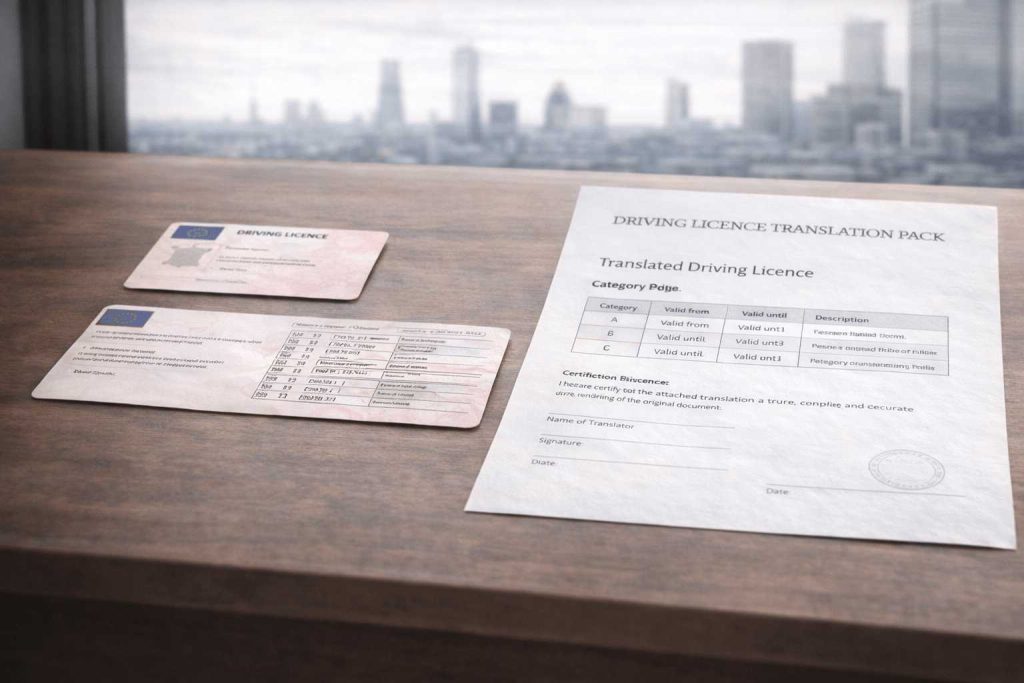
A driving licence translation is not just about turning one language into another. For DVLA-related use, the real goal is to make the original licence easy to verify without changing what the document actually says.
That is where many submissions go wrong. A licence can be translated accurately at sentence level and still create problems if the layout is stripped out, category rows are simplified, restriction codes are guessed, or the reverse side is ignored. When a reviewer needs to compare dates, categories, codes, issuing details, and restrictions quickly, clarity matters just as much as language.
This guide explains what should be translated on a foreign driving licence, what should never be edited, and how to prepare a submission that is easier to assess. It also covers licence categories, codes, layout retention, and practical acceptance tips so your translation works as a document, not just as text.
If you already have a scan of your licence, upload your file to TS24 and we can confirm the right certification level, turnaround, and formatting approach before you submit.
The short answer
For a DVLA-facing translation, translate every meaningful item that affects identity, entitlement, dates, restrictions, and official verification.
That usually includes:
- the front and back of the licence
- the holder’s name exactly as shown
- licence number exactly as shown
- issuing authority
- issue and expiry dates
- place of issue where shown
- vehicle categories and subcategories
- restriction or information codes
- notes, endorsements, and observations
- stamps, seals, and visible official markings
- legends, labels, and headings on the card
What should not be edited:
- the original numbering system
- category letters or alphanumeric codes
- licence numbers
- date values
- spelling of names as shown on the source document
- the structure of category tables
- the fact that something is unclear, truncated, handwritten, or partially obscured
The safest principle is simple: translate the content, preserve the document logic.
Why driving licence translations get rejected or questioned
A driving licence is compact, coded, and highly structured. Unlike a birth certificate or letter, it relies on short labels, symbols, categories, tables, and back-side codes. That means the main risk is not usually vocabulary. It is editorial interference.
Common problems include:
- only translating the front and omitting the reverse side
- rewriting category tables into prose
- converting local categories into supposed UK equivalents
- expanding codes without showing the original code itself
- silently correcting spellings, dates, or document numbers
- removing abbreviations, seals, and official notes because they look repetitive
- failing to show where a field appears on the original licence
In practice, a strong driving licence translation should help a caseworker cross-check the source document quickly. If the translation forces the reviewer to guess where a field came from, the pack is weaker than it should be.
When a translation may be needed
The exact route depends on what you are doing with the licence. Some people need a translation because they are applying, exchanging a non-GB licence, proving what they are entitled to drive, dealing with insurers or employers, or submitting a wider document pack where the licence is supporting ID.
A translation is usually most useful when:
- the licence is not fully in English or Welsh
- the reverse side contains categories, codes, or restrictions in another language
- abbreviations or field labels are not self-explanatory
- the authority reviewing the document needs a certified English version for file review
- the licence is being used alongside other official paperwork in a UK submission
It is also important not to confuse a certified translation with an International Driving Permit. They are different documents used for different purposes.
What to translate on a driving licence
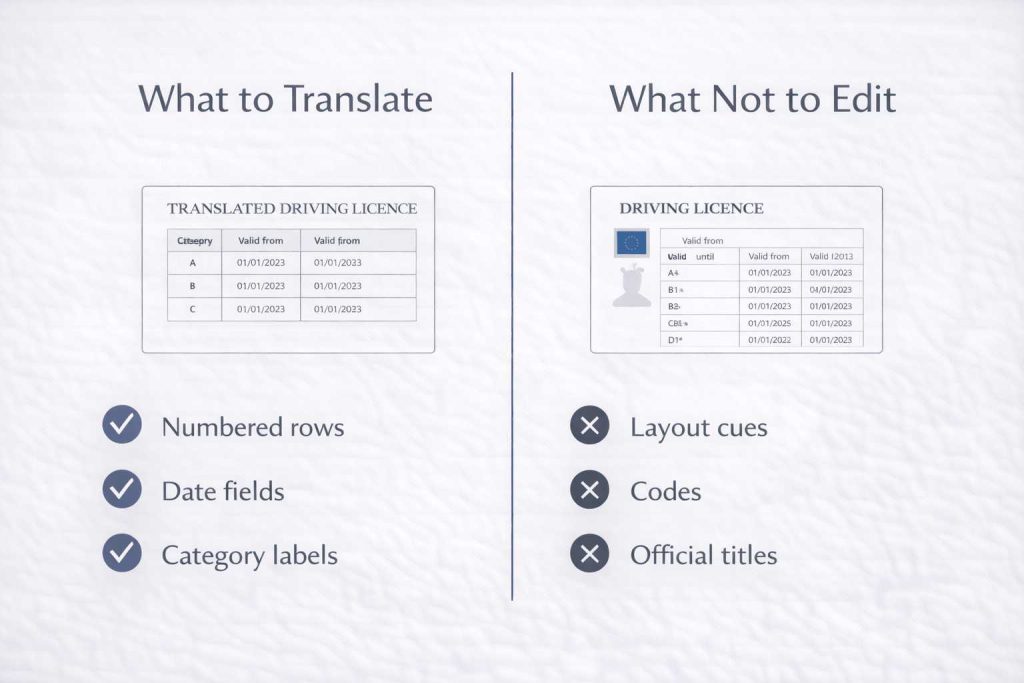
1. Identity fields
Translate every identity field that appears on the licence, including:
- surname
- given name(s)
- date of birth
- place of birth, where shown
- address, where shown
- signature label, where relevant
- issuing country or authority
Names should be reproduced exactly as shown on the source document. The translation can explain field labels, but it should not rewrite a person’s identity details into a preferred spelling just because that spelling appears on another document.
2. Document identifiers
These fields should always be carried over exactly and clearly:
- licence number
- card number or serial number, where present
- issue date
- expiry date
- first issue date, where shown
- issuing office or administrative authority
These are verification points. A translator should translate the field names, not alter the values.
3. Vehicle categories and entitlement rows
This is one of the most important parts of the whole translation.
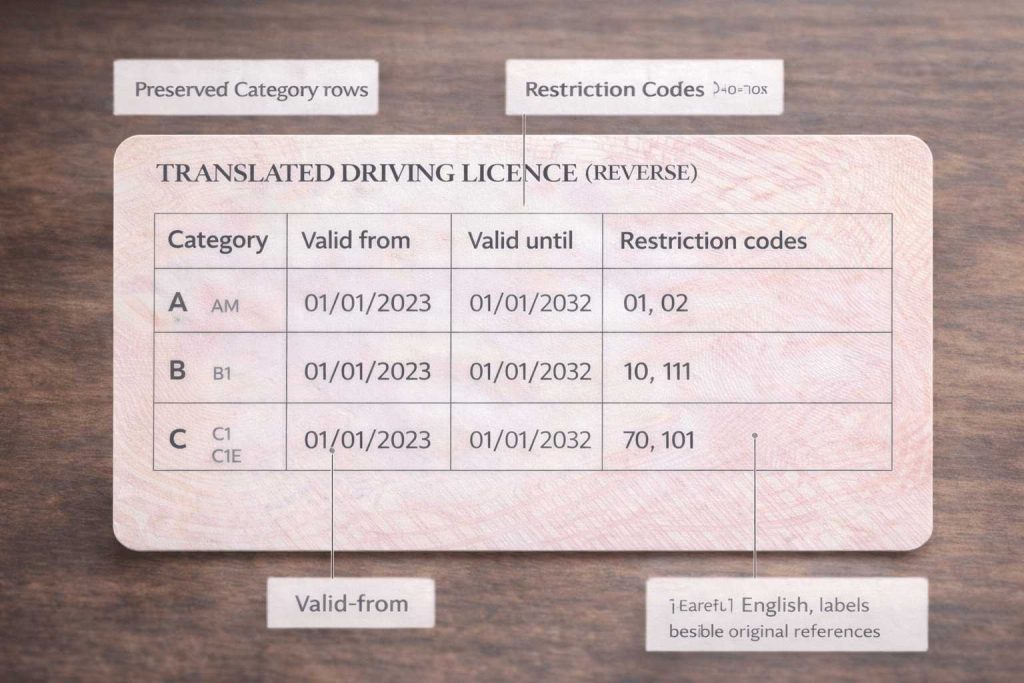
Categories should normally be shown in a table or mirrored list that preserves:
- category letter or code
- valid from date
- valid to date
- restrictions attached to that category
- any local note or remark linked to the category row
Do not collapse category rows into a vague sentence like “The holder can drive cars and motorcycles.” That loses detail. A reviewer may need to see the exact sequence of categories, dates, and linked codes.
4. Restriction and information codes
Codes are often printed on the back of the licence and can change the meaning of the entitlement. These may relate to:
- medical restrictions
- vehicle adaptations
- licence conditions
- automatic-only entitlement
- eyewear requirements
- administrative limitations
The translation should keep the original code visible and provide the translation or explanation beside it where it is reliably identifiable.
A good format looks like this:
- Code 01 — eyesight correction required
- Code 78 — restricted to automatic vehicles
Where the source document uses national codes or non-standard abbreviations, the translation should say so plainly instead of guessing.
5. Headings, legends, and document labels
Short headings matter more than many people think. They help the reviewer understand what each number or field actually refers to.
Translate:
- field labels
n- legends - table headings
- explanatory notes
- side notes or footnotes
- back-side instructions that affect interpretation
6. Stamps, seals, and annotations
Official markings should not be ignored. If the licence includes a stamp, seal, barcode label, handwritten amendment, or visible endorsement, it should be described where relevant.
Examples:
- round official stamp: partially legible
- embossed seal present
- handwritten note in blue ink across reverse side
- laminated overlay partially obscures lower text
That type of description is useful because it tells the reviewer what is visible on the original, even where perfect transcription is not possible.
What not to edit in a driving licence translation
This is where a lot of avoidable damage happens.
Do not convert categories into UK equivalents unless the authority specifically asks for an explanatory note
A translation is not an entitlement assessment. It should not decide that a foreign category is “basically Category B” or “equivalent to C1.”
It can translate the field labels and explain what the source document says, but it should not rewrite the licence as a UK entitlement decision. That is not the translator’s role.
Do not change codes to make them look more familiar
Codes must remain codes. If the original shows 78, 01, 95, or another restriction marker, keep it. You can add a clear explanation if the meaning is established, but never replace the code with your own interpretation.
Do not “clean up” names, dates, or numbers
Do not:
- switch day and month formats without showing the original value clearly
- correct spellings
- normalise transliteration
- remove hyphens or accents
- shorten a long licence number
- reformat document numbers into a new style
If there is a discrepancy, that should be visible rather than hidden.
Do not omit the reverse side
Many licences look simple from the front but store their real entitlement data on the back. If the back contains categories, dates, codes, notes, or symbols, omitting it creates an incomplete translation.
Do not redesign the document so heavily that cross-checking becomes hard
A translation does not need to be a graphic clone, but it should retain the original logic. If the source uses a structured table, the translation should use a structured table. If notes appear under a category row, the translation should show that relationship.
Do not guess unclear text
If a field is blurred, cropped, smudged, or partly hidden by laminate glare, the translation should say so.
Examples:
- illegible
- partially legible
- obscured by glare
- text truncated on source image
That is better than inventing certainty.
A practical rule: preserve layout, not decoration
The best driving licence translations usually follow a simple document rule:
Preserve the layout logic, not every design detail.
That means:
- mirror tables where tables exist
- keep front and back separate
- show each field in roughly the same grouping as the original
- place the translated text so a reviewer can compare line by line
- retain category rows in sequence
- keep codes attached to the relevant row or note
It does not mean recreating every colour, icon, or background pattern.
For acceptance, the translation should feel easy to audit.
What a strong driving licence translation package looks like
A well-prepared pack usually includes:
- A clear scan or high-quality photo of the original licence
- Translation of both sides where both sides contain information
- A complete English rendering of all meaningful text
- Preserved table structure for categories and dates
- Original codes retained with translated explanations where appropriate
- A certification statement confirming the translation is true and accurate
- Translator or agency details, signature, and date
If your scan is poor, the translation may still be accurate, but the submission becomes more vulnerable. That is why document quality matters before translation even begins.
Acceptance tips that genuinely reduce friction

Use a clean, glare-free scan
Driving licences are often laminated, glossy, and small. That makes them easy to photograph badly.
Before ordering the translation:
- scan or photograph both sides
- avoid flash reflections
- crop tightly but do not cut off edges
- keep all corners visible
- make sure category rows and codes are readable
- submit colour images where possible
Tell the translator what the licence is for
A translation prepared for DVLA-related use may need more attention to category rows, restriction codes, and layout retention than a translation prepared only as general supporting ID.
Context improves formatting decisions.
Keep the translation complete, even if some fields look repetitive
Small labels, repeated headings, and side notes are often exactly what help a reviewer trust the document.
Do not over-certify without a reason
Many UK applications accept a standard certified translation. If another body specifically asks for notarisation or legalisation, that should be handled separately. Adding extra layers without need can slow things down and increase cost.
Send the original and the translation together when requested
A translation explains the original. It does not replace it.
Licence categories: why they matter in translation
Many applicants focus on the name and expiry date, but entitlement categories often matter just as much.
In Great Britain, published guidance distinguishes between categories such as AM, A1, A, B, B1, BE, C1, C1E, C, CE, D1, and D. A reviewer may be looking carefully at the original category row, date range, and any linked restriction code.
That is why the translation should not reduce everything to a generic phrase like “car licence” or “motorcycle licence.” A stronger translation preserves the exact category references from the source and explains them accurately.
This is also why the reverse side is so often the decisive side.
Codes translation: explain, do not overwrite
Restriction codes can change the practical meaning of the entitlement.
For example, a code may show that the holder must wear corrective lenses or is restricted to automatic vehicles. If a translation drops those codes, the document stops telling the full story.
Best practice is to present codes like this:
| Original code | English explanation | Translator note |
| 01 | Eyesight correction required | Meaning established from standard code reference |
| 78 | Automatic vehicles only | Meaning established from standard code reference |
| National code / local note | Translate where clear | Mark as local or non-standard if not directly equivalent |
This protects the meaning of the original while staying transparent.
A side-by-side guide: what to translate and what not to edit
| Translate fully | Do not edit or reinterpret |
| Name fields and labels | Spelling of the holder’s details |
| Date labels and date fields | Date values |
| Issuing authority | Authority names into a different institution |
| Category rows | Category letters or order |
| Restriction codes and notes | Codes into invented alternatives |
| Front and back headings | Structure of the table |
| Stamps, seals, annotations | The fact that text is unclear or partial |
| Legends and explanatory notes | Missing content by guessing |
Example of a weak translation versus a strong one
Weak version
“The holder is allowed to drive cars, motorcycles, and light vehicles. Licence valid until 2029.”
Why it is weak:
- no category table
- no codes
- no back-side detail
- no issue date
- no authority detail
- no field structure
- impossible to cross-check row by row
Strong version
A structured translation that shows:
- front side fields in labelled format
- reverse side category table
- category letters preserved exactly
- valid from and valid to dates preserved row by row
- restriction codes shown beside relevant category rows
- explanatory note where the code meaning is established
- certification statement at the end
The second version is easier to trust because it lets the reviewer compare, not infer.
A practical example
Imagine a foreign licence where the front is partly bilingual but the reverse side contains category rows and restriction notes only in the source language.
A weak approach would translate the obvious front-side fields and assume the rest is self-explanatory.
A stronger approach would:
- translate the front and back
- reproduce the category table
- retain local category codes exactly
- translate every row heading
- explain visible restrictions without converting them into a UK entitlement decision
- note any stamp or endorsement that appears over the table
That is the difference between a translation that merely exists and a translation that helps the file move.
Submission checklist before you send your pack
Use this quick checklist before submitting your licence translation:
- Both sides of the licence have been reviewed
- All meaningful text has been translated
- Category rows are preserved in table form
- Codes remain visible in the translation
- Names, numbers, and dates match the source exactly
- Notes, endorsements, and stamps are included or described
- Unclear text is marked as unclear, not guessed
- The certification statement is signed and dated
- The translator or agency details are present
- The scan is readable and free from glare
If you want a second pair of eyes before you submit, send the scan to TS24 and we can check whether the format is submission-ready before production starts.
Why applicants choose TS24 for driving licence translations
TS24 handles certified translations for official, legal, and government-facing use across more than 200 languages. For document-led submissions, that matters because speed alone is not enough. The layout, completeness, and certification wording all have to work together.
What clients usually want from a driving licence translation is simple:
- accurate English text
- careful handling of categories and codes
- complete front-and-back coverage
- fast turnaround where deadlines matter
- certification that is clear and professionally presented
TS24’s certified translation team supports standard, urgent, same-day, and document-specific requests, with guidance available before you order. Recent client feedback consistently highlights fast turnaround, responsive communication, and reliable document presentation.
If your licence is part of a larger pack, we can also translate related supporting documents such as passports, immigration papers, legal records, and other official certificates so the whole submission is consistent.
Final word
The safest DVLA licence translation is not the one that looks polished at first glance. It is the one that preserves the evidence.
Translate the full document. Keep the category logic. Retain the codes. Do not rewrite the entitlement. Do not tidy away awkward details. Do not hide unclear text behind confident wording.
When the translation makes the original easier to verify, the submission becomes stronger.
If you need a certified driving licence translation prepared for UK official use, send TS24 a clear scan of both sides and we will confirm the price, turnaround, and best formatting approach for your document.
FAQs
Do I need a DVLA driving licence translation if my licence is partly in English?
Possibly. If any important field remains unclear in another language, especially on the reverse side, it is safer to translate the full licence. Categories, restriction codes, notes, and local labels often appear on the back and should not be left unexplained.
What should a DVLA driving licence translation include?
A strong translation should include both sides of the licence where relevant, all identity fields, issue and expiry dates, issuing authority, category rows, restriction codes, notes, and a signed certification statement with translator or agency details.
Can a translator change foreign licence categories into UK categories?
No. The translation should preserve the original category letters or codes and explain them where possible. It should not decide that a foreign category is automatically equivalent to a UK entitlement unless an authority specifically asks for a separate explanatory assessment.
Are licence codes important in a driving licence translation?
Yes. Codes can affect what the holder is allowed to drive and under what conditions. A complete translation should keep the original code visible and provide an accurate English explanation where the meaning is established.
Is a certified translation the same as an International Driving Permit?
No. A certified translation explains a document in English for official review. An International Driving Permit is a separate travel-related document used in some jurisdictions for driving abroad.
How can I improve the chances of acceptance?
Use a clean colour scan of both sides, keep all corners visible, avoid glare, choose a certified translation provider familiar with coded official documents, and make sure the translation preserves the original layout logic rather than rewriting the licence into narrative form.

