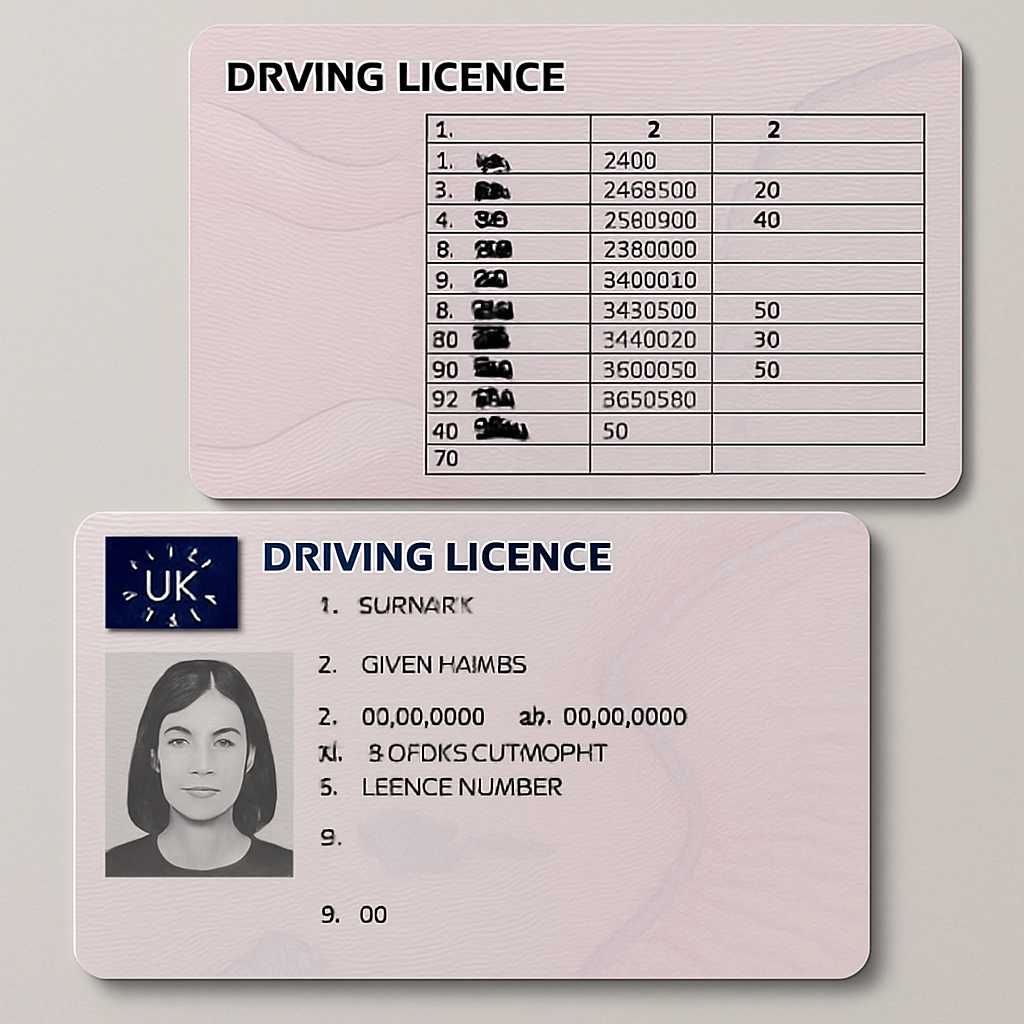
A foreign driving licence often looks simple until someone actually has to rely on it for a licence exchange, employer check, insurance review, legal file, or application pack.
The common mistake is assuming the front is the document and the back is just administration. It is not. On GB-style photocard licences, the reverse side carries the vehicle categories, “valid from” and “valid to” dates, and the information or restriction codes that define what the holder can actually drive. (GOV.UK)
That is why driving licence translation codes matter so much. A good translation does not just convert words; it preserves legal meaning. If a category is mistranslated, if a code is omitted, or if a restriction note is flattened into vague wording, the translated document can become less useful at exactly the moment it is meant to prove entitlement. (GOV.UK)
The back of a driving licence is not admin clutter; it is the entitlement map. For clients, solicitors, HR teams, compliance staff, and anyone submitting official documents, the safest approach is simple: translate the whole licence, keep the structure readable, and explain every code that changes how the holder may drive.
What “categories”, “codes” and “restrictions” actually mean
People often use these words interchangeably, but they are not the same.
- Categories are the classes of vehicle the licence holder is entitled to drive.
- Codes are the numbered notes attached to those entitlements.
- Restrictions are the real-world limits created by those codes, such as automatic-only use, eyesight correction, seat limits, trailer limits, or other conditions.
Endorsements are different again. These are offence codes and penalty-point records, not entitlement notes on the reverse-side category table. (GOV.UK)
That distinction matters in translation. A document reviewer needs to see whether a note is describing what the person may drive, what they must do to drive legally, or what has been recorded as a traffic offence. Blending those into one generic word such as “remarks” or “notes” can create avoidable confusion.
How to read the back of a driving licence properly
A proper reading of the reverse side usually depends on four elements being kept together:
- Category letter or code
- Valid from date
- Valid to date
- Information or restriction code
On official UK guidance, the back of the photocard shows the categories displayed in a table, the start and end dates for each entitlement, the information or restriction codes, and even an overflow field where extra code information can continue. If dates are replaced by lines, the holder is not entitled to drive that category. (GOV.UK)
This is exactly why layout retention matters. Reviewers do not read a driving licence like a novel. They scan rows, compare dates, and cross-check codes against individual categories. When the translation breaks that structure, accuracy can still be technically present while usability collapses.
The most common driving licence categories explained
The exact system varies by country, and Northern Ireland references differ from Great Britain, but the GB category framework gives a useful benchmark for understanding many licence translations. (GOV.UK)
Private and everyday vehicle categories
- AM – mopeds and certain light quad bikes
- A1 – light motorcycles up to 125cc
- A2 – motorcycles up to 35kW
- A – larger motorcycles
- B1 – light four-wheel vehicles
- B – cars and vehicles up to the relevant mass/passenger limits
- BE – category B vehicle with trailer entitlement (GOV.UK)
Medium and heavy vehicle categories
- C1 – medium-sized vehicles between 3,500kg and 7,500kg MAM
- C1E – C1 vehicles with a larger trailer
- C – large goods vehicles over 3,500kg
- CE – category C vehicles with trailer entitlement (GOV.UK)
Passenger vehicle categories
- D1 – minibuses within the category limits
- D1E – D1 vehicles with trailer entitlement
- D – buses with more than 8 passenger seats
- DE – category D vehicles with trailer entitlement (GOV.UK)
Other letters that still matter
Older or specialist licences may also show categories such as f for agricultural tractor, G for road roller, H for tracked vehicles, k for mowing machine or pedestrian-controlled vehicle, l for electrically propelled vehicle, M for trolley vehicles, and n for exempt from duty. (GOV.UK)
For translation purposes, the key point is not just naming the category. It is matching the category to the correct row, correct dates, and correct code notes.
The restriction codes that are most often misunderstood
Official driving licence code guidance makes clear that the numbered codes printed on the back of a licence tell you what conditions must be met to drive. Some are medical or adaptation-related. Some are operational. Some are administrative. (GOV.UK)
Here are some of the codes that regularly need careful handling in translation:
- 01 – eyesight correction
- 02 – hearing or communication aid
- 70 – exchange of licence
- 71 – duplicate of licence
- 78 – restricted to vehicles with automatic transmission
- 79 – restricted to vehicles meeting the specification shown in brackets
- 101 – not for hire or reward
- 111 – limited to 16 passenger seats
- 122 – valid on successful completion of compulsory basic training (CBT) (GOV.UK)
A strong translation does not merely copy these numbers. It explains them cleanly and attaches them to the right entitlement. That is especially important with codes like 78 and 79, where the number changes what the holder is legally allowed to drive, not just how the licence is described.
Why code 78 is so important
Code 78 is one of the most commercially important codes because it means the holder is restricted to vehicles with automatic transmission. If a translation leaves out that code or reduces it to a vague note such as “special condition”, the translated licence may suggest a broader entitlement than the original actually gives. (GOV.UK)
Why code 79 needs context, not guesswork
Code 79 is easy to oversimplify. Official guidance says it restricts entitlement to vehicles that match the specification shown in brackets. In practice, the bracketed detail is part of the legal meaning. A translator should therefore preserve both the code and the bracket explanation, not replace it with a generic summary. (GOV.UK)
Why code 111 can affect work and transport use
Code 111 limits entitlement to 16 passenger seats. That is not a minor note. For employers, transport providers, and compliance teams, it can be the difference between an acceptable entitlement and an unsuitable one for a given role. (GOV.UK)
Restriction codes are not the same as endorsement codes
This is one of the biggest content gaps on competing pages, and it is where many licence translations become unhelpfully vague.
A restriction code tells you a condition attached to an entitlement. An endorsement code records a motoring offence and any related penalty points.
Official endorsement guidance includes examples such as:
- SP30 – exceeding the statutory speed limit on a public road
- TS10 – failing to comply with traffic light signals
- DR10 – driving or attempting to drive with alcohol above the limit
- IN10 – using a vehicle uninsured against third-party risks (GOV.UK)
If a licence translation or accompanying explanation lumps these together under “codes”, it can confuse the reader about whether the issue is a driving entitlement or a driving record. For legal and compliance use, that distinction should always be made explicit.
Why older licences and exchanged licences cause more confusion
If a licence was issued before January 2013, the groups or categories may not align neatly with current category labels. GOV.UK notes that categories changed in January 2013 and had changed several times before that, with older licences using “groups” before they became “categories”. (GOV.UK)
That matters because a translation may be technically accurate at word level while still failing the real test: helping a reviewer understand the current entitlement correctly.
It also helps explain why codes such as 70 (“exchange of licence”) and 71 (“duplicate of licence”) are not decorative extras. They can signal administrative history that may matter when a document is being checked alongside another licensing record. (GOV.UK)
Northern Ireland is another reason translators should avoid assumptions. Official UK guidance explicitly notes that categories and some codes differ in Northern Ireland, so the safest practice is to translate the source document exactly as issued and avoid forcing it into a simplified GB-only template where the original does not match. (GOV.UK)
What a correct driving licence translation should include
When a non-English or non-Welsh document is submitted to the Home Office, official guidance says it must be accompanied by a full translation that can be independently verified. The translation must include confirmation that it is an accurate translation of the original document, the date of translation, the translator’s full name and signature, and the translator’s contact details. GOV.UK’s certification guidance also tells translators to confirm in writing that it is a true and accurate translation of the original document, with the date, full name, and contact details. (GOV.UK)
For a driving licence, that normally means the translation should include all of the following:
- The front and back of the licence
- All personal details exactly as shown
- The full category table
- Every validity date
- Every information, restriction, or exchange code
- Any overflow notes or continuation notes
- Issuing authority details
- A certification statement that matches official expectations (GOV.UK)
In plain terms, a submission-ready licence translation is not just “a translation of the card”. It is a translation of the entitlement structure.
Why layout retention matters more than most people think
“Layout retention” sounds cosmetic until a real reviewer has to use the document.
A badly formatted translation often turns a row-based licence table into a paragraph. That creates three problems immediately:
- The reader cannot see which code belongs to which category
- The reader cannot compare start and end dates quickly
- The reader may misread a restricted entitlement as a full entitlement
Here is the difference.
Weak translation: “Car licence valid until 2030. Automatic vehicles. Trailer allowed.”
Useful translation: “Category B — valid from 10.06.2020 to 10.06.2030 — Code 78: restricted to vehicles with automatic transmission.”
The second version is not longer for the sake of it. It is safer because it keeps the meaning attached to the correct entitlement.
The same principle applies to higher-risk rows. A D1 entitlement with code 111 is not the same thing as an unrestricted passenger entitlement. A BE or C1E row without its related notes can also be misleading. Good licence translation preserves the decision-making structure, not just the vocabulary. (GOV.UK)
Common mistakes that cause avoidable delays
1. Translating only the front
The back contains the categories and codes. Leaving it out makes the translation incomplete for any reviewer who needs to understand entitlement. (GOV.UK)
2. Treating all codes as general remarks
Some codes are medical, some are administrative, and some create legal restrictions on use. They should not be collapsed into one vague note field. (GOV.UK)
3. Dropping bracketed details after code 79
If the bracket text is omitted, the code loses part of its meaning. (GOV.UK)
4. Confusing entitlement codes with offence codes
Restriction codes and endorsement codes serve different purposes. A clean translation should make that difference obvious. (GOV.UK)
5. Flattening the table into prose
A paragraph may be readable, but it is slower to verify and easier to misinterpret than a structured row-by-row translation.
6. Inconsistent spelling of names or places
A licence is often checked alongside passports, visas, certificates, or court papers. Transliteration and naming should stay consistent across the file.
When a driving licence translation is commonly needed
A driving licence translation can be useful wherever the original licence is being reviewed in a context where the language, categories, or codes are not immediately understood. Typical examples include:
- Licence exchange or licensing administration
- Visa or immigration supporting documents
- Employer onboarding for driving-related roles
- Fleet, insurer, or compliance checks
- Accident, litigation, or solicitor files
- Regulated identity or residency packs
The real trigger is rarely the word “licence” by itself. It is usually the need to verify what the holder is entitled to drive, whether any restrictions apply, and whether the translation can be trusted as a complete record.
A practical checklist before you order a translation
Before you upload your file, check these points:
- Scan or photograph both sides clearly
- Make sure every date and code is readable
- State the purpose of the translation
- Mention whether the receiving organisation needs a digital copy, printed original, or both
- Ask for the category table to be kept in a structured format
- Ask for all codes, endorsements, and restriction notes to be translated in full
- Check that names match your other supporting documents
A two-minute check at this stage can save a much longer delay later.
Why clients choose TS24 for driving licence translations
TS24’s site says it has 15+ years in business, has translated 250,000+ documents, works across 200+ languages, offers a dedicated drivers licence translation service, and is an ATC-accredited agency with translators registered with bodies such as CIOL, ITI, and ATA. Its current Trustpilot profile shows 5 stars from 176 reviews, with customer feedback highlighting speed, value, and professional communication. TS24’s own driving licence page also states that a standard driver’s licence can be translated within 24 hours. (translationservices24.com)
If your priority is a translation that keeps the category table intact, explains the restriction notes clearly, and arrives with certification wording fit for official use, the safest next step is to upload a clear scan of both sides and ask TS24 to review the licence as a complete entitlement document, not just as a piece of ID.
FAQs
Do I need both sides of my driving licence translated?
Yes, in most official-use scenarios that is the safest approach. The reverse side carries the category table, validity dates, and information or restriction codes. Home Office guidance also refers to a full translation for non-English or non-Welsh documents. (GOV.UK)
What does code 78 mean on a driving licence translation?
Code 78 means the holder is restricted to vehicles with automatic transmission. A correct driving licence translation should show both the code and its meaning clearly against the relevant category. (GOV.UK)
Are driving licence categories the same in every country?
No. Many licences use familiar category letters, especially across Europe, but official UK guidance says categories differ in Northern Ireland, and older licences may use earlier group or category systems. Translators should therefore preserve the original document structure and explain it carefully rather than assuming a perfect one-to-one match. (GOV.UK)
What is the difference between a restriction code and an endorsement code?
A restriction code affects what the holder is allowed to drive or the conditions attached to that entitlement. An endorsement code records a motoring offence and related penalty points on the driving record. They are not interchangeable and should not be translated as though they mean the same thing. (GOV.UK)
What must a certified driving licence translation include?
For official UK use, certification should confirm that the translation is accurate, and include the date, the translator’s full name, signature where required, and contact details. For a driving licence, the translation should also include the whole card, including categories, dates, and codes. (GOV.UK)
Can I translate my own driving licence?
For formal submission, self-translation is usually the riskier route. Where an authority expects a certified translation, the safer option is to use a professional provider who can supply the certification details needed for independent verification. (GOV.UK)

