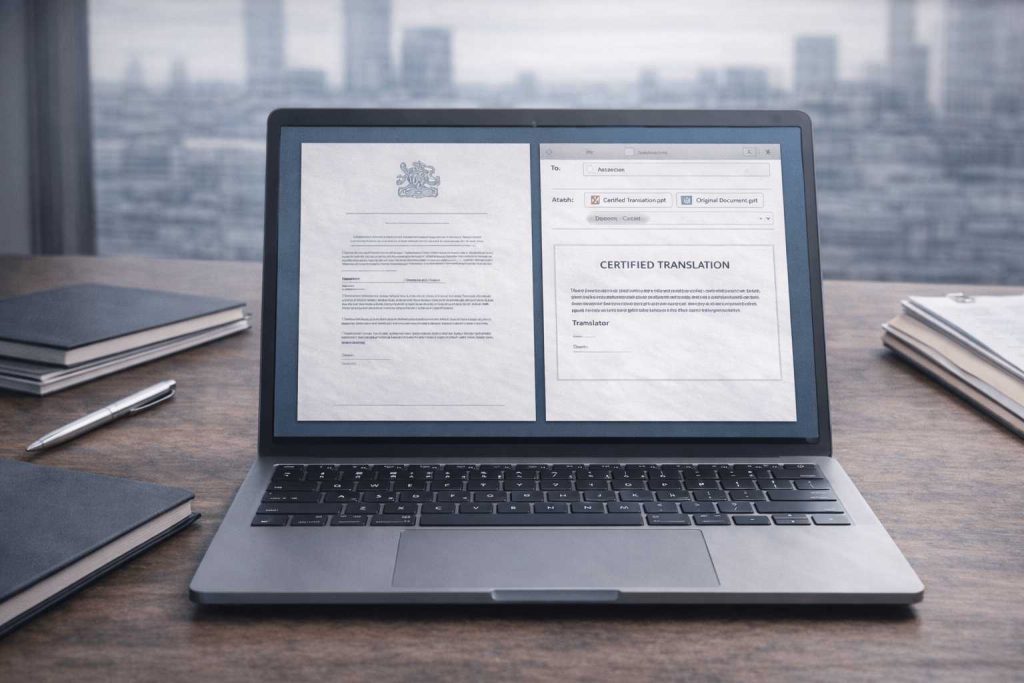
If you are asking whether a digital certified translation is accepted, the real answer is simpler than most pages make it sound: a PDF certified translation usually works best when the submission itself is digital. If you are uploading documents to an online portal, sending a pack by email, or sharing files for pre-approval, email delivery is often the fastest and cleanest route. If the authority wants originals, wet-ink paperwork, notarisation, apostille, or in-person inspection, digital delivery may still help you move quickly, but it should not be your only format.
That distinction matters because many people order the wrong thing. They panic-order a hard copy for a portal upload that only wanted PDFs. Or they submit a beautifully translated PDF to a process that still expects original paper documents. The result is delay, extra cost, and repeat work.
The safer rule is this:
Do not choose the format first. Choose the submission route first.
Once you know how the receiving authority wants the documents delivered, the right translation format becomes much easier to choose.
At TS24, we see this every day with visa files, legal papers, academic records, bank statements, certificates, licences, and business documents. Some submissions are perfect for PDF email delivery. Others need a posted certified copy, notarisation, or a fuller legalisation chain.
What a digital certified translation actually is
A digital certified translation is a certified translation delivered electronically, usually as a PDF. The translation should still include the same core certification details expected for official use, such as a statement of accuracy, the date, the translator or agency details, and the relevant signature or certification wording.
In practical terms, that means you are not buying a “less official” version. You are buying the same translation work in a different delivery format.
A proper digital certified translation should usually include:
- A full translation of the source document
- A certification statement confirming accuracy
- The date of certification
- The translator’s or agency representative’s details
- Signature and certification wording appropriate to the job
- A clean, readable PDF that is easy to submit and store
What changes is not the seriousness of the document. What changes is how it is delivered and how the receiving body reviews it.
When PDF email delivery works best
Digital delivery tends to work best when the authority, institution, or client is already operating through email, uploads, or online case handling.
1. Online application portals
This is the clearest use case.
If the process is built around online uploads, a PDF certified translation is usually the most efficient option because:
- the original and translation can be submitted together
- the caseworker sees the same file version you approved
- there is no courier delay
- you can forward or re-upload the pack quickly if asked
- you keep a stable digital record for future use
This is often the smoothest route for immigration support documents, recruitment compliance packs, academic applications, and document checks that begin online.
2. Email submission to a caseworker, admissions team, solicitor, employer, or administrator
Email delivery works particularly well where the recipient is reviewing documents rather than handling physical originals.
Examples include:
- pre-assessment of official papers
- compliance reviews before a final appointment
- academic admissions checks
- HR onboarding documents
- solicitor review packs
- document screening before notarisation or apostille
In these cases, speed and readability matter more than paper.
3. Urgent deadlines
If your submission deadline is today, tomorrow morning, or within 24 hours, waiting for post can create a problem that did not need to exist.
A digital certified translation helps because:
- you can start from a scan or clear photo
- the translation can be delivered as soon as it is completed
- you can submit immediately after approval
- hard copies can still follow if needed later
For urgent applications, PDF first is often the smart operational choice.
4. Multi-party sharing
Some document packs need to be seen by more than one person before final submission. A PDF works well when the same certified file must be shared with:
- a lawyer
- a university admissions office
- an employer
- a family sponsor
- a relocation adviser
- an overseas authority reviewing next steps
A single certified PDF reduces version confusion.
When print is safer than digital
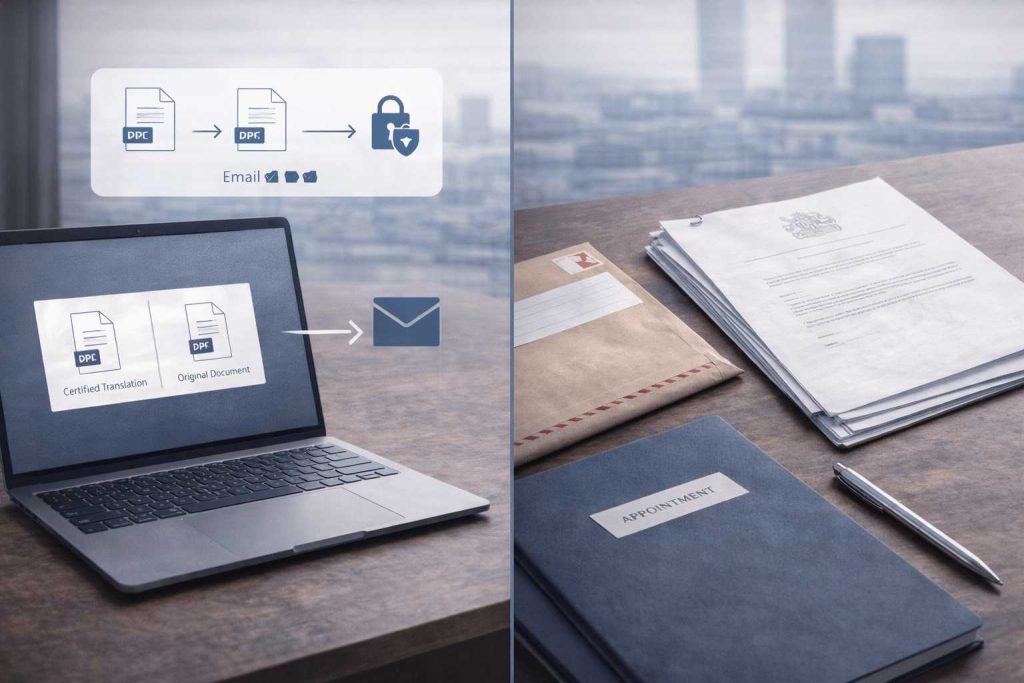
A digital certified translation is useful, but it is not always enough.
1. The authority asks for originals or hard copies
This is the biggest warning sign. If the instructions say:
- original documents only
- hard copy required
- wet signature required
- bring paper documents to appointment
- post originals
then PDF delivery is not the endpoint. It may still help you review and prepare the file, but you should also arrange the correct paper format.
2. The process is in person
Some appointment-based processes still revolve around physical document inspection. In those cases, a digital translation may help you prepare, but it does not replace the format the officer expects on the day.
3. The document needs notarisation, apostille, or further legalisation
Once a document moves into a more formal legal chain, the paper route often becomes more important.
This is especially relevant if the receiving body has asked for:
- notarised translation
- apostille
- legalisation
- embassy attestation
- bound or sealed paper pack
A digital certified translation can still be the starting file, but it is often not the final deliverable.
4. The document itself has high-format sensitivity
Some documents are more likely to attract scrutiny if layout, stamps, annotations, signatures, or handwritten notes are unclear. If the source scan is weak, a PDF-only submission can become risky because the recipient may doubt whether the translation fully reflects the source.
In those cases, better scans and, where appropriate, a posted certified copy can reduce friction.
The simplest decision rule
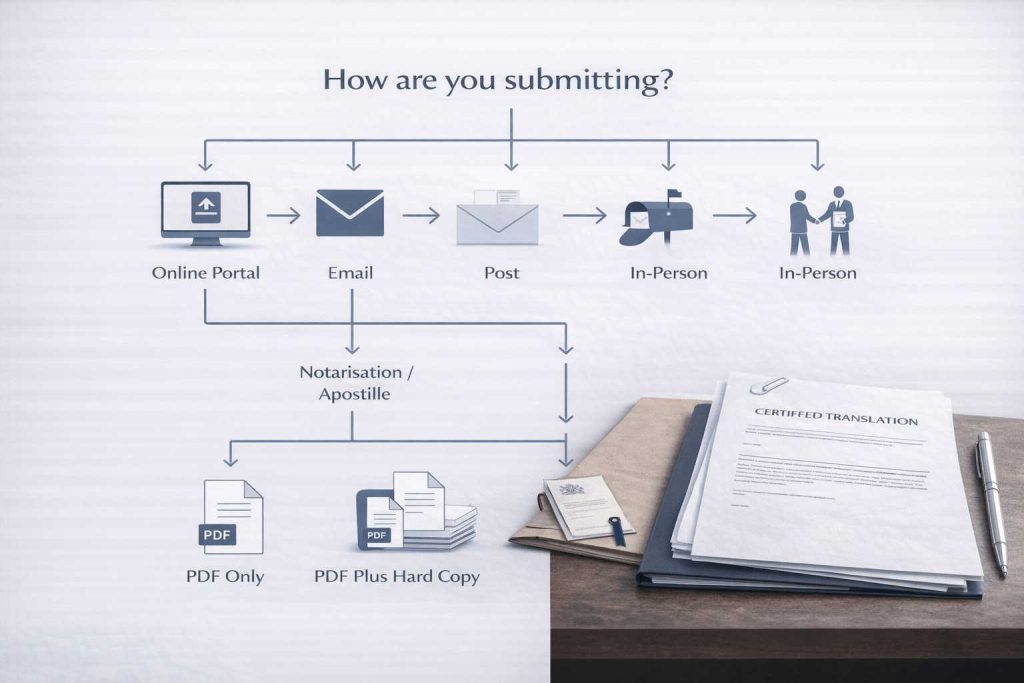
Here is the practical version most clients need.
| Submission situation | Best first choice | Why |
| Online portal upload | Digital certified PDF | Matches the submission route |
| Email to administrator or caseworker | Digital certified PDF | Fast, shareable, easy to track |
| Urgent same-day submission | Digital certified PDF | No courier delay |
| In-person appointment requiring originals | PDF + hard copy | Review fast, attend correctly |
| Post-based application | Hard copy, with PDF backup | Paper is part of the process |
| Notarisation or apostille required | Ask for the full paper chain | Digital alone is usually not enough |
| Unclear instructions | Start with PDF, confirm format before issue | Avoid paying twice |
What makes a digital certified translation more likely to be accepted
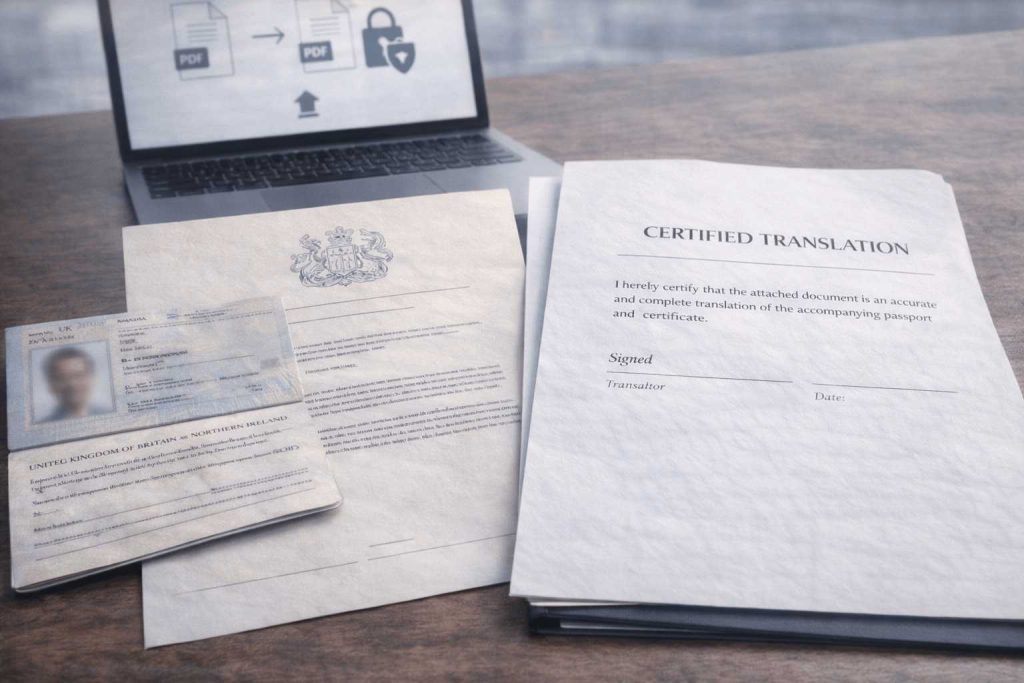
A PDF gets accepted more easily when it is professionally prepared and easy to verify.
Complete certification wording
The translation should not look like a plain bilingual document. It should clearly show that it has been certified for official use.
Full translator or agency details
The receiving party must be able to see who produced the translation and how that certification can be relied upon.
Signature and date
These details help show that the certification is real, current, and tied to the file in front of the reviewer.
A clean copy of the source document
Even the best translation struggles if the original scan is cropped, blurred, rotated, shadowed, or missing stamps and handwritten notes.
One consistent submission pack
Where appropriate, keep the source and translation together in a tidy sequence. The easier it is to review, the easier it is to approve.
No avoidable edits after issue
Do not rename pages inside the PDF, move certification pages around carelessly, compress the file into unreadability, or submit screenshots when a full PDF exists.
The mistake most people make: treating “digital” and “accepted” as the same question
They are not the same.
A digital certified translation can be perfectly valid and still be the wrong format for a particular authority.
The right question is:
Will this authority accept a certified translation in PDF form for this exact submission step?
That one line prevents most rework.
For example:
- A portal upload may fully accept a certified PDF.
- A registry appointment may want paper documents in hand.
- A legal process may accept the PDF for review but still require notarised paper later.
- An overseas authority may want a legalised chain, not just a certified translation.
The key is to match the translation format to the stage of the process, not just the document type.
Digital vs printed certified translations: what actually changes
Speed
Digital wins. You can receive, check, forward, and submit the file much faster.
Convenience
Digital wins again. It is easier to store, resend, and attach to applications.
Physical formality
Printed copies often feel stronger in paper-led or appointment-led processes, especially where the authority expects originals or wet-ink documentation.
Risk of mismatch
Printed copies can be a waste if the submission is digital-only. PDF-only can be risky if the authority clearly wants paper.
Best all-round option
When the instructions are not fully clear, many clients benefit from a digital-first plus optional hard-copy approach.
That gives you:
- immediate submission ability
- a reviewable PDF
- a paper route if later requested
A practical email-delivery checklist
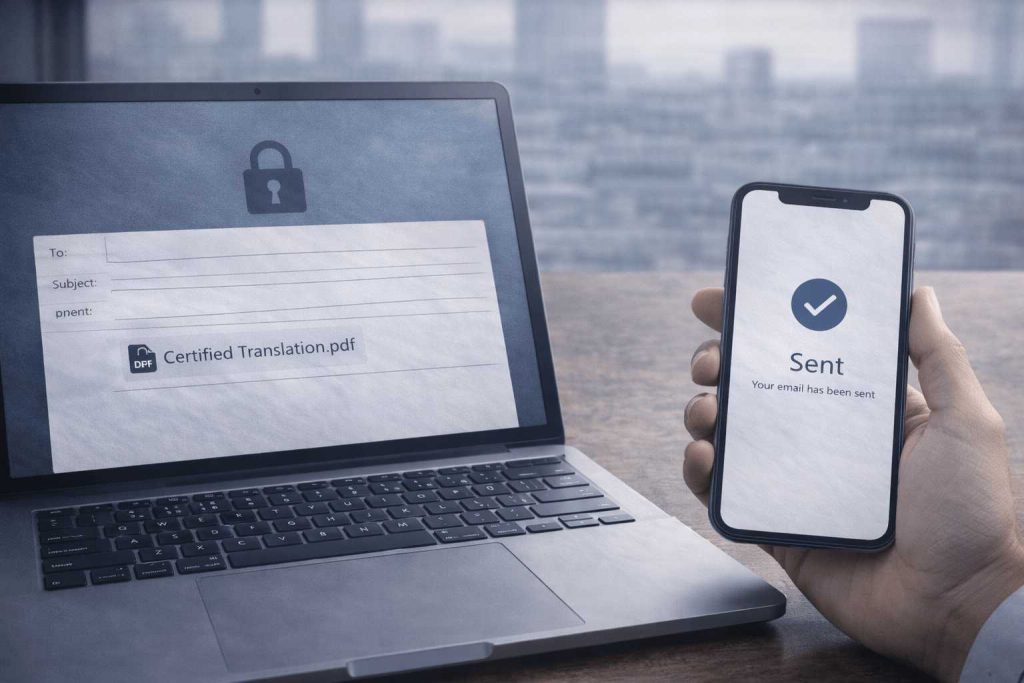
If you are relying on email delivery, do these things before you submit.
Before translation starts
- Make sure your scan is complete and readable
- Include every page, stamp, annotation, and handwritten note
- Say where the translation will be submitted
- Mention whether the recipient asked for PDF, paper, notarisation, or apostille
- Flag any urgent deadline immediately
When you receive the PDF
- Check names, dates, and document numbers against the source
- Check that all pages are included
- Check that the certification page is present
- Check that the file is readable on both desktop and phone
- Save the original email and attachment thread
When you submit
- Upload the full PDF, not screenshots
- Keep the file at readable quality
- Submit the source and translation together where relevant
- Do not crop the certification page
- Do not print and scan again unless absolutely necessary
Common reasons digital certified translations get rejected
Most rejections are avoidable.
Missing certification details
A translation without proper certification wording looks incomplete even if the language work is strong.
Partial translation
If the source contains stamps, seals, notes, or back-page text and they are not reflected properly, the reviewer may treat the file as incomplete.
Poor scan quality
A good translation cannot rescue an unreadable original.
Wrong format for the stage
This is the big one. The translation may be fine, but the authority wanted paper, originals, or an additional legal step.
Self-translation or informal translation
Official use usually requires independence and proper certification. A self-made translation, even if accurate, can still fail on formality.
Over-compressed files
A portal-friendly file size is helpful, but not if it makes stamps, signatures, or key numbers hard to read.
Three real-world scenarios
Scenario 1: Online visa support pack
You are uploading bank statements, a birth certificate, and an employer letter to an online system. A digital certified translation is usually the best route because the submission itself is digital. A posted hard copy adds time without improving the upload.
Scenario 2: Registry or appointment-based process
You have an in-person appointment and the instructions emphasise original documents. In that case, PDF delivery can still help you review the translation quickly, but you should order the hard copy before the appointment date.
Scenario 3: Overseas legal use
You need the translation for use abroad and have been told the document may need notarisation or apostille. Here, a digital PDF may help you approve the wording, but it is probably not the final format you will rely on.
Why email delivery is often the best starting point
Even when a hard copy is eventually needed, email delivery still offers real advantages at the start.
It helps you:
- review the translation before dispatch
- catch name mismatches early
- confirm the file is complete
- move faster on urgent matters
- share the document with advisers before final submission
- avoid paying for the wrong paper format too soon
That is why, in many cases, the smartest route is not “digital instead of paper.” It is digital first, then paper only if the process actually requires it.
What to ask before you order
If you want to avoid delay, ask these five questions first:
- Is the submission online, by email, by post, or in person?
- Does the authority specifically ask for originals, hard copies, or wet signatures?
- Is standard certification enough, or do they want notarisation or apostille?
- Will a certified PDF be accepted at this stage?
- Do I need the source and translation as one pack?
Those five questions solve most format problems before they start.
A better way to order a certified translation
The best translation order is not just “translate this document.” It is:
“Translate this document for this exact authority, for this exact submission route, by this exact deadline.”
That gives the translator or agency the context needed to advise properly on:
- digital-only delivery
- PDF plus posted hard copy
- notarised translation
- apostille-ready workflow
- urgent turnaround
- layout sensitivity
- multi-file document packs
Need a PDF certified translation without the guesswork?
If your submission is digital, start with the route that matches it. Send a clear scan, say who the document is for, and say whether the authority has mentioned hard copy, notarisation, or apostille.
TS24 handles certified translations in 200+ languages, with urgent options, PDF document support, secure file handling, and specialist help for official submissions. If your deadline is close, send the files first and let the format be checked before the translation is issued.
Client feedback: “The turnaround time was remarkably fast.”
Why that matters here: speed only helps when the format is right the first time.
Need to move today? Upload your file, mention the receiving authority, and ask for the most suitable delivery format before work begins.
Final takeaway
So, is a digital certified translation accepted?
Often, yes. But not because it is digital. It is accepted when the receiving authority allows PDF submission for that stage of the process and the certification details are complete, professional, and easy to verify.
If the route is digital, PDF delivery is often the best option. If the route is paper-led, appointment-led, or legally formalised, hard copy or additional certification may still be necessary.
The safest approach is simple:
Match the translation format to the submission method.
That is how you avoid rework, delay, and rejected documents.
FAQs
Is a digital certified translation accepted for UK submissions?
A digital certified translation is often accepted for UK submissions when the process is handled through online uploads or email and the translation includes full certification details. If the authority asks for original paper documents or wet-ink paperwork, a hard copy may still be needed.
Can I submit a certified translation as a PDF by email?
Yes, many document checks and online submissions can be handled with a certified translation PDF sent by email. The important point is whether the receiving authority accepts email or portal submission for that stage.
What is the difference between digital and printed certified translations?
The translation content can be the same. The difference is the delivery format. A digital certified translation is sent as a PDF, while a printed certified translation is supplied as a physical hard copy for paper-led or in-person use.
When should I order a hard copy instead of a digital certified translation?
Order a hard copy when the authority asks for originals, paper documents, wet signatures, in-person presentation, notarisation, apostille, or any formal paper chain beyond standard certification.
Will printing a digital certified translation make it acceptable everywhere?
No. Printing a PDF can be helpful for reference, but it does not automatically turn a digital file into the exact format every authority wants. Some recipients accept a printed certified PDF, while others want a provider-issued hard copy or additional legal formalities.
What should a certified translation PDF include?
A certified translation PDF should include the full translation, certification wording confirming accuracy, the date, translator or agency details, and the appropriate signature or certification page for official use.

