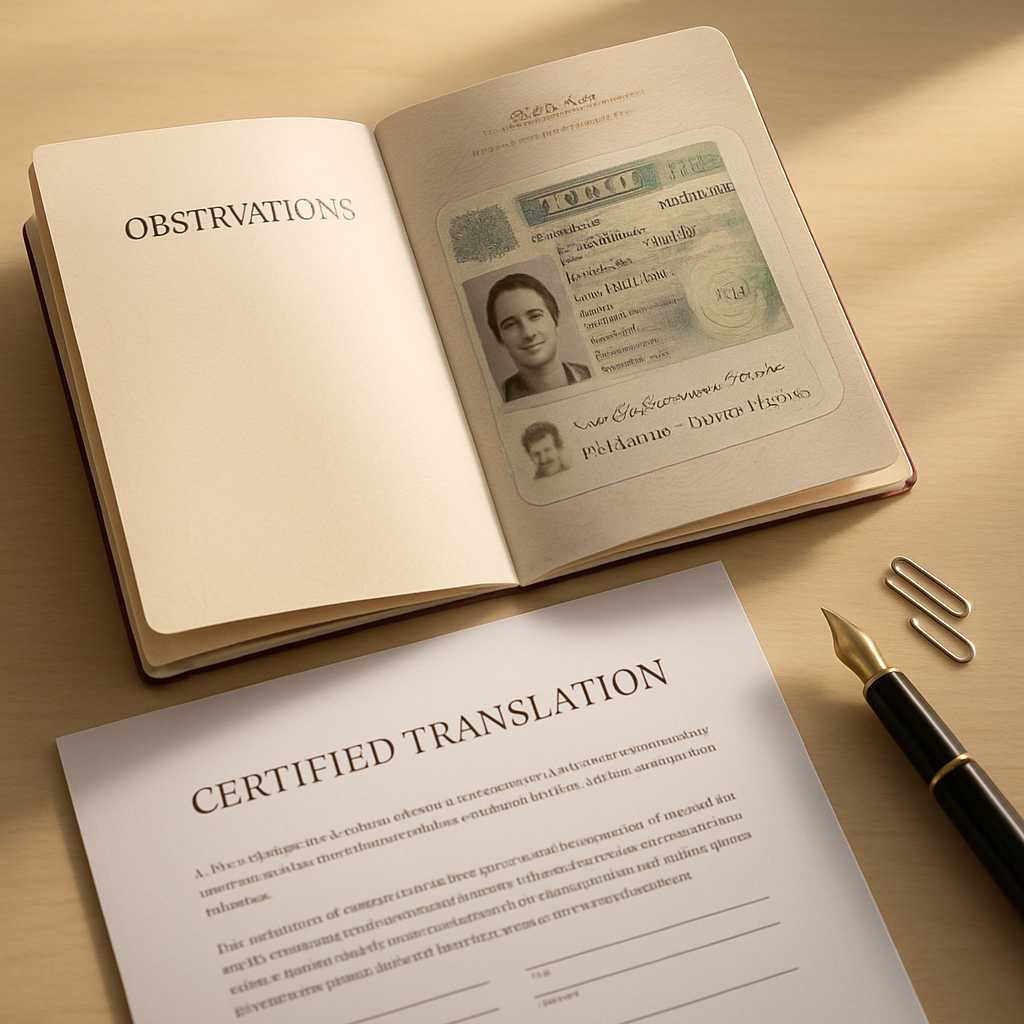
A lot of people assume passport translation means one thing: translate the photo page, add a certification statement, and submit it. That is sometimes enough. But when a passport contains official observations, immigration notes, endorsements, visa pages, entry or exit stamps, replacement notes, or handwritten annotations, the real question changes. It is no longer “Do I need a passport translation?” It becomes “Which parts of this passport actually matter to the application?” For UK passport paperwork, documents not in English or Welsh need a certified translation, and for Home Office-facing submissions, translations need to be complete and independently verifiable. (GOV.UK)
That is where passport endorsement translation matters. It deals with the parts of the passport that carry legal, immigration, identity, or timeline meaning beyond the main bio-data page. If the receiving authority needs to understand those notes, they should appear in the certified pack clearly, accurately, and in a way that is easy to compare against the source document.
The mistake people make with passport translation
Most weak passport submissions fail for a simple reason: the translated pack reflects the document category, but not the document purpose.
A passport used only to confirm identity may need just the main identity page. A passport used to prove immigration status, travel history, right of abode wording, diplomatic or official status, linked names, or residency timeline may need much more.
That distinction matters because official observations in British passports are not decorative text. HM Passport Office says observations are printed, stamped, or handwritten notes added to some passports to show important information about the passport or the holder, including immigration or nationality status, identity, early expiry, or official and diplomatic service. It also states that observations are printed on the observations page rather than the personal details page. (GOV.UK)
The practical rule is this: Translate the pages that prove the point, not just the page with the photograph.
What passport endorsement translation usually covers
Passport endorsement translation can include any of the following where they appear and where they affect the receiving authority’s decision:
- official observations page wording
- visa pages with active, expired, or historical visas relevant to the matter
- entry and exit stamps used to support a timeline
- handwritten or stamped notes added by an issuing or border authority
- amendment, renewal, replacement, cancellation, or restriction wording
- linked-name or identity notes
- residence or immigration-condition wording
- official service or diplomatic wording
Some competitor pages mention stamps and endorsements, but few explain when those pages actually become necessary. The safer working approach is to treat the passport as an evidence pack. If a note changes how the passport is interpreted, that note belongs in the translation.
When the bio-data page is usually enough
In many routine cases, only the main passport page is needed. That is often true when the passport is being used simply to show:
- full name
- date of birth
- passport number
- nationality
- issue and expiry dates
- place of birth
- issuing authority
This is common for straightforward ID verification, standard HR onboarding, basic university checks, or simple administrative records.
If there are no observations, no visa pages relevant to the matter, and no notes affecting status or timeline, a certified translation of the main page may be all that is required.
When observations, endorsements, and visa pages should definitely be translated
A fuller certified pack is the safer choice when any of the following applies:
1. The application depends on immigration status
If the passport contains wording that affects how the holder’s status is understood, that wording should be translated in full. HM Passport Office guidance shows that observations can reflect immigration control, right of abode, entitlement to readmission, and other nationality or status details. (GOV.UK)
2. A solicitor, bank, employer, or compliance team needs more than identity
In property, compliance, probate, and onboarding matters, the receiving side may need to understand not just who the person is, but also why a visa, entry stamp, residence page, or official note matters.
3. The visa page explains lawful stay, residency, or travel timing
A visa page may show the type of permission granted, dates of validity, number of entries, or the country and authority involved. If your application relies on residence history, lawful entry, status continuity, or prior travel, leaving that page untranslated weakens the file.
4. The passport contains an official observation
If the passport includes an observations page with live wording, it should not be ignored. A page that says there are no official observations is different from a page containing a status-related note.
5. There are handwritten notes, renewal notes, or replacement wording
When a passport has been amended, replaced, limited, corrected, or annotated, that text can change the meaning of the document. Those notes should be translated rather than assumed away.
6. The timeline matters
For nationality, immigration, court, family, or compliance files, dates often matter more than labels. Entry and exit stamps can become important where the application needs to show presence, absence, travel sequence, or continuity.
A better way to decide what to translate
Use this quick test before ordering the translation:
Translate the page if it answers one of these questions:
- Who is this person?
- What is their status?
- Why was this passport issued or limited in a particular way?
- Which visa or permission applied?
- When did the holder enter or leave?
- Does this page explain a name, nationality, or right-of-abode issue?
- Would a reviewer raise questions if this page remained untranslated?
Usually do not translate the page if:
- it is blank
- it contains only standard design elements
- it adds no evidence to the purpose of the submission
- the receiving authority has clearly confirmed it only needs the main page
This approach keeps the pack proportionate while still protecting against omissions.
What a strong certified passport pack should include
A reliable passport endorsement translation pack should usually contain:
- the relevant original passport pages as clear scans
- the full translation of every included page
- translated observations, stamp notes, and endorsements where present
- a clear certification statement
- the date of translation
- translator or agency identification
- signature and contact details
- consistent treatment of names, dates, document numbers, and page references
For UK certification, GOV.UK says a certified translation should confirm that it is a true and accurate translation of the original and include the date, full name, and contact details. Home Office visitor guidance adds that translations should be full, independently verifiable, and include confirmation of accuracy, date, full name and signature, plus contact details. (GOV.UK)
How observations and stamp notes should be handled in translation
This is where quality really shows.
Translate wording fully
If the note is readable, translate the full wording clearly and keep the meaning exact.
Preserve dates, numbers, and codes exactly
Dates, reference numbers, visa numbers, and passport numbers should match the source format carefully. A single wrong digit can cause more trouble than a clumsy sentence.
Identify stamps and seals honestly
If a stamp is legible, it should be translated or described clearly. If part of it is unclear, that should be stated rather than guessed.
Examples of careful rendering include:
- [Entry stamp: airport name, date]
- [Residence visa sticker]
- [Official observation]
- [Stamp partly illegible]
- [Handwritten note in blue ink]
Keep page structure easy to compare
A reviewer should be able to move between the source page and translated page without hunting for where the content went.
Do not “clean up” the evidence
A passport translation is not the place to improve formatting, modernise wording, or standardise what the issuing authority originally wrote. The goal is faithful representation.
Why scan quality matters more for passport notes than people expect
Observations, endorsements, and visa pages are often the hardest parts of a passport to scan well. Glare, page curvature, cropping, and low contrast can make a short note unreadable.
Before uploading, make sure the scan or photo:
- shows the full page edge to edge
- avoids flash glare on laminated or glossy pages
- keeps the text upright and sharp
- captures all stamps, side notes, and perforated areas clearly
- includes both pages if a spread or sequence matters
- is sent in order when multiple visa pages are relevant
A good translation can only work from a good image. If the observation is half visible, the translation will inherit the same weakness.
The difference between certified, notarised, and legalised
This is another area where people over-order or under-order.
For many UK uses, a certified translation is enough. That is the standard format typically required when a document is not in English or Welsh and needs to be submitted for official review. For passport applications, GOV.UK requires certified translations for documents not in English or Welsh, while its certification guidance sets out the core elements of a certified translation. (GOV.UK)
Notarisation is different. It is usually needed only when the receiving authority specifically asks for it. Legalisation or apostille is different again, and usually matters for use abroad where the foreign authority asks for legalised documents. GOV.UK’s legalisation guidance makes clear that apostille is used when another country says a UK document must be legalised. (GOV.UK)
So the right question is not “What is the highest level available?” It is “What level does the receiving authority actually require?”
Why this matters for UKVI, HM Passport Office, solicitors, and compliance teams
Different reviewers read passport pages differently.
UKVI or Home Office reviewers may focus on whether the translated pack is complete, verifiable, and consistent.
Passport-related reviewers may focus on whether the supporting evidence is correctly translated for a passport application.
Solicitors and compliance teams may care about identity, linked names, visa status, lawful presence, or timeline.
Universities and employers may only need the identity page unless the status question goes further.
That is why one-size-fits-all passport translation advice is weak advice. The same passport can require a one-page certified translation in one file and a multi-page certified pack in another.
Three common real-world scenarios
A family application with a residence visa page
The main passport page proves identity. The residence visa page proves status continuity. Translating only the photo page leaves half the story untold.
A property or bank compliance matter
The passport page identifies the holder, but the supporting visa or endorsement may explain residency or lawful presence. If the compliance team asks about it, the cleanest answer is a full certified pack.
A nationality or immigration timeline file
A reviewer may need to understand entry dates, visa dates, and official notes together. In that situation, stamp notes and endorsements become evidence, not background detail.
What makes a passport pack feel submission-ready
A strong pack feels easy to trust. That usually means:
- no cropped pages
- no missing observation text
- no selective translation of only the “nice” parts
- no mismatch between source and translated page order
- no vague handling of stamps
- no missing certification details
- no unexplained gaps where visa pages were obviously skipped
On TS24’s live pages, the strongest recurring themes are certified translation, immigration document handling, submission-ready formatting, same-day and 24-hour options, and clear certification for UK authorities. TS24 group pages also present trust markers including ATC membership, ITI and CIOL registration, 200+ languages, 15+ years’ experience, 8,000+ qualified translators, and 1,000+ positive reviews. (Translation Services 24 London)
If your passport includes observations, endorsements, visa pages, or hard-to-read stamp notes, send the full set together rather than ordering a one-page translation and fixing the gaps later. That is usually faster, cleaner, and cheaper than a second round of revisions after a solicitor, caseworker, or reviewer asks what was left out.
A simple checklist before you upload your passport
- Mark every page with meaningful text, stamps, or annotations.
- Decide what the passport must prove in this specific file.
- Include the observations page if it contains wording.
- Include visa pages if visa type, dates, or status matter.
- Include entry or exit stamps if the timeline matters.
- Make sure the scan is complete and readable.
- Ask for a certified pack, not just a page-by-page language conversion.
- Confirm whether notarisation or legalisation is actually required.
- Check names, dates, numbers, and page order before submission.
- Upload the full relevant pack early if the matter is urgent.
A passport with observations or endorsements should be translated like evidence, not treated like a generic ID card. When the extra pages matter, translating them properly is what turns a weak submission into a clear one.
If you need the pack checked quickly, upload the passport pages together and ask for the translator to confirm which pages should be included for the exact authority or purpose. That single step usually prevents the most common omission in passport endorsement translation: leaving out the page that actually explains the case.
FAQs
Do I need passport endorsement translation if I already translated the photo page?
Not always, but often yes when the passport contains observations, immigration wording, visa pages, replacement notes, or travel stamps relevant to the purpose of the submission. The photo page proves identity. It does not automatically prove status, timeline, or later official notes.
Should official observations be translated for a certified passport pack?
Yes, if the observations page contains active wording that affects identity, nationality, immigration status, validity, or official service. Official observations are there to communicate important information, so they should not be ignored when they matter to the receiving authority.
Do visa pages and stamp notes need translation?
They do when the application relies on visa type, validity dates, entry history, residency, lawful stay, or travel sequence. They usually do not when the passport is being used only for basic identity confirmation and the authority has not asked for more.
What should a certified passport pack include?
A strong pack includes the relevant original pages, full translations of those pages, translated observations and stamp notes where present, and a certification statement with date, translator or agency details, signature where required, and contact information.
Can partially illegible passport stamps still be translated?
Yes, but they should be handled honestly. Readable parts can be translated, and unreadable parts should be marked clearly as partly illegible rather than guessed.
Do I need a notarised translation of passport observations?
Usually only if the receiving authority asks for notarisation specifically. For many UK uses, certified translation is enough. For overseas use, apostille or further legalisation may also be required depending on the destination authority. (GOV.UK)

