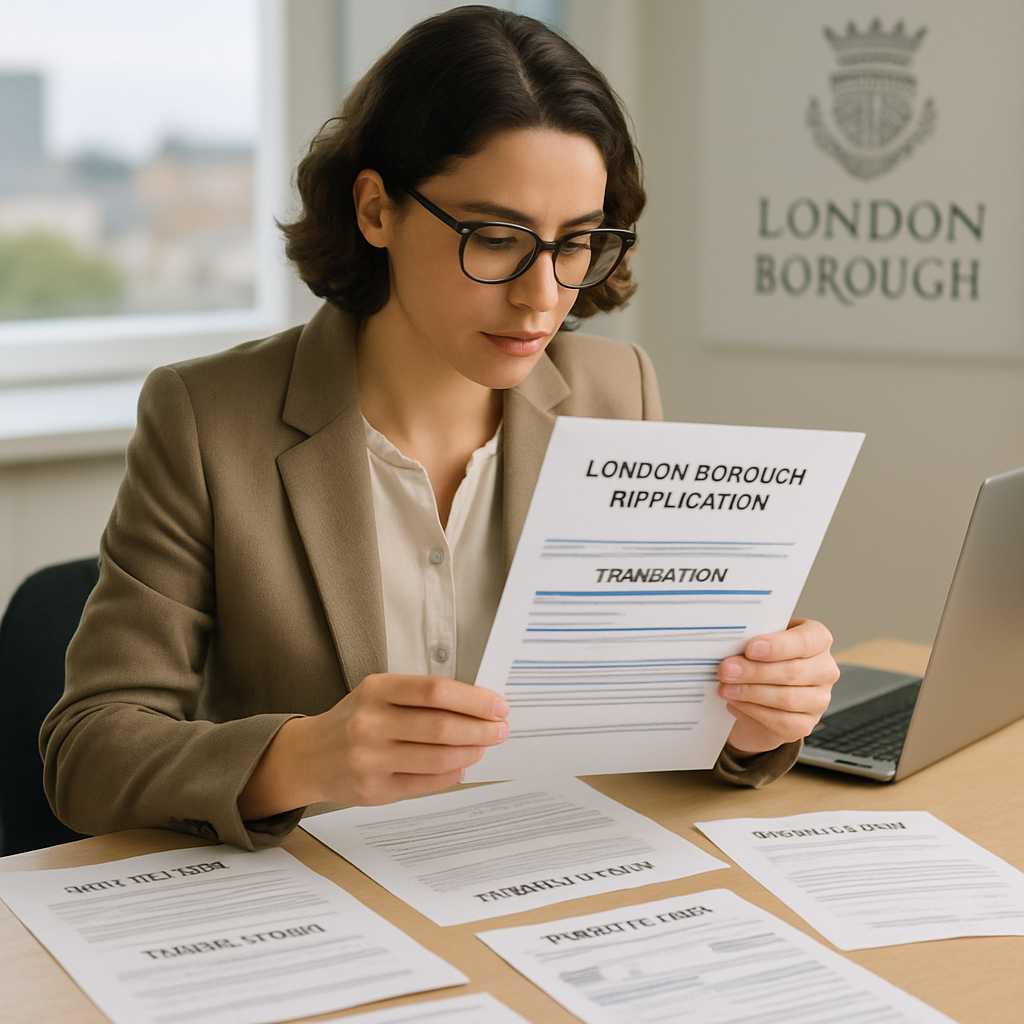
London Borough Submissions: Why Local Requirements Can Differ
If you have been told to submit translated documents to a London council, it is easy to assume the rules will be the same everywhere. In practice, London borough translation requirements can differ more than people expect. The reason is simple: there is no single borough-wide rulebook covering every service, every document type, and every submission route.
A school admissions team may ask for one set of proof. A housing register team may want a longer address history. A benefits or social care department may accept one format, while another service asks for something more specific. Some councils help residents understand council-issued letters in other languages, but that does not always mean they will translate your foreign documents into English for an application. That distinction matters.
For applicants, solicitors, caseworkers, and families, the safest approach is never to rely on what another borough accepted last time. Check the exact service, the exact document list, and the exact submission channel before you send anything.
If you need a borough-ready document pack, start with certified translation services and make sure the translation is prepared for the service you are actually dealing with, not for a generic “London council” standard.
One city, many different submission standards
People often talk about “the council” as though London works like one body. It does not. Each borough runs multiple services, and each service can set its own evidence checks, operational processes, and upload instructions.
That means the real question is usually not: “Does London council accept this?” It is: “Will this specific borough, in this specific department, for this specific application, accept this exact document in this exact format?”
That is why one applicant can submit a recent utility bill without trouble, while another is asked for a tenancy agreement, a council tax reference, a benefits letter, or a longer residency trail. It is also why one caseworker may tell you a certified translation is enough, while another asks you to confirm whether notarisation is needed for a particular overseas use.
This is also where delays begin. Most rework does not happen because the translation itself is wrong. It happens because the evidence pack was built around the wrong checklist.
Where local council submissions usually differ
1. The service you are applying to
The first difference is the service itself. A borough may handle:
- school admissions
- social housing or housing register applications
- council tax support
- benefits evidence
- subject access requests
- social care or safeguarding paperwork
- local connection evidence
- proof of residence checks
- supporting letters for other official processes
Each of those services can ask for different evidence, even inside the same borough.
2. The document types they accept
One team may accept recent utility bills, bank statements, or benefits letters. Another may reject utility bills entirely and ask instead for a tenancy agreement, a solicitor’s completion letter, or a signed letter from the council tax payer plus additional supporting papers. That is why document type matters as much as translation quality.
3. The age of the document
Some services care about recency. Others care about continuity. A recent utility bill may work for one application, but a housing team may want proof covering multiple years of address history. If you only translate the newest page and the borough wants a longer residency trail, you may still be asked to resubmit.
4. Whether they need a simple translation, certified translation, or more
For many UK-facing official uses, a standard certified translation is the right starting point. But some bodies may ask for an extra step if the document is going abroad or feeding into a wider legal process. That is why it helps to clarify early whether you need:
- a standard certified translation
- a notarised translation
- an apostille or another legalisation step
Ordering more certification than you need can waste time and money. Ordering less can create a last-minute rejection.
5. The upload method and file rules
Even when the document itself is acceptable, the submission method can still cause problems. Common issues include:
- poor scans
- cut-off edges
- missing reverse pages
- blurred stamps or signatures
- separate files uploaded out of sequence
- unsupported file types
- oversized files
- photographs with glare or shadow
A translation can be perfectly prepared and still fail if the upload pack is messy.
Real examples of acceptance differences across London boroughs
School admissions do not follow one London-wide evidence list
In one borough, a school admissions team may accept a recent utility bill, a recent bank or credit card statement, a driving licence, benefits evidence, HMRC paperwork, or other similar address-linked documents. In another borough, the position can be much stricter. An in-year application may ask for a tenancy agreement through a letting or estate agent, a housing benefit letter, or a solicitor’s letter confirming completion. If you do not have that, you may need a signed letter from the council tax payer plus two supporting documents. In that same process, utility bills and bank statements may not be accepted at all.
That is a major difference. The same applicant, with the same address, could be fine in one borough and incomplete in another. Practical takeaway: never order a proof of address translation until you know whether that proof is actually on the accepted list.
Even proof of address can mean very different things
Some boroughs want two proofs. Some want a council tax reference plus one additional document. Some want preferred proof and alternative proof. Some reject business addresses, future addresses, or temporary arrangements.
For example, one school admissions route may ask for a council tax reference number and one additional proof such as a tenancy agreement, rent book, TV licence, full UK driving licence, or home utility bill. That is not the same as a borough that accepts a wider range of standard address evidence. Practical takeaway: “proof of address” is not one document category. It is a borough-specific evidence rule.
Housing applications can be broader and more document-heavy
Housing submissions often go further than school admissions. A housing register team may ask for:
- proof of identity
- proof of address
- financial information
- family details
- health or support evidence
- special circumstances documents
- change-of-circumstances proof after submission
In some borough housing systems, applicants may need to provide recent utility bills, tenancy agreements, official letters, bank statements, payslips, children’s birth certificates, medical information, and more. Other housing processes are even more detailed and may require a full multi-year address history supported by documents from more than one source, with one recent full bank statement included as part of that trail. That is a very different translation job from a single-page proof of address. Practical takeaway: for housing, always ask whether the borough needs just the latest proof or a continuous evidence history.
Some services want years of address history, not just current residency
One of the biggest reasons applications are delayed is that applicants translate only their current paperwork when the borough is actually checking continuity. For some housing routes, the authority may want the last three years of address history, supported with documents from multiple sources and a recent full bank statement. Other application forms can ask for proof of residence across five years and supporting documents tied to employment, benefits, pregnancy, children, or local connection. If your paperwork spans multiple addresses, your translation order should reflect that from the start. Practical takeaway: ask, “How many years back do you need me to prove?” before you upload anything.
Councils may help with their own communications but not your foreign documents
This is one of the most misunderstood points. A borough may offer interpreters or provide translated versions of council letters to help residents understand council communications. That is a public-access service. But that does not automatically mean the same borough will translate your foreign-language documents into English for you.
In practice, some councils let residents request translation of council letters or other council documents. Others make clear that they can help people access services and understand information, but they do not provide translation into English for foreign documents, which means applicants must arrange that themselves. That difference matters because many people wrongly assume, “The council offers translation, so they will translate my non-English evidence.” Often, they will not. Practical takeaway: separate these two questions every time: Will the borough help me understand council-issued information? Who is responsible for translating my own foreign documents into English?
Why this matters for translated submissions
The translation itself needs to do more than convert words. It needs to support a successful submission. That means the translated pack should be prepared around:
- the target borough
- the target department
- the exact application type
- the accepted evidence list
- the recency or history requirement
- the upload method
- the level of certification required
A strong submission is not just “accurately translated.” It is “submission-ready.” That is why people dealing with council, housing, school, legal, and public-sector paperwork often benefit from using public sector translation specialists who understand the operational side of evidence packs, not just the language itself.
The document types that most often cause avoidable delays
Proof of address documents
These often include:
- utility bills
- bank statements
- council tax documents
- tenancy agreements
- rent books
- benefits letters
- employer letters
- insurance certificates
- TV licence evidence
The problem is not only translation. It is whether the borough accepts that document class at all.
Identity documents
These may include:
- passports
- residence permits
- birth certificates
- marriage certificates
- driving licences
- Home Office documents
If names, dates, or address details differ across documents, the borough may question the pack even if the translation is accurate. This is why cross-document consistency checks are essential. For identity paperwork, passport translation services and other official document translation support should be handled carefully and presented clearly.
Financial evidence
Housing and support-related submissions often rely on:
- bank statements
- payslips
- tax documents
- benefits breakdowns
- official payment records
These are high-friction documents because borough teams often use them to verify both eligibility and continuity. For these, layout clarity matters just as much as terminology. A messy translation of a bank statement can cause almost as much trouble as an inaccurate one. Where financial paperwork is involved, financial document translation services can help preserve structure and readability.
Family and status documents
These may include:
- full birth certificates
- marriage certificates
- custody papers
- pregnancy confirmation
- school or college letters
- immigration records
These are often linked to household composition, dependency, and priority decisions. Missing pages, missing stamps, or untranslated annotations can trigger questions quickly.
The seven checklist questions to ask before you submit
Before ordering translation, ask the borough or check the exact service page for these questions:
1. Which department is assessing the documents?
Do not rely on a general council contact page if the submission is for housing, admissions, benefits, or another specialist team.
2. Which documents are accepted for this exact application?
Do not assume a utility bill, bank statement, or tenancy agreement will work everywhere.
3. How recent do the documents need to be?
Some evidence must be current. Some must prove a period of residence.
4. Do you need only current evidence or full address history?
This question alone can save a complete resubmission.
5. Do all non-English documents need a certified English translation?
In many official contexts, yes. But always confirm whether anything extra is required.
6. Is standard certified translation enough, or have they asked for notarisation or legalisation?
Do not add extra certification unless it has a real purpose.
7. How should files be uploaded?
Check file type, page order, image quality, and size limits before the deadline.
How to prepare a borough-ready translation pack
A good submission pack should be built like a case file, not a loose collection of pages.
Include the full document, not just the part you think matters
If the borough is checking continuity, household details, official status, or address history, partial pages can weaken the submission.
Keep names, dates, and addresses consistent across the pack
If the spelling differs between the passport, bank statement, tenancy agreement, and translated certificate, flag that early and handle it clearly.
Preserve structure where possible
For statements, letters, certificates, and forms, clean layout helps the reviewer match the translation against the original quickly.
Make scans readable before translation starts
A blurred original produces a weaker final pack. Use flat, high-resolution scans or clear photos with all corners visible.
Keep related evidence together
If the borough needs proof of residence plus a benefits letter plus a translated tenancy agreement, send them as one organised pack rather than separate fragments.
Ask the right certification question at the beginning
A large number of applicants ask for notarisation too early. For most UK official uses, a properly prepared certified translation is the right starting point. Only escalate to notarisation when the receiving body actually requires it. If timing is tight, urgent translation services can help keep the application moving without sacrificing structure.
A simple way to think about acceptance differences
Here is the easiest way to remember it: Same city does not mean same checklist. A borough may differ from another borough on:
- accepted proof of address
- the number of documents needed
- whether recent or historic evidence is required
- whether bank statements are accepted
- whether utility bills are accepted
- whether the service provides translation support for its own letters
- whether the applicant must arrange translation into English
- whether upload rules are strict
- whether additional evidence is requested after first review
That is why borough-specific preparation is more reliable than generic “official translation” advice.
When to use certified translation, and when to ask about more
For most UK-facing official submissions, the starting point is a properly prepared certified translation that clearly confirms the translation is true and accurate and includes the relevant certification details. That is usually what people need for council-linked evidence packs, official letters, civil documents, and standard administrative submissions.
Ask about more only when:
- the receiving body expressly requests it
- the document is being used abroad
- a solicitor, notary, embassy, or overseas authority is involved
- the application instructions say certified translation alone is not enough
If there is any doubt, it is worth checking what certified translation means in the UK before adding extra steps that may not be necessary.
Why applicants choose TS24 London for borough-facing document packs
When people are dealing with borough submissions, they usually want three things: acceptance, speed, and clarity. TS24 London supports that with:
- certified translation for official UK use
- ATC membership and translators registered with recognised professional bodies
- support across 200+ languages
- options for urgent turnaround
- experience with public-sector, legal, personal, and administrative documents
- additional notarisation support where genuinely required
If your application involves school admissions, housing, proof of address, identity documents, or mixed supporting evidence, the safest next step is to upload the full set together rather than translating documents one by one in isolation. Send the complete pack through the TS24 London certified translation page and request review against the exact borough service you are dealing with. That usually saves more time than correcting a rejected submission later.
Final word
London borough translation requirements differ because boroughs do not assess every submission the same way. Different teams ask different questions, accept different evidence, and follow different operational rules. The most reliable approach is not to guess what “London councils” want in general. It is to prepare the translation for the exact borough, the exact service, and the exact document checklist in front of you. That is how you reduce delays, avoid repeat uploads, and give the reviewer a pack they can verify quickly.
If you are working to a deadline, upload your file set now, ask for the pack to be prepared for the correct borough service, and get the submission right the first time.
FAQs
Do all London boroughs accept the same translated documents?
No. London borough translation requirements can differ by borough and by service. A school admissions team, housing register, or benefits team may each ask for different supporting evidence and formats.
Can a council translate my foreign documents into English for me?
Not always. Some boroughs provide interpreting or translations for council-issued communications, but that does not necessarily mean they will translate your own foreign-language documents into English for an application.
Is a certified translation usually enough for a borough submission?
In many UK official contexts, yes. A certified translation is often the correct starting point for council-facing submissions. Extra notarisation should usually be added only if the receiving body specifically asks for it.
Why would one borough accept a utility bill while another rejects it?
Because local council submissions are service-specific. One borough or team may accept utility bills as proof of address, while another may require a tenancy agreement, council tax-linked evidence, or a different combination of documents.
What documents commonly need translation for London borough applications?
Common examples include passports, birth certificates, marriage certificates, tenancy agreements, utility bills, bank statements, benefits letters, employer letters, and official Home Office or residency documents.
How can I avoid delays with London borough translation requirements?
Check the exact service checklist first, confirm accepted evidence, confirm whether address history is needed, make sure every non-English document is translated correctly, and upload a clear, complete pack in the right format.

