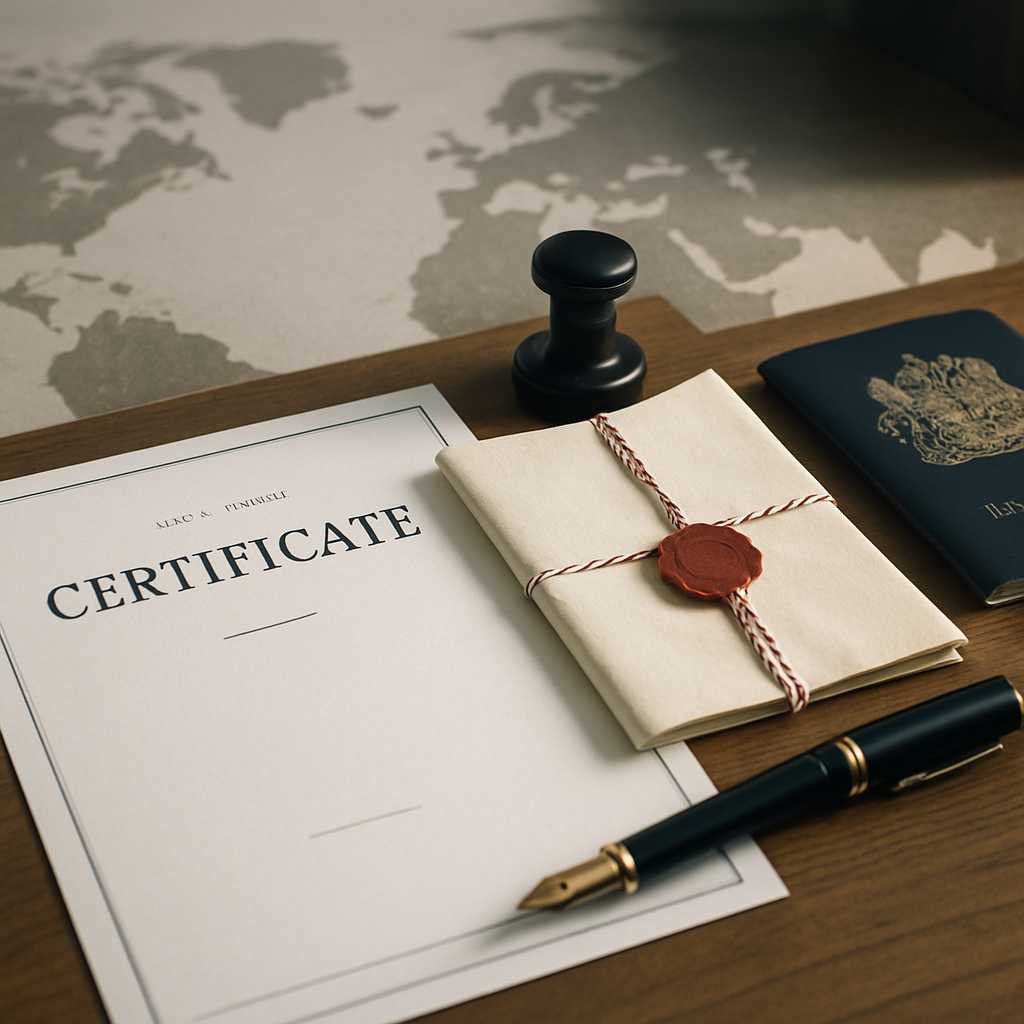
When Legalisation Matters More Than Speed
When documents are heading overseas, speed feels urgent. However, in many international cases, the real priority is getting the order right. A fast translation sent through the wrong route can still be rejected, while a carefully prepared document pack moves through legalisation, apostille, notarisation, and embassy checks with far less risk.
This is why a proper document legalisation translation guide starts with one principle: the quickest route is not always the safest route. If the receiving authority wants notarisation before legalisation, or embassy legalisation after apostille, getting one stage wrong can force you to repeat the entire process.
For international applications, visas, overseas employment, academic admissions, powers of attorney, company setup, marriage paperwork, and court-related submissions, the question is not just “How fast can this be translated?” It is “What exact version of this document will be accepted at the other end?”
If you already have a deadline, the safest next step is to get a free quote and send the scan plus any authority instructions at the same time. This allows the certification route to be checked before money and time are spent on the wrong process.
Why Legalisation Often Matters More Than Turnaround
A standard certified translation may be perfectly suitable for one authority and completely insufficient for another. The difference usually comes down to how official the receiving body needs the paperwork to be.
In practical terms, international document acceptance usually depends on four layers:
- The document itself: Is it an original public document, a certified copy, or a private document?
- The translation: Does the authority want a certified translation, a notarised translation, a sworn translation, or no translation at all yet?
- The legalisation route: Is an apostille enough, or is embassy legalisation required as well?
- The order of steps: Does the original need legalising first, or does the translation itself need to be notarised and legalised?
This is where many applicants lose time. They focus on express turnaround, only to discover later that the translated copy was produced before the original was correctly authenticated, or that the embassy wanted a different format altogether.
A better approach is to confirm the route first, then move quickly. For projects involving certificates, contracts, powers of attorney, corporate documents, or cross-border legal submissions, TS24 clients usually start with certified translation services or notarised translation services depending on what the destination authority has requested.
What Each Term Really Means
Certified Translation
A certified translation is a translation accompanied by a signed statement confirming that it is a true and accurate translation of the original document. This is commonly used for official submissions where the authority needs accountability from the translator or translation company.
Notarisation
Notarisation adds another layer. A Notary Public or solicitor verifies the relevant declaration or signature connected with the translation. This is often requested when the document is going overseas or when the receiving authority wants stronger formal authentication.
Apostille
An apostille is the certificate attached by the UK Legalisation Office to confirm that the signature, seal, or stamp on a UK public document is genuine. For many Hague Convention countries, this is the main legalisation step.
Embassy Legalisation
Embassy legalisation, sometimes called consular legalisation or attestation, is an extra stage used when the destination country requires more than an apostille. This is common in non-Hague routes and can add both complexity and time.
Sworn Translation
A sworn translation is not the same as a standard UK certified translation. Some countries require a translator who is officially recognised in that jurisdiction. This means the correct route is driven by the destination authority, not by UK terminology alone.
The Three Questions That Decide the Correct Order
Before any translation begins, ask these three questions:
1. Where Was the Document Issued?
This matters because legalisation usually happens in the country of origin. A UK-issued document follows a UK route. A foreign-issued document normally has to be legalised in its own country before any UK-side translation work is planned.
2. Where Will the Document Be Used?
A document for a Hague Convention country may only need apostille plus the right translation format. A document for a non-Hague destination may need embassy legalisation after the UK legalisation step.
3. What Exactly Did the Receiving Authority Ask For?
The wording matters. “Certified translation” is not the same as “notarised translation,” and neither automatically means “apostilled translation.” If the authority email says “legalised translation,” “sworn translation,” or “embassy-attested document,” that instruction should shape the route from the start.
A useful rule is this: do not buy speed until you have confirmed the sequence.
The Most Common Routes for UK-Issued Documents
Route 1: UK Public Document for a Hague Convention Country
This often applies to documents such as birth certificates, marriage certificates, death certificates, or certain official records.
Typical route:
- Original UK public document
- Apostille on the original or qualifying official copy
- Certified translation if the receiving authority requires a translated version
This route is usually simpler because apostille may be enough without embassy legalisation.
Route 2: Private UK Document for a Hague Convention Country
This often applies to powers of attorney, declarations, consent letters, contracts, or company documents that are not already in a form the Legalisation Office can accept directly.
Typical route:
- Solicitor certification or notarisation of the document
- Apostille
- Certified translation if required
The key point here is that private documents often need an initial certification step before legalisation can happen.
Route 3: UK Document for a Non-Hague Country
This is where many delays happen.
Typical route:
- Certification or notarisation as required
- Apostille from the UK Legalisation Office
- Embassy or consular legalisation
- Translation in the format required by the receiving authority
In some cases, the translation is produced after the original has been legalised. In others, the translation itself also needs to be notarised and legalised. The destination rules decide this.
Route 4: When the Translation Itself Must Be Legalised
Some authorities do not just want the original document legalised. They also want the translation to carry legal standing.
Typical route:
- Certified translation
- Notarisation of the translation
- Apostille or other legalisation of the notarised translation
- Embassy legalisation if required
This is exactly why translation should not always be the first step.
When to Translate Before Legalisation and When to Translate After
This is the part most quick guides miss.
Translate After Legalisation When:
- The original UK document must first receive apostille
- The authority wants the final legalised document translated
- You want to avoid translating a version that may change during certification
Translate Before Legalisation When:
- The receiving authority specifically asks for a legalised translation
- The translation itself must be notarised and then apostilled
- The document pack must be bound or prepared in a specific official format
The Safest Answer in Real Life
The correct order is not “always translate first” or “always legalise first.” It is:
- Legalise the original when the authority needs the original authenticated.
- Legalise the translation when the authority needs the translated text formally authenticated.
That distinction saves people from repeating expensive steps.
A Practical Guide by Document Type
Document type
Usual route
What people often get wrong
- Birth or marriage certificate: Apostille first, then certified translation if required. Ordering a plain translation when the authority wanted the certificate legalised first.
- Degree certificate or transcript: Check whether original, certified copy, or institution-issued version is needed before apostille. Sending a scan that cannot be used for legalisation.
- Power of attorney: Notarisation first, then apostille, then possible embassy legalisation. Assuming a certified translation alone is enough.
- Company incorporation documents: Check whether official certified copies are required before legalisation. Using downloaded company documents when signed certified copies are required.
- Court orders or legal papers: Route depends on issuing authority and destination country. Translating too early before confirming whether the court-issued version needs legalisation.
For complex official packs, it is usually safer to combine legal translation services with a certification check rather than treating translation as a standalone admin task.
The Mistakes That Cause the Biggest Delays
Choosing the Wrong Level of Certification
Many clients ask for a certified translation when what they actually need is a notarised or legalised translation. That misunderstanding can cost more time than any normal turnaround.
Legalising the Wrong Version
A scan, photocopy, or printout may not qualify for the route you need. If the authority expects an original signed or certified version, starting from the wrong document stops everything.
Assuming Apostille Solves Every International Case
It does not. Some destinations need embassy legalisation after apostille. Some want sworn translations from their own recognised translators. Some want both.
Translating Before Checking Destination Rules
This is one of the most expensive errors. If the authority wants the translation bound to a notarised set, or wants the apostilled version translated, a fast early translation can become unusable.
Forgetting Language-Specific Requirements
Documents for Arabic-speaking authorities, for example, may need additional formatting, terminology accuracy, or local acceptance checks. In those cases, it helps to involve specialist Arabic translation services early rather than treating Arabic as a routine add-on.
The “Speed Versus Acceptance” Decision Most People Get Wrong
There is nothing wrong with urgency. The problem is urgency without sequence.
A common pattern looks like this:
Someone orders same-day translation, then learns the original needed notarisation first, then discovers the destination country wants embassy legalisation too, then pays again to rebuild the file pack.
That is why the right question is not “Can this be done today?” but “What version of this document will still be accepted next week?”
If your submission deadline is close, the smart move is to confirm the route and then use urgent translation services only once the paperwork path is clear.
A Simple Checklist Before You Place the Order
Before you upload anything, gather these five items:
- The document itself
- The country where it will be used
- The exact authority requesting it
- Any email or checklist that mentions apostille, notarisation, sworn translation, or embassy legalisation
- Your deadline
Sending those details with your enquiry makes the quote more useful because it is based on acceptance, not just word count.
How TS24 Can Help with Legalisation-Sensitive Translations
For international-use documents, the value is not just in translating the text. It is in checking whether the text should be translated now, later, or in a different certified format.
That is why the safest client journey is usually:
- Upload the document
- Include the authority instructions
- Confirm the certification route
- Translate the correct version
- Prepare the file for the next official step
TS24 already supports clients with certified translation services, notarised translation services, legal translation services, and language-specific work such as Arabic translation services. For straightforward cases, you can get a free quote in minutes. For projects with multiple documents or tight timing, it is worth sending the whole pack together so the order of steps can be checked first.
“Fast, accurate, efficient and flexible service.”
“High-quality documents for a fraction of price quoted by other agencies.”
Those kinds of outcomes matter most when the process is built around acceptance rather than guesswork.
When the Safest Move is to Pause and Verify
You should stop and verify the route before ordering if:
- The destination authority uses the phrase “legalised translation”
- The country is outside the Hague apostille route
- The document is private rather than an official public record
- The document pack includes powers of attorney, contracts, company records, court papers, or declarations
- The authority has asked for a sworn translator
- The document was issued outside the UK
In those cases, a short delay at the start usually prevents a much bigger delay later.
Final Word
For domestic use, turnaround can be the main priority. For international use, acceptance usually matters more.
A strong document legalisation translation guide does not promise the fastest possible translation at any cost. It helps you avoid the slowest possible outcome: rejection after submission.
If you are not sure whether your documents need certification, notarisation, apostille, embassy legalisation, or a different order entirely, send the scan and the authority’s wording before the job starts. That one step can save days.
Ready to move forward? Upload your file through the TS24 quote form or contact the team directly with the document and destination country so the route can be checked before translation begins.
FAQs
What is the difference between apostille and embassy legalisation?
An apostille is a UK legalisation certificate used for countries that accept the Hague Convention route. Embassy legalisation is an extra step required by some countries that want their embassy or consulate to authenticate the document after apostille.
Do I need a certified translation before apostille?
Not always. If the receiving authority wants the original UK document legalised first, apostille may come before translation. If the authority wants the translation itself legalised, the translation may need to be notarised and then apostilled. The destination rules decide the order.
Can a notarised translation be enough without embassy legalisation?
Yes, in some cases. A notarised translation may be sufficient if that is all the authority has asked for. But if the country or institution requires apostille or embassy legalisation as well, notarisation alone will not complete the route.
Can UK-issued documents be legalised if they were translated first?
Sometimes, but not always. A UK public document can often be apostilled in its original form first. A translation can then be certified separately if required. If the translation itself must be legalised, it will usually need notarisation before legalisation.
What if my document was issued outside the UK?
Documents issued outside the UK normally need to be legalised in the country where they were issued, not through the UK legalisation process. Once the original route is clear, the translation can then be prepared in the format the receiving authority needs.
What documents most often need notarisation, apostille, and translation together?
Common examples include powers of attorney, corporate documents, academic certificates, civil status documents, declarations, and certain legal papers being used abroad. The exact combination depends on the country and the authority receiving them.

