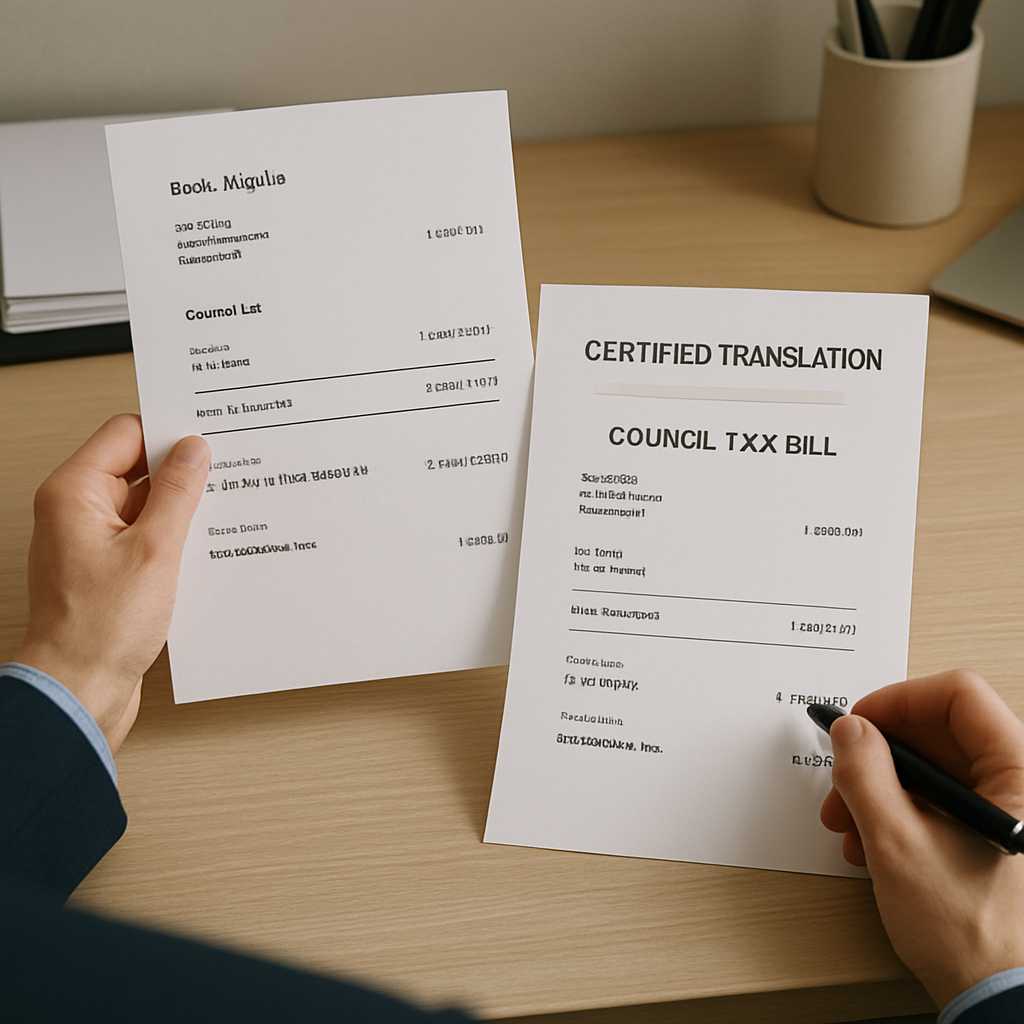
Introduction
A council letter can look ordinary until an application depends on it. A council tax bill may be the document that proves where you live. A benefits decision letter may explain income, support, or household circumstances. A housing letter may confirm temporary accommodation, a tenancy position, banding, arrears, a review outcome, or a homelessness decision. When any of those documents are not in English, a weak translation can turn straightforward evidence into a problem.
That is why council letter translation UK requests are rarely just about changing words from one language into another. They are about preserving the evidence inside the letter clearly enough for a caseworker, solicitor, university, landlord, court, or public authority to follow without hesitation.
For many applications, the real question is not, “Is this an official-looking document?” It is, “What does this letter actually prove?” Once you answer that, you know what must be translated fully, what must stay visible, and what details cannot be left out.
If your file depends on a council tax bill, housing letter, benefits notice, or local authority decision, send the full document set rather than only the first page. That is usually the difference between a translation that looks tidy and a translation that actually does its job.
Why Council Letters Matter More Than People Expect
Applicants often focus on the headline documents first: passports, certificates, permits, contracts, or court papers. Council letters tend to sit in the supporting pile. But in practice, local authority mail often carries the detail that makes the rest of the application make sense.
A council letter may be used to show:
- current address
- past residence during a specific period
- who is responsible for a property
- household composition
- eligibility for housing or council support
- a benefits decision or entitlement period
- a homelessness assessment or review outcome
- temporary accommodation details
- payment history, arrears, discounts, or account status
- a timeline that supports another document in the file
That is why a council letter should never be treated as a throwaway attachment. If the application relies on it, the translation needs to preserve the letter as evidence, not just as correspondence.
Which Local Authority Letters Are Most Often Translated
The most common council letter translation UK requests usually fall into a few practical categories.
Council Tax Bills and Council Tax Notices
These are often used as proof of address, proof of occupancy, or evidence linking a person to a property. The most important details are usually the name, full address, issue date, billing period, reference number, and the authority issuing the document.
Council Tax Reduction and Benefits-Related Letters
These can help explain financial circumstances, household composition, award periods, reassessments, overpayment notices, or entitlement changes. A front-page-only translation is often not enough where effective dates, calculation notes, or review rights appear later in the document.
Housing Letters
These may include:
- housing allocation or banding decisions
- bidding or shortlist updates
- rent and arrears letters
- temporary accommodation notices
- tenancy-related correspondence
- suitability letters
- homelessness prevention or relief correspondence
- review or appeal decisions
These letters are often dense with dates, references, policy wording, and property details. That makes them especially important to translate carefully.
Education and Residence Letters from Local Authority Departments
In some cases, local authority letters connected with school admissions, residence checks, special educational support, or children’s services may be used as supporting evidence. The relevance usually lies in the dates, named individuals, address, and the authority’s role.
Proof of Address: Where Council Letter Translations Often Succeed or Fail
When a council letter is being used as proof of address, people often assume the address line is the only thing that matters. It usually is not.
A strong proof-of-address translation should make it easy to see:
- full name of the person named on the letter
- full property address exactly as shown
- issue date or billing period
- the issuing local authority
- account, reference, or claim number where relevant
- whether the letter relates to liability, discount, support, allocation, or occupancy
- any wording that affects how the document should be interpreted
A weak proof-of-address translation usually fails in one of four ways.
1. The Address is Visible, but the Timing is Not
An address without a visible issue date, billing period, award period, or decision date is incomplete as evidence.
2. The Name and Address are Split Across Different Parts of the Document
Many council letters place identity details in one area and the actual decision or property details elsewhere. Both parts matter.
3. Side Notes, Reference Panels, or Continuation Pages are Ignored
The back page, summary box, footer, or attached schedule may contain the very detail that proves the point.
4. The Translation Describes the Document Instead of Translating It
“Council tax bill” or “housing letter” is not evidence by itself. The useful part is who it relates to, which address it concerns, and what dates and status it shows.
Benefits Letters and Housing Letters: What People Forget to Translate
Benefits letters and housing letters often look repetitive, but they are packed with details that can affect how the document is read in an application.
The parts most often missed are:
- effective dates
- review or reconsideration dates
- household member details
- property address and occupancy wording
- account references
- arrears balances or payment schedules
- decision reasons
- officer or department details
- annexes, schedules, and continuation pages
- appeal or review rights
This matters because many applications are judged as a set, not as single pages. A translated passport or tenancy agreement may be fine on its own, but if the council letter is what explains why the household lived at that address, received that support, or moved into that accommodation, then the translation of the council letter is doing essential work.
A Simple Example
A council tax bill shows the applicant’s address. A housing letter shows temporary accommodation from the same local authority. A benefits letter explains the household circumstances during the same period.
Individually, each document says something. Together, they build a timeline. If only the first page of one letter is translated, the timeline becomes harder to follow. That is where avoidable questions start.
A Better Way to Translate Local Authority Mail
The safest approach is to translate by evidence chain, not by document type alone. Ask what the application needs to prove, then translate the documents that prove it.
If the Application Needs to Prove Address
Translate the council tax bill, housing letter, residency notice, or other council correspondence that shows the address clearly and with dates.
If the Application Needs to Prove Housing Position
Translate banding letters, temporary accommodation letters, homelessness decisions, tenancy letters, or rent statements that explain the local authority’s decision and the applicant’s status.
If the Application Needs to Prove Financial or Support Context
Translate the benefits or reduction letters that show entitlement, review periods, reassessments, or linked property details.
If the Application Depends on Chronology
Translate the letters in sequence so dates, addresses, and references can be compared across the whole file. This is usually more effective than translating only the document that looks most formal.
What a Certified Translation of a Council Letter Should Include
For official use, a council letter translation should not read like a casual summary. It should be prepared as a formal document that can be checked and trusted.
A strong certified translation should include:
- a full translation of the relevant document
- clear certification wording confirming accuracy
- date of translation
- translator or company identification
- contact details for verification
- signature or authorised sign-off where required
- formatting that makes the source and translation easy to compare
Where the original includes stamps, signatures, handwritten notes, side panels, or official references, those should be reflected clearly in the translated version as well.
For most UK submissions, the safest default is full certified translation rather than a selective summary. If a receiving authority has asked for something more specific, that requirement should drive the format.
Certified, Notarised, or Something Else?
This is one of the most common points of confusion. A certified translation is often the correct starting point for council letters used in UK applications. But people frequently assume that “official” automatically means notarised or legalised. It does not.
The right question is: What has the receiving authority actually asked for? If the instruction is simply to provide a certified translation of a non-English document, then that is usually what should be ordered. If a foreign authority, court process, or cross-border legal matter requires a higher level of authentication, that should be specified separately.
Paying for the wrong process wastes time. Ordering too little can do the same.
The Mistakes That Weaken Council Letter Translations Most
Translating Only the Front Page
The first page often identifies the subject. Later pages often prove it.
Leaving Out Dates, References, and Officer Details
Those details may be what allow the document to be cross-checked.
Ignoring Inserts or Attached Schedules
Housing and benefits letters often rely on accompanying pages.
Flattening Important Wording
There is a difference between a review invitation, a decision notice, a reassessment, an award confirmation, and a refusal. That difference should stay clear in translation.
Missing Handwriting, Stamps, or Notes
A handwritten date, officer note, or signature may matter more than a block of standard text.
Ordering the Translation Too Late
Council letters are sometimes longer and more technical than expected. If the file is urgent, leave time for full review and proper certification.
What to Send When Ordering a Council Letter Translation
The fastest way to get a useful translation is to send a complete and readable file. Use this checklist before you upload anything:
- Scan every page, not just the first page.
- Keep pages in the original order.
- Include the back page if there is text, guidance, or a language panel.
- Include attachments, schedules, and inserts.
- Make sure names, addresses, and dates are readable.
- Send related letters together if they support the same application point.
- Tell the translator what the document is being used for.
- Flag any deadline at the start.
A complete upload gives the translator the best chance of preserving the evidence chain properly.
What If Your Council Can Translate the Letter for You?
If your main problem is understanding a council letter you received, it is sensible to ask the council first whether they offer translation or interpreting support for their own communications. That is different from preparing a certified translation for submission to another authority.
A council may help you understand its letter. But if you need to send that same letter to UKVI, a court, a university, a solicitor, a landlord, or another institution that requires English documentation, you may still need a formal certified translation prepared for that purpose.
Those are two different needs: understanding the letter and submitting the letter as evidence. The second usually requires a more formal translation standard.
Why This Matters for Applications in Real Life
A council letter is rarely important because of its title. It is important because of the role it plays in the file. A council tax bill may support address. A benefits letter may support circumstances. A housing decision may explain status. A review outcome may explain chronology.
When the translation preserves that role clearly, the application reads more smoothly. When it does not, the reader has to guess.
That is the real value of getting local authority mail translated properly: less confusion, stronger evidence, and fewer avoidable questions at the point of review.
Need a Council Letter Translated for an Application?
If your council letter is being used as proof of address, evidence of housing status, or part of a wider application bundle, send the full document set in one go. That makes it much easier to preserve the names, dates, references, and linked pages that matter.
TS24 London handles certified translation for official documents used in immigration, legal, academic, and professional contexts. If your file includes council tax bills, housing letters, benefits notices, or other local authority mail, upload the documents clearly and get them checked before submission rather than after a document request arrives.
Final Word
Council letters often look routine. In applications, they are anything but routine. They can prove where you lived, what support you received, what housing decision was made, and how your timeline fits together. That is why council letter translation UK work should focus on evidence, not just language.
Translate the full letter. Keep the dates clear. Preserve the references. Match the format to the real requirement. And treat every page as part of the story the application needs to tell.
FAQs
Do I need a certified translation for a council letter in the UK?
If the council letter is being submitted to a body that requires English documentation and the original is not in English or Welsh, a certified translation is usually the safest option. The key point is not that the letter came from a council, but that it is being used as official evidence.
Can a council tax bill be used as proof of address?
Yes, a council tax bill is commonly used as proof of address in many contexts. But it only helps if the name, address, date, and issuing authority are clear and readable. If it is not in English, the translation needs to preserve those details properly.
Should I translate all pages of a benefits letter?
Usually, yes, if the letter is being relied on as evidence. Benefits letters often spread important information across multiple pages, including dates, decision wording, calculation notes, and review rights.
Are housing letters from the council worth translating for applications?
Absolutely. Housing letters can be crucial where an application depends on temporary accommodation, homelessness decisions, tenancy matters, banding, or local authority housing status. They are often more important than applicants realise.
Do I need notarisation for a council letter translation?
Not necessarily. Many UK submissions only require certified translation. Notarisation or further authentication should only be ordered where the receiving authority has specifically asked for it.
What if my council letter includes tables, codes, or handwritten notes?
Those should be reflected clearly in the translation. Codes, references, annotations, stamps, and handwritten details can all affect how the document is interpreted, especially in housing and benefits matters.

