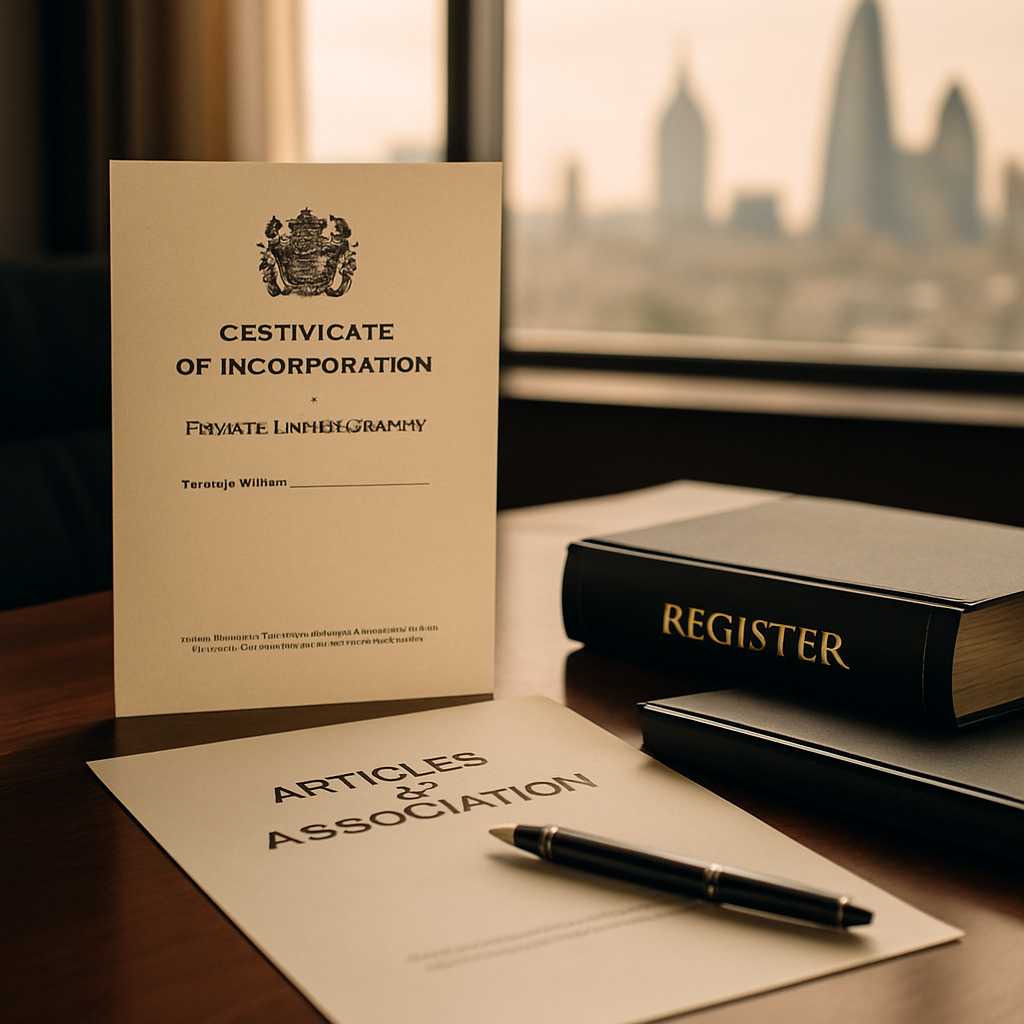
What counts as a Companies House document?
In practice, businesses use the phrase in two slightly different ways. First, they may mean documents issued by Companies House or ordered from the register, such as:
- certificate of incorporation
- certified certificate
- certified copy of a filed document
Second, they may mean documents filed with, connected to, or commonly checked against the Companies House record, such as:
- articles of association
- memorandum
- register extracts
- confirmation statement material
- resolutions
- change-of-name paperwork
- director or shareholder records
That distinction matters because the translation brief changes with it. A certificate translation is usually short and highly formal. A full constitutional pack is longer, more technical, and far more sensitive to numbering, cross-references, and internal consistency.
The safest approach is to translate the full decision trail, not just the headline document. That often means pairing the main certificate with the article changes, resolution, and any register extract that proves who approved what.
The documents businesses usually need translated
Below are the records businesses most often include in a corporate translation pack.
1. Certificate of incorporation
This is often the first document requested because it proves the company exists. It is commonly needed for:
- opening overseas subsidiaries or branches
- foreign bank account applications
- supplier or investor due diligence
- commercial onboarding
- official registration in another jurisdiction
A strong translation of the incorporation certificate should preserve:
- full company name
- company number
- date of incorporation
- jurisdiction wording
- registrar wording
- seal, signature, or certification notes where relevant
This is not a document where “close enough” wording is good enough. Even short certificates deserve careful treatment because every element tends to be checked against another document later in the process.
2. Articles of association
If the certificate proves the company exists, the articles of association explain how it operates. This is one of the most important companies house translation documents for overseas legal, banking, and compliance use.
Businesses usually need articles translated when they are:
- incorporating or registering in another country
- dealing with a foreign investor
- opening a regulated or high-value account
- proving signing authority or governance structure
- completing legal due diligence for a transaction
The translation has to handle much more than legal vocabulary. It must also preserve:
- article numbering
- section headings
- defined terms
- voting thresholds
- quorum rules
- director authority wording
- share provisions
- amendment references
This is where legal-document experience matters. TS24’s legal translation services are particularly useful when the articles include dense governance language, historic amendments, or scanned formatting that needs to stay readable.
3. Memorandum and other constitutional documents
Older companies, overseas entities, and multi-document corporate packs often involve constitutional records beyond the current articles. These can include:
- memorandum of association
- charter or statute equivalents
- constitutional amendments
- adoption resolutions
- legacy governance documents
This category is especially important when dealing with cross-border registration because different authorities ask for different combinations of constitutional proof. The safest workflow is to review the whole constitutional pack at once so the terminology stays identical throughout.
4. Registers of members, directors, and PSC-related records
Businesses do not always start by asking for “register translation,” but these records become critical when the receiving authority wants evidence of ownership or control.
Common examples include:
- register of members
- register of directors
- register of secretaries
- people with significant control material
- share allotment or transfer records
- shareholder certificates or extracts
These documents look simple, but they carry high risk because:
- names must match passports and contracts
- dates must match resolutions and filings
- addresses and roles must remain exact
- share classes and percentages must be consistent
A clean register translation is often what makes the wider pack feel reliable. When the register conflicts with the certificate or articles, it creates immediate doubt.
5. Resolutions
Resolutions are among the most overlooked companies house translation documents, but they are often the pages that explain why a change appears on the public record.
Businesses commonly need translations of:
- board resolutions
- shareholder resolutions
- written resolutions
- special resolutions
- resolutions approving name changes
- resolutions adopting new articles
- resolutions approving share allotments or restructuring steps
These matter because the receiving authority often wants the authority behind the change, not just proof that the change appears on a register somewhere.
A good resolution translation should preserve:
- the exact passing date
- whether the resolution is board or shareholder level
- whether it is ordinary or special
- signing blocks
- annex references
- any schedules or attachments
When deadlines are tight, these are often the pages that arrive late. TS24’s urgent translation services are useful when a board meeting, completion date, or filing window leaves little room for delay.
6. Change-of-name documents and related certificates
If a company has rebranded, merged, or reorganised, the translation pack often needs to show the chain from old name to new name.
This can involve:
- certificate of incorporation on change of name
- name-change resolution
- updated articles
- supporting registry extract
- legacy certificate for the prior name
This is one of the most common points where incomplete packs cause problems. A foreign authority may have one contract under the old name and a bank application under the new one. If the translation pack does not bridge that change clearly, extra evidence is usually requested.
7. Certified copies and certified facts certificates
Sometimes the business does not need a translation of an internally held copy. It needs a translation of a certified copy or a certificate with certified facts ordered from Companies House.
These are common when the receiving authority wants something more formal than a downloaded filing history document. In those cases, the translation should clearly mirror the certified document supplied, including:
- certification wording
- certification page
- embossed or stamped notes
- attached schedules
- registrar wording
8. Supporting company documents often bundled with Companies House records
Many cross-border matters include documents that are not strictly “Companies House documents” but are routinely packaged with them:
- certificate of good standing
- powers of attorney
- bank letters
- share certificates
- audited accounts
- tax certificates
- director ID documents
- commercial register forms from the receiving country
This is where a joined-up project approach saves time. Instead of treating each file as a separate job, the better method is to translate the full corporate set with one terminology approach and one formatting standard.
A quick comparison of what usually needs the most care
| Document | Why it is requested | What usually causes problems |
|---|---|---|
| Certificate of incorporation | Proves legal existence | company number, date, certification notes |
| Articles of association | Shows governance rules | numbering, defined terms, amendment history |
| Registers | Shows ownership and control | names, dates, share classes, role labels |
| Resolutions | Explains a corporate change | authority wording, dates, annexes, signatures |
| Change-of-name documents | Links old and new identity | incomplete chain of evidence |
| Certified copies/certificates | Formal proof for overseas use | omitted certification pages or seals |
What foreign authorities and counterparties usually want to see
In most cases, the question is not, “Can you translate this page?” The real question is, “Can you show the company exists, who controls it, how it is governed, and who approved this change?”
That is why the most useful translation packs usually answer four business questions:
Is the company real and active?
This is usually covered by the incorporation certificate and, where needed, a certified certificate or recent official copy.
Who owns or controls it?
This is where register material, share records, or PSC-related information becomes important.
What rules govern it?
That comes from the articles and other constitutional documents.
Who authorised the transaction or change?
That is usually proved through resolutions and supporting records.
This is the core insight many competing pages miss. Businesses rarely fail because they translated the wrong phrase. They run into trouble because they translated only one document when the receiving side needed the full corporate story.
When certified, notarised, or further legalisation may be needed
Different receiving authorities ask for different levels of formality. A business may need:
- a standard certified translation
- a notarised translation
- legalisation or apostille-related handling
- a translated certified copy, rather than a translation of an ordinary scan
That is why it helps to confirm the end use before work begins. If the documents are headed to a regulator, court, overseas register, embassy, or notary, the safest move is to prepare the translation in the format that the receiving side expects from the start. For projects that need extra formalisation, TS24 also provides notarised translation services.
The safest workflow for translating company document packs
A strong workflow reduces risk long before final delivery.
Step 1: Review the pack as a set
Do not start with the certificate alone if articles, resolutions, and registers are coming next. Review everything together first.
Step 2: Lock key company terms
Set the approved wording for:
- company name
- registered office wording
- director titles
- shareholder terms
- share classes
- constitutional document titles
- governance terminology
Step 3: Match names and numbers across every file
This includes:
- company number
- dates
- old and new company names
- director names
- share amounts
- article references
- resolution references
Step 4: Preserve structure
For corporate records, layout is not decoration. Headings, numbering, signature blocks, side notes, and schedules often carry legal meaning.
Step 5: Certify appropriately
The certification page should match the project’s official purpose.
Step 6: Run a final pack-level review
This is where the biggest value sits. The final reviewer should check the pack as one corporate narrative, not as isolated documents. If your pack includes scanned PDFs, annexes, or certificates that need careful formatting, TS24’s PDF document translation service can help keep the output usable and professional.
Common mistakes businesses make
Translating only the certificate
A certificate proves incorporation, but not necessarily ownership, governance, or authorisation.
Ignoring change history
If the company name, articles, or director structure changed, the translation pack has to explain that clearly.
Letting terminology drift
Using different equivalents for the same corporate term across articles, registers, and resolutions creates doubt.
Forgetting certification pages, notes, or stamps
These are often just as important as the main body text.
Treating layout as optional
In corporate material, a misplaced note, broken table, or missing annex heading can make the file harder to rely on.
Waiting until the filing deadline is close
Resolutions and supporting documents often arrive late. If the matter is time-sensitive, it is better to line up urgent translation services early.
What businesses should send for a faster quote
To keep the project moving, send:
- clear scans or PDFs of every page
- the target language
- the destination country
- the purpose of the translation
- any filing or completion deadline
- whether certification, notarisation, or hard copies are required
If the matter involves multiple company documents, say that upfront. That lets the translation team manage terminology and consistency across the whole set instead of pricing it as disconnected fragments. You can also check TS24’s translation prices if you want a quick sense of likely costs before sending the files.
Why businesses choose TS24 for corporate document translation
Corporate packs need more than literal accuracy. They need process control, legal-document familiarity, and consistency across multiple related files. TS24 supports this with:
- 15+ years of experience
- 8,000+ qualified translators
- 200+ languages
- ATC accreditation
- ITI and CIOL-registered translators
- quality assurance processes
- urgent, same-day, 24h and 48h options
- 1,000+ positive reviews
For legal-sector work, TS24 also highlights a 4.9/5 Trustpilot rating and case-study experience supporting law-firm clients. In one published case study, TS24’s work with Osborne Clarke covered over 150,000 words across several projects. That kind of scale matters when a corporate translation brief expands from one certificate to a full transaction pack.
If you already have the files, the simplest next step is to upload them for a quote through TS24’s certified translation services page or contact TS24 directly to discuss the pack.
A practical checklist before you order
Before sending your companies house translation documents, check that you have:
- the latest version of each document
- every page, including certification sheets and annexes
- clear scans of seals, signatures, and notes
- any old-name/new-name support documents
- any related resolution that explains the change
- confirmation of where the translated pack will be used
- confirmation of whether standard certification is enough
That one check can save a surprising amount of time.
Final thought
Most businesses do not need every Companies House document translated. They need the right combination of documents translated so the receiving authority, bank, investor, or foreign register can understand the company clearly and trust the pack immediately. That usually starts with the incorporation certificate, then expands into articles, registers, and resolutions. The strongest approach is to translate the pack as one coherent record of existence, control, governance, and authority.
If that is what your matter requires, TS24 can handle the corporate set from start to finish through its certified translation services, legal translation services, and urgent translation services.
Frequently asked questions
Do Companies House documents need certified translation?
If the documents will be used for official purposes abroad or submitted to an authority that does not accept the original language, a certified translation is often the safest option. The exact level of certification depends on the destination country and receiving institution.
Which companies house translation documents are requested most often?
The most common requests are for the certificate of incorporation, articles of association, memorandum or constitutional documents, registers, and resolutions. Change-of-name paperwork and certified copies are also frequently needed.
Do I need to translate articles of association and resolutions together?
Very often, yes. The articles show the governance framework, while the resolutions show what decision was actually taken. When the matter involves a name change, restructuring step, or authority issue, both documents are often needed together.
Can a certificate of incorporation be translated on its own?
Yes, but it depends on the purpose. For some matters, the certificate alone is enough. For others, the receiving side will also ask for articles, register extracts, or resolutions to understand ownership, authority, or governance.
Are company registers and shareholder records part of companies house translation documents?
They often are in practice, especially when the goal is to prove ownership or control. Even when the request starts with a public filing, supporting register material may be needed to complete the pack.
How fast can corporate document translations be completed?
That depends on the language pair, number of pages, formatting complexity, and whether the documents need certification or notarisation. Short certificates can move quickly, while articles and multi-document packs take longer because consistency across the set matters.

