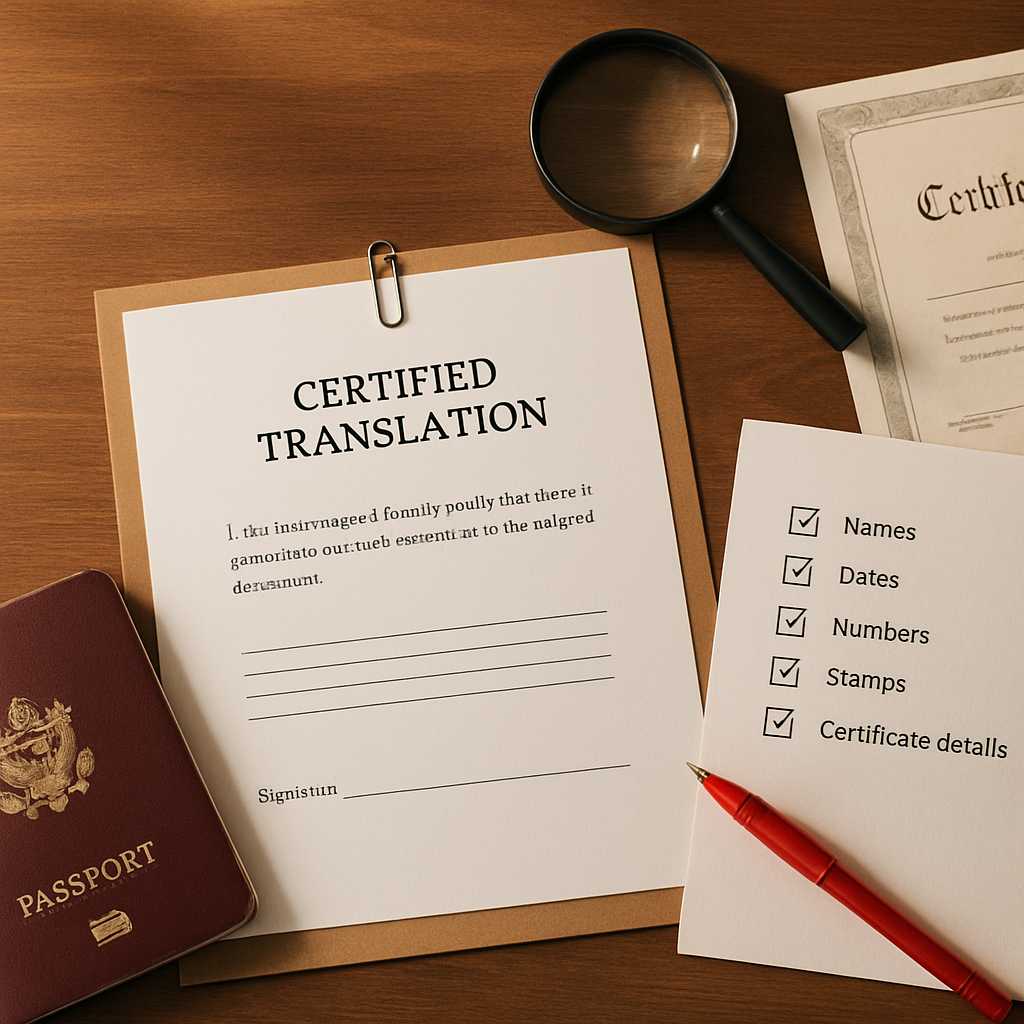
You have your translation back. It looks clean, professional, and ready to go.
This is the point where many people assume the difficult part is over. In reality, the last review is often the step that protects the entire application.
A certified translation can still cause delays if the personal details do not line up with the source document, if a date has been flipped into the wrong format, if a document number is one digit out, or if a stamp, signature, handwritten note, or certificate detail has been missed. The problem is not always a dramatic translation error. More often, it is a small mismatch that creates doubt for the person reviewing your file.
That is why a proper self-audit matters. Before you submit anything to a government body, employer, university, solicitor, bank, court, regulator, or overseas authority, run a final check that focuses on the details most likely to hold up approval: names, dates, numbers, stamp notes, and certification wording.
If your translation is for immigration, legal use, HR onboarding, banking, licensing, or international paperwork, this page will help you review it like a case handler rather than just a customer.
Why a final self-audit is worth doing
A reviewer rarely knows what you meant to submit. They only know what is on the page in front of them. If the source document says one thing and the translated version suggests another, the reviewer may stop, question the document, ask for clarification, or refuse to rely on it. Even where the issue is minor, the result can still be frustrating: extra emails, re-submission, missed deadlines, or additional verification.
The safest way to think about a pre-submission check is this: your translation does not only need to read well. It needs to match, align, and verify.
That means checking:
- whether every key identity detail matches the source
- whether all dates make sense in context
- whether numbers are copied accurately
- whether stamps, seals, signatures, and handwritten annotations are accounted for
- whether the certification page includes the information a receiving authority expects
- whether the translated pack makes sense when viewed alongside your passport, form, or supporting documents
What reviewers tend to notice first
When an official document is checked, the reviewer usually does not start by reading every sentence in depth. They scan for anchors. Those anchors are normally:
- full name
- date of birth
- document number
- issue date
- expiry date
- place names
- authority names
- marriage or birth dates
- account numbers or financial figures
- signatures, seals, and visible marks
- certification wording and translator details
That is why the fastest and most effective audit is not “read everything again from top to bottom.” It is “check the anchors first, then confirm completeness.”
The five-minute pre-submission audit
Use this in order, without skipping ahead.
1. Check names exactly as they appear
Names cause more problems than many people expect because they are not only about spelling. They are also about consistency across documents. Review every occurrence of:
- first name
- middle name
- surname
- maiden name
- previous name
- father’s name or mother’s name where shown
- initials
- hyphenated names
- place names tied to identity records
Look for these common issues:
- one letter changed in a surname
- name order reversed
- middle name omitted
- maiden name not reflected
- accented characters handled inconsistently
- transliteration changing between documents
- passport spelling not matching the spelling used in the translation
A translation can be linguistically correct and still create a problem if the spelling of the same person’s name changes from one document to another.
For example:
- Mohamed / Mohammed / Muhammad
- Yulia / Iuliia / Julia
- Aleksandr / Alexander
- Fatima Al Zahra / Fatimah Al-Zahra
The safest rule is simple: where a passport or official ID already shows the person’s name in English, the translated document should usually follow that established spelling unless there is a very specific reason not to.
2. Check every date with extra care
Dates fail in three main ways:
- the wrong numbers are copied
- the month and day are reversed
- the timeline across the full document pack does not make sense
Check:
- date of birth
- date of issue
- date of expiry
- date of registration
- date of marriage
- date of judgment
- date of certification
- any handwritten date on stamp notes or endorsements
Pay particular attention to date format. A reviewer may understand both 03/07/2024 and 07/03/2024, but the risk is obvious: one means 3 July, the other means 7 March. If your translated document contains numeric dates only, make sure the month and day cannot be misunderstood. A written format such as 3 July 2024 is often clearer than a slash format when certainty matters.
Then step back and test the timeline:
- Was the certificate issued after the event it records?
- Does the translation date come after the source document date?
- Do divorce, marriage, birth, employment, graduation, or court dates line up with the wider application?
- Are there inconsistent issue and expiry dates between the source and translation?
A single date mismatch can change the meaning of the entire file.
3. Check all numbers, not just the obvious ones
People often review names and dates carefully, then skim numbers. That is a mistake. Numbers are high-risk because they are easy to misread and easy for reviewers to compare.
Check:
- passport numbers
- ID numbers
- case numbers
- certificate serial numbers
- licence numbers
- reference numbers
- account numbers
- invoice numbers
- registration entries
- financial amounts
- tax figures
- percentages
- page numbers
- article or clause numbering in legal texts
Look out for:
- 0 and O
- 1 and I
- 5 and S
- 8 and B
- dropped zeros
- extra spaces inside number strings
- decimal separators changed incorrectly
- thousands separators changed without explanation
This matters particularly in bank statements, payslips, tax records, court papers, contracts, and educational transcripts. A figure such as 10,500.00 can become 10.500,00 depending on local formatting. A professional translation may adapt language, but the underlying value must remain unmistakably correct.
4. Check stamps, seals, signatures, and handwritten notes
A surprising number of submission problems happen because the visible features of the original were not fully reflected. Review whether the translation accounts for:
- official stamps
- embossed seals
- wet signatures
- initials
- marginal notes
- handwritten amendments
- registrar notes
- visa or entry marks
- court seals
- notary wording
- illegible sections marked as unclear where necessary
Do not assume these are decorative. A stamp may show the issuing authority, the office location, a filing number, or a crucial date. A handwritten note may record an amendment, cancellation, or registration entry. A proper translation should make it clear that these visible features exist and, where legible, what they say.
Examples of useful presentation:
- [Round blue municipal seal]
- [Signature]
- [Handwritten note: registration corrected on 14 May 2022]
- [Text partly illegible]
- [Embossed seal present]
If the original document has an important mark and the translated version ignores it completely, that is worth querying before submission.
5. Check the certificate page or certification block
This is the section many people forget to audit because they focus only on the translated body text. Do not skip it. The certification section should be clear, professional, and complete. Depending on the destination, it may appear on a separate certificate page or as a certification block attached to the translation.
Review whether it includes:
- confirmation that the translation is true and accurate
- the date of translation or certification
- translator or authorised company representative name
- signature
- contact details
- source and target language where appropriate
- company details or credentials where required for the use case
For some submissions, especially immigration or formal legal use, the certificate details are just as important as the translated content itself. If the certificate is missing, vague, unsigned, or hard to verify, pause before you submit.
The cross-document consistency check most people miss
This is the step that makes a submission pack look reliable. Do not review the translation in isolation. Put it beside the other documents in your application and compare the core identity details across the whole pack.
Check whether the translated document matches:
- your passport
- your application form
- previous translations
- bank statements
- birth or marriage certificates
- academic records
- court orders
- employer letters
- visa or immigration reference numbers
This is where inconsistencies show up. Common examples include:
- passport shows “Amina Yusuf Khan” but translation says “Amina Yousaf Khan”
- bank statement has one passport number digit different from the translated ID page
- translated certificate uses a different marriage date from the date already entered on the application form
- one document uses a maiden name while another uses a married name without explanation
A reviewer may not know which version is correct. They only know the file is inconsistent.
A practical self-audit method that works
If you want the fastest accurate review, use this three-pass approach.
Pass one: identity details only
Ignore everything else and highlight:
- names
- dates of birth
- document numbers
- issue and expiry dates
- authority names
This catches the mistakes most likely to trigger questions.
Pass two: visible marks and completeness
Now check whether all these appear in some form:
- all pages
- all stamps
- all seals
- all signatures
- all annotations
- all handwritten notes
- all page references
- both sides of the document where relevant
This catches omissions.
Pass three: certificate and submission readiness
Finally ask:
- Is the certification section complete?
- Is the translation easy to read?
- Is the file format the authority expects?
- Are hard copy, notarisation, or apostille requirements already confirmed if needed?
- Does the translation pack look ready to be reviewed without explanation?
This catches presentation and compliance issues.
What to do if you find a problem
Do not edit the translation yourself. That usually creates more risk, not less. Instead:
- Mark the exact issue clearly.
- Reference the page and line or field.
- Explain what appears in the original.
- Attach supporting context if needed, such as the passport spelling to be followed.
- Ask for the amendment in one message rather than sending multiple scattered notes.
A useful amendment request is specific. Good example: “On page 2, the surname appears as Petrova in the translation, but the passport spelling used across my application is Petrova-Ivanova. Please update all occurrences to match the passport and confirm the certificate remains unchanged apart from the corrected name.” Poor example: “There are some mistakes. Please check again.” The clearer the correction request, the faster the revision process.
When a small mismatch is not actually small
Some differences look minor until they affect a decision. Treat these as high priority:
- name mismatch against passport or ID
- wrong date of birth
- wrong passport or case number
- omitted stamp or legal note
- missing page
- incomplete translation
- unsigned certification
- wrong translation type for the destination
- incorrect document chronology
- altered number formatting that changes the value
These are not style points. They can affect acceptance.
Certified, notarised, or legalised: check the level before submission
Another common mistake is reviewing the translation carefully but missing the bigger issue: the authority may need a different level of authentication. Before you submit, confirm whether the destination needs:
- a standard certified translation
- a notarised translation
- an apostille or legalisation
- a sworn translation for use in another jurisdiction
- a hard-copy original rather than email-only delivery
There is no value in a perfect final text if the receiving body expects an extra step and it has not been arranged. If you are submitting abroad, verify this before your deadline rather than after a refusal.
The documents that deserve the strictest audit
Every certified translation should be checked, but some document types deserve extra scrutiny because small details carry legal or evidential weight.
Personal status documents
- birth certificates
- marriage certificates
- divorce certificates
- death certificates
- adoption papers
Check names, dates, places, registry numbers, margins, seals, and annotations.
Identity documents
- passports
- national ID cards
- residence permits
- driving licences
Check spelling against the English version already shown on the document, plus numbers, issue dates, expiry dates, and issuing authority.
Financial documents
- bank statements
- payslips
- tax letters
- proof of funds
- company records
Check account numbers, balances, date ranges, decimal separators, salary figures, and bank letterhead details.
Legal documents
- court orders
- witness statements
- contracts
- powers of attorney
- police certificates
Check clause numbering, court references, seals, signatures, dates, names, and whether any note or endorsement has been missed.
Academic and professional records
- diplomas
- transcripts
- qualification certificates
- licences
- membership records
Check dates awarded, institution names, grades, registration numbers, and classification language.
The pre-submission checklist you can follow every time
Use this list before you send your file anywhere.
Names
- Every personal name matches the source document.
- The English spelling matches the passport or official ID where relevant.
- Name order is correct.
- Maiden names, previous names, and initials are handled consistently.
- Place names and authority names are spelled consistently throughout.
Dates
- All dates match the source.
- Day and month are not reversed.
- The timeline across documents makes sense.
- Issue, registration, event, expiry, and certification dates align logically.
Numbers
- Passport, ID, certificate, case, and reference numbers are correct.
- Financial figures are copied accurately.
- Decimal and thousands separators do not change the meaning.
- Page numbers and legal clause numbers are complete.
Visible features
- Stamps are noted.
- Seals are noted.
- Signatures are marked.
- Handwritten notes are included or identified where legible.
- Illegible text is marked honestly rather than guessed.
Certificate details
- Accuracy statement is present.
- Date is present.
- Name of translator or authorised representative is present.
- Signature is present.
- Contact details are present.
- Any required credentials or company details are included.
Submission readiness
- All pages are included.
- File format is acceptable.
- Hard copy has been ordered if needed.
- Notarisation or apostille has been checked if relevant.
- The translation matches the rest of the submission pack.
A better way to think about “accuracy”
Many people think accuracy means the words are translated correctly. That is only one part of it. For official submissions, accuracy usually means four things at once:
- the meaning is correct
- the identity details are correct
- the visible document features are accounted for
- the certification details are present and usable
That is why a good self-audit is not perfectionism. It is risk control.
Before you send it, ask these three final questions
- If a caseworker compared this translation to my passport and application form in under 30 seconds, would everything line up?
- If they checked only the dates and numbers, would anything cause doubt?
- If they looked only at the certificate page, would they have enough information to trust and verify the translation?
If the answer to all three is yes, your file is usually in much better shape.
Why clients use TS24 for submission-ready document translations
When timing matters, the safest process is to use a provider that already works with official submissions and understands how small inconsistencies can affect outcomes. TS24 supports certified document translation in over 200 languages and handles official, legal, academic, financial, and personal records for UK and international use. Clients come to TS24 when they need clear certification, reliable formatting, fast turnaround, and a team that understands names, dates, numbers, seals, and submission standards as practical approval issues rather than afterthoughts.
If your document needs to be checked, translated, certified, notarised, or prepared for overseas use, send the file before you submit it. It is far easier to correct a detail at review stage than explain it after a delay. Send your document to TS24 and get a quote before your deadline gets tighter. A careful final check now can save days later.
Frequently asked questions
How do I check a certified translation before submitting?
Compare the translation against the original and focus first on names, dates, document numbers, stamps, signatures, and the certification section. Then compare the translated document against your passport, application form, and other supporting documents to make sure everything is consistent.
What should a certified translation include before submission?
A submission-ready certified translation should include the full translated content, notes for visible marks such as stamps or seals where relevant, and a certification section confirming accuracy with the date, name, signature, and contact details of the translator or authorised company representative.
Why are names, dates, and numbers so important in a certified translation?
These are the details reviewers use first to verify identity, chronology, and document authenticity. Even a small mismatch in a surname, birth date, passport number, or certificate reference can trigger delays, clarification requests, or rejection.
Do I need to check stamps and handwritten notes in a certified translation?
Yes. Stamps, seals, signatures, and handwritten annotations can contain key information such as authority details, registration data, amendments, or official endorsements. If they matter on the original, they should not be ignored in the translated version.
Can I correct a certified translation myself before submitting?
No. You should not edit the translated text or certificate yourself. Mark the issue clearly and request a formal correction from the translation provider so the final version remains consistent, professional, and properly certified.
Do I need a notarised or legalised translation instead of a standard certified translation?
Sometimes. It depends on the receiving authority and the country where the document will be used. A standard certified translation is often enough for UK submissions, but some legal, overseas, or institution-specific uses may require notarisation, apostille, or another formal step.

