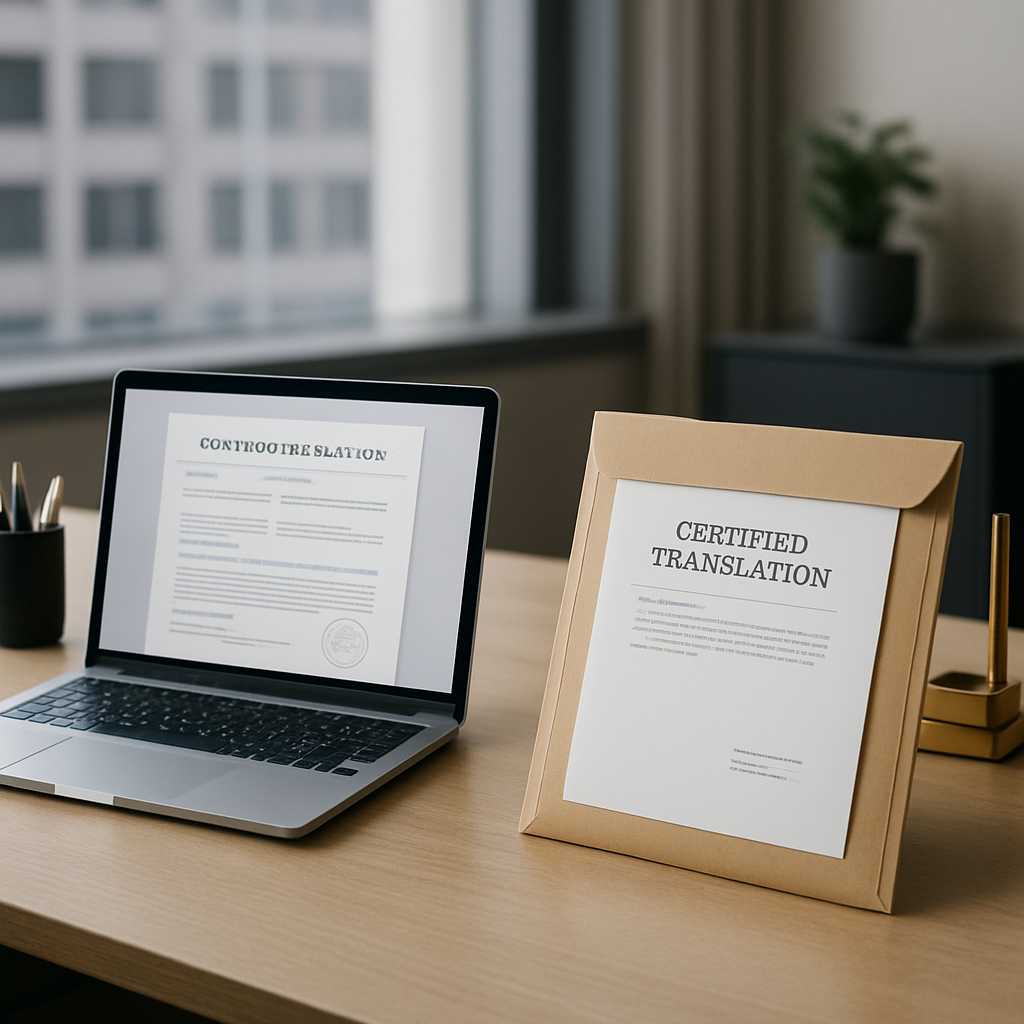
Delivery Choices: Email PDF vs Post in London – What to Pick
When comparing certified translation delivery options, many people often ask the wrong question. Instead of inquiring which format is “more official,” the smarter question is simpler: what does the receiving body actually want, and how fast do you need it?
In London, most delivery issues arise not from the translation itself but from choosing the wrong output format too late. A certified PDF may be ideal for an online submission due today, while a posted hard copy might be the safer choice for a solicitor’s paper bundle, a wet-ink preference, or a document that needs to be presented physically. The best choice aligns with the authority’s requirements, the timeline, and the submission method.
For UK-facing submissions, the translation must be complete and independently verifiable. Government guidance stipulates that a non-English or non-Welsh document should be accompanied by a full translation that includes confirmation of accuracy, the date, the translator’s name and signature or authorized signature, and contact details.
If you know your deadline is tight, start with a provider that can manage both the translation and the delivery format without switching suppliers halfway through. TS24 London positions its service around certified human translation, digital delivery, hard-copy availability, and fast turnaround, with dedicated guidance on UKVI translation in London, same-day translation, and submission-ready certified translations.
Quick answer: Choose email PDF when speed, portal upload, or remote review are priorities. Opt for post when the receiving party has requested a physical set, a signed paper file, or a hard-copy pack. Consider both options when the deadline is short but there’s a chance a physical copy may still be requested later.
What a Certified Translation Must Do Before Delivery Even Matters
Before deciding between email or post, ensure the translation itself is correct. Delivery only addresses the final step; it does not rectify a flawed document.
A usable certified translation should be:
- Full, not selective
- Easy to compare with the source
- Clearly certified as accurate
- Dated
- Attributable to a real translator or translation company
- Supported by contact details
- Formatted for easy review by the receiving body
This is crucial because a beautifully delivered translation can still cause delays if page numbers are missing, stamps are ignored, or the certification wording is incomplete. Therefore, the safest workflow is to:
- Confirm who will receive the document
- Confirm whether digital is acceptable
- Confirm whether a hard copy is needed
- Confirm whether standard certification is sufficient
- Order the correct format the first time
Email PDF Delivery: When It Is the Right Choice
For many clients in London, PDF delivery is the most practical option. It is fast, easy to forward, simple to upload, and ideal when a document needs to be reviewed by multiple people before submission. If you are sending a visa pack, responding to a university request, or sharing documents with a solicitor, HR team, or advisor, a certified PDF usually eliminates unnecessary waiting.
PDF Delivery Is Usually the Best Fit When:
- The application is submitted online
- The authority accepts uploaded supporting files
- You need the translation the same day or next day
- Several people need to review it before filing
- You are outside London but using a London provider
- The hard copy is optional rather than mandatory
Why PDF Often Wins on Speed
The timing advantage is clear: there is no packaging, no dispatch window, no courier collection, and no last-mile delay. Once the translation has been checked and certified, it can be sent immediately. This is particularly useful when the real deadline is not “tomorrow,” but “tomorrow morning before an appointment,” “before a portal closes,” or “before someone else signs off the pack.”
At TS24 London, digital delivery is integrated into the workflow, while hard copies remain available if needed. Their rush guidance also distinguishes between same-day, 12-hour, and 24-hour work, ensuring that every urgent job is treated appropriately.
PDF Delivery Is Strongest for These Document Types:
- Birth certificates
- Marriage certificates
- Passports and ID cards
- Police certificates
- Diplomas and transcripts
- Bank statements
- Payslips
- Sponsorship letters
- Tenancy agreements
- Standard supporting documents for UK applications
If your file is entering an online process, the digital version often serves as the working copy that advances the application. A good next step is to upload your document as soon as the scan is ready, rather than waiting to decide whether you might also want a hard copy later.
Posted Hard Copy: When It Still Matters
Hard copies are not outdated; they are simply more situational. A posted certified translation is beneficial when the receiver expects paper, when a physical bundle is easier to present, or when a wet-ink signature, stamp impression, or original-looking pack instills more confidence in the receiving party.
Post Is Usually the Better Fit When:
- A solicitor or barrister is preparing a paper bundle
- A notary or overseas authority expects a physical file
- The recipient explicitly asks for a signed or stamped hard copy
- You want a paper set for records, interviews, or appointments
- Multiple authorities may need separate printed copies
- The file may later need notarization or additional formal steps
The Real Advantage of a Posted Copy
The advantage of a posted hard copy is not that paper is automatically better; it is that some workflows still revolve around paper handling. A physical set can be easier to staple into a larger pack, present at an in-person appointment, or circulate where printed review is still customary. It can also alleviate anxiety for clients who prefer having something tangible in hand before an important submission.
The Trade-off
However, posting adds another layer of complexity. You are not only managing translation time but also dispatch timing, delivery service choice, branch cut-offs, postcode restrictions, and the risk of simple transit delays. Royal Mail’s premium option, Special Delivery Guaranteed by 1pm, includes full tracking, photo and signature on delivery, compensation cover, and a next-working-day guarantee when posted by the relevant cut-off. This makes it a strong choice for important paper copies, but even premium post requires planning. If you find out at 4:45 pm that you need a hard copy for the next morning, the issue extends beyond translation alone; it becomes a logistical challenge.
The London Decision Most People Miss
The real comparison is not simply PDF vs post. It is about:
- Translation complete by deadline versus translation plus delivery by deadline
- Reviewable now versus physically received later
- Submission-ready digitally versus submission-ready on paper
This distinction changes everything. A same-day certified PDF may be realistic for a short, clean file, while a same-day posted hard copy is only feasible if the translation finishes early enough for dispatch and the delivery method truly supports the deadline. This is why rush work should always be planned around the final use, not just the translation label.
Side-by-Side: Email PDF vs Posted Hard Copy
| Factor | Email PDF | Posted Hard Copy |
|---|---|---|
| Speed | Fastest option | Slower due to dispatch and transit |
| Best for | Online submissions, remote review, urgent deadlines | Paper bundles, wet-ink preferences, physical presentation |
| Review workflow | Easy to forward and approve | Slower to circulate unless scanned again |
| Deadline control | High | Lower, as delivery timing adds risk |
| Proof of receipt | Email trail or portal upload | Stronger if sent with tracked/signed service |
| Reprintability | Immediate | Requires extra copies to be ordered or printed |
| Stress level on urgent jobs | Lower | Higher if discovered late |
| Ideal use case | “I must submit today” | “I must present or hold a paper set” |
When PDF Is the Clear Winner
Choose PDF first when:
- The submission is online
- Your deadline is tight
- You only have clear scans, not originals
- You need an answer or approval before printing
- The recipient has not specifically requested paper
- You want to avoid postal delays completely
A useful rule is this: If the file will be uploaded before it is ever printed, PDF should usually lead the workflow. This is why many immigration, HR, university, and admin-driven files move fastest as certified PDFs first.
When Post Is the Safer Choice
Choose hard copy first when:
- The receiving body has explicitly requested it
- You need a formal paper pack for an appointment
- A legal team is assembling a physical bundle
- The file may be notarized, witnessed, or reused physically
- The client cannot risk arriving without paper in hand
If the file will be handed over in person, attached to a paper bundle, or visually checked as a physical set, post becomes significantly more important.
The Overlooked Third Option: Order Both
For many jobs in London, the smartest answer is not one or the other; it is both. Order the certified PDF first so the job can move immediately, while also ordering a posted hard copy to cover yourself if the receiving body later requests paper.
This approach is particularly wise when:
- The deadline is close
- The authority’s wording is vague
- More than one institution may view the file
- A solicitor, school, or employer may want printed copies later
- You want to avoid restarting the process
The cost of ordering both is often less than the cost of delays, re-ordering, or missing a submission window.
How Delivery Choice Affects Turnaround
The wrong delivery choice can quietly transform a “fast” translation into a slow overall job.
Same-Day Can Work When:
- The file is short
- The scan is clean
- The format is standard
- The language pair is common
- PDF delivery is acceptable
24-Hour Is Often Wiser When:
- The pack includes several documents
- The formatting matters
- The file needs more careful checking
- You may need both digital and printed output
- The submission is tomorrow rather than today
Longer Lead Time Is Better When:
- The bundle is large
- The document is of poor quality
- The language pair is less common
- Legal or academic accuracy is especially sensitive
- Post, notarization, or extra certification may be required
If you know that delivery format is part of the job, mention it at the first inquiry. Do not wait until the translation is finished to indicate that you also need a posted set.
Common Mistakes That Create Avoidable Delay
1. Assuming Paper Is Always “More Accepted”
It is not; sometimes it is simply slower.
2. Assuming PDF Is Always Enough
It often is, but not always. The receiving body decides.
3. Ordering the Translation Before Checking Submission Method
This leads to having the right words in the wrong format.
4. Leaving Hard-Copy Dispatch Until the End of the Day
Even premium delivery depends on cut-offs and handling windows. Royal Mail’s Special Delivery page outlines specific posting guidance and cut-off advice.
5. Using Economy Post for a Deadline-Driven Physical File
Royal Mail states that 2nd Class and other non-1st Class letters are delivered every other weekday, making it a poor choice for deadline-sensitive certified translation packs.
6. Sending a Poor Scan and Then Paying for Rush Delivery
Speed cannot fix an unreadable source file.
A Simple Decision Framework
Before you order, ask these five questions:
1. Who Is Receiving the Translation?
A UKVI portal, university admissions team, solicitor, employer, notary, or overseas authority may all have different requirements.
2. Is the Submission Digital or Physical?
This usually determines the delivery method faster than anything else.
3. Has Anyone Asked Specifically for a Hard Copy?
If yes, do not try to second-guess them.
4. Is the Deadline About Review or Receipt?
A PDF can be reviewed instantly, while a posted copy must arrive.
5. Would Ordering Both Remove Risk?
In many cases, yes.
London Examples: What Usually Makes Sense
Online Visa or Immigration Submission
Start with PDF. Add hard copy only if another adviser or institution also wants paper. Ensure the certification is complete and independently verifiable, referring to the UKVI translation checklist.
University or ENIC-Style Academic Use
PDF is typically the working format first, especially where files are uploaded or reviewed remotely. If an original-looking paper set may later be requested, order both.
Solicitor or Court-Facing File
If the legal team is working on paper, hard copy is more important. If they are reviewing electronically first, send the PDF immediately and arrange for post in parallel.
Employer, Landlord, Bank, or HR Request
PDF is often the fastest and cleanest first move unless the recipient explicitly states otherwise.
Overseas Authority or Notarial Chain
Do not assume a normal certified PDF is the endpoint. Inquire whether printed sets, notarization, or further formalization are expected before the job begins.
What to Pick
If you want the practical answer most London clients need, it is this:
- Pick email PDF when speed, portal upload, and remote review matter most.
- Pick post when the recipient has clearly asked for a physical certified copy.
- Pick both when the deadline is tight and the consequences of guessing wrong are higher than the cost of covering both formats.
The strongest approach is not the one that feels most formal; it is the one that ensures the right translation reaches the right hands in the right format the first time. If your submission is time-sensitive, contact TS24 London and send the full file in one go. Mention the receiving authority, the deadline, and whether you need PDF only, posted hard copy, or both. This single step can eliminate most delivery confusion before it starts.
FAQs
Is a PDF Certified Translation Accepted in the UK?
Often, yes, especially where the submission is digital and the translation includes the required certification details. However, it is always safest to follow the receiving body’s instructions rather than assume one format fits all cases.
Do I Need a Posted Hard Copy for UKVI?
Not automatically. What matters first is that the translation is complete, accurate, and independently verifiable with the required certification details. Whether you also need a physical copy depends on how the supporting documents are being submitted.
Which Certified Translation Delivery Option Is Fastest?
Email PDF is the fastest option as it eliminates dispatch and transit time. Hard copy adds delivery logistics, even when the translation itself is completed quickly.
Does Post Affect Turnaround on Urgent Certified Translations?
Yes, post can introduce an additional operational layer: print preparation, dispatch timing, service choice, and delivery risk. This is why urgent clients often request the PDF first and hard copy second.
Should I Choose PDF Delivery or Posted Hard Copy for Legal Documents?
Choose based on the legal workflow, not merely the document label. If the legal team is filing or reviewing digitally, PDF is usually the first move. If they require a physical hearing bundle or signed paper set, hard copy becomes more critical.
Is 2nd Class Post a Good Option for Certified Translation Hard Copies?
Not for deadline-sensitive files. It may be acceptable for non-urgent duplicate sets, but not where timing is crucial.

