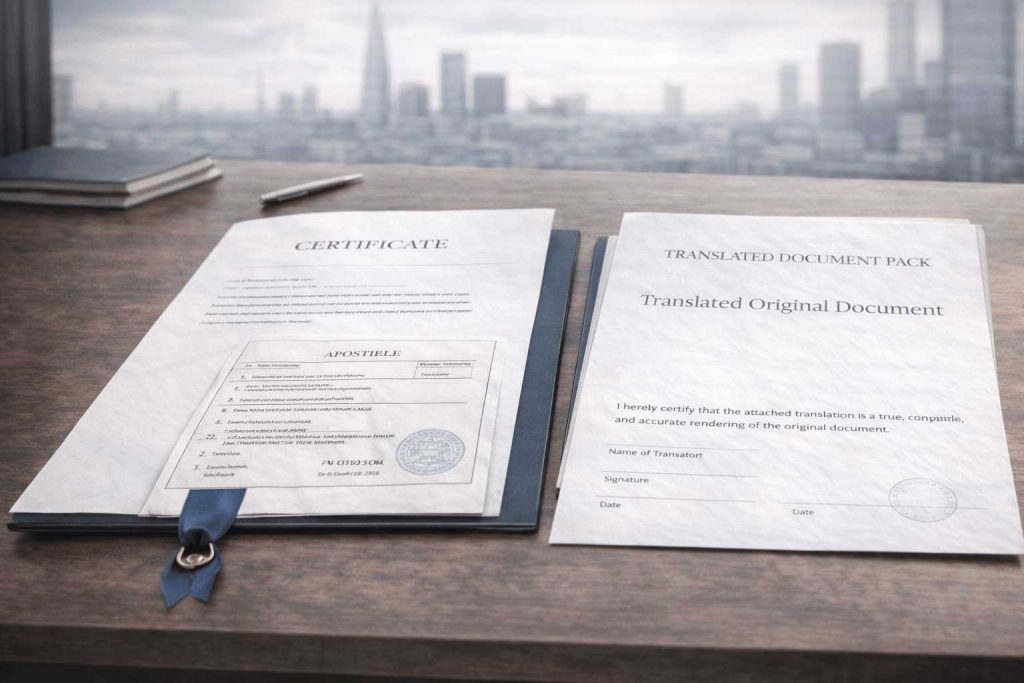
If you are unsure about apostille and translation order, the safest answer is usually this: apostille first, translation second. In the UK, the FCDO Legalisation Office checks the signature, seal, or stamp on a document and then attaches an apostille. That means the version you translate should normally be the final version you plan to submit, not an earlier draft. The main exceptions are cases where the translation itself must be notarised or legalised, or where a particular country or consulate applies its own sequence.
That simple rule saves a surprising amount of money and delay. People often pay for a translation too early, only to discover that the receiving authority wanted the apostille page translated as well, wanted a certified copy instead of the original, or needed a paper apostille rather than an e-Apostille. Once one of those details changes, the whole pack may need to be redone.
When speed matters, the goal is not just to get a translation done quickly. The goal is to translate the right version, in the right order, for the right authority.
The rule that prevents most rework
Use this working rule throughout the project:
Translate the final submission pack, not the draft pack.
In practice, that means:
- if the final pack is the original document plus apostille, translate after apostille
- if the final pack is a certified copy plus apostille, translate after the certification and apostille are complete
- if the receiving authority wants the translation itself to carry notarisation or legalisation, produce the translation first, then notarise and legalise that translation as its own document
That is the clearest way to avoid double payment, inconsistent layouts, and missing pages.
Why this question causes so much confusion
An apostille does not confirm that the document’s contents are true. It confirms that the signature, stamp, or seal is genuine. That distinction matters, because the receiving authority may still care about format, language, whether the document is an original or certified copy, and whether one apostille or several apostilles are required.
The second source of confusion is that there is no single worldwide order for every document type. Hague Convention countries often accept a straightforward apostille route, while some destinations still require embassy or consular legalisation after the apostille. Some authorities also impose separate rules on the translation itself. Italy is a classic example: some official processes require the foreign document to be apostilled, while the translation must be legalised by the Italian consulate.
So the real question is not only, “Should I translate before or after apostille?” The real question is, “What is the final form of the pack that my receiving authority expects?”
The correct order in most FCDO cases
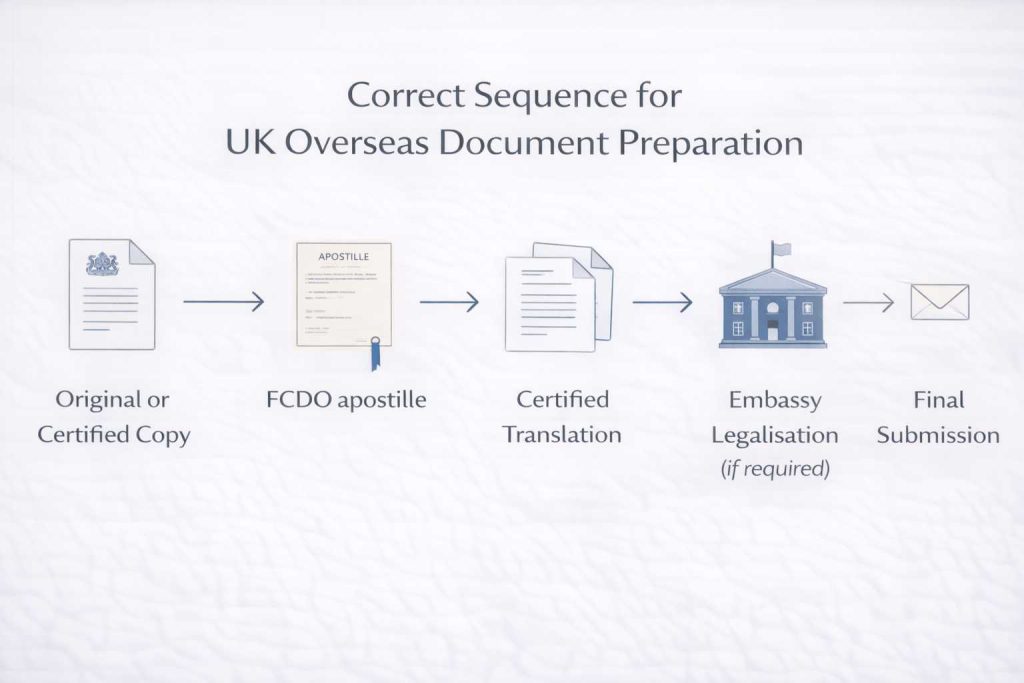
For most UK-issued documents being sent abroad, this is the safest order:
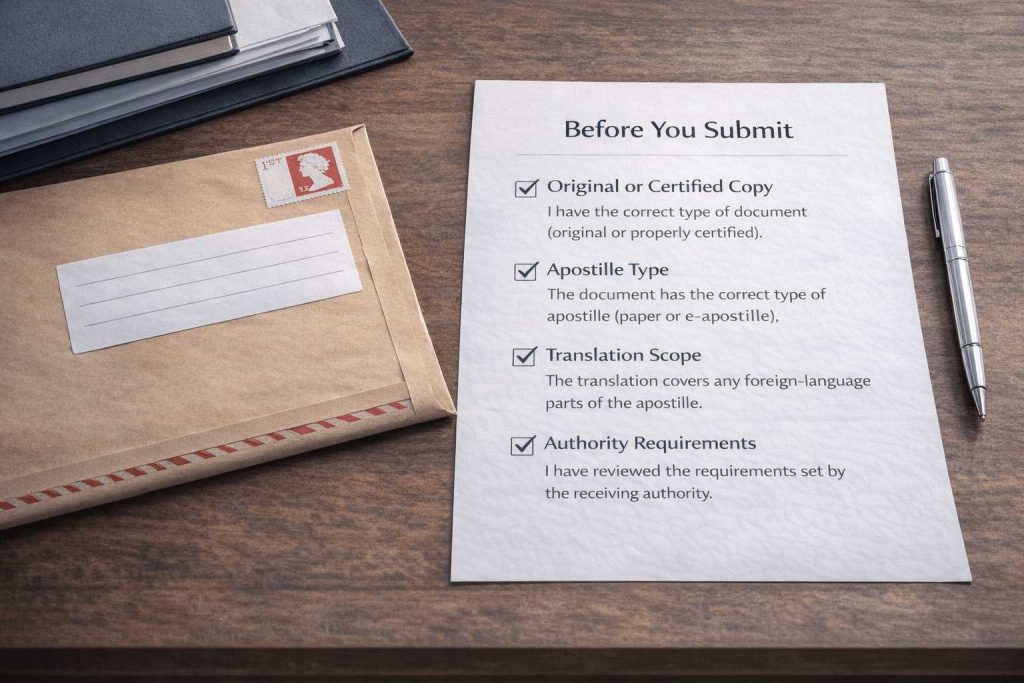
1. Confirm the destination authority’s exact document requirements
Before paying for anything, confirm:
- whether they want the original document or a certified copy
- whether they accept a paper apostille or will accept an e-Apostille
- whether each document needs its own apostille
- whether the apostille page, notarial page, or embassy page must also be translated
- whether the translation must itself be notarised or legalised
This one check can save the whole project.
2. Put the document into the right legalisable form
Some documents can be legalised as official originals, such as registry certificates and certain government-issued documents. Other documents need a UK public official, such as a solicitor or notary, to certify them first. The FCDO guidance specifically states that copies of documents such as passports and driving licences can be legalised when they have been certified by a UK public official.
3. Get the apostille on that final legalisable version
Once the document is in the correct form, submit it for legalisation. For standard paper applications, the current official fee is £45 per document plus postage or courier costs, and the usual timeframe is up to 15 working days plus return time. For e-Apostilles, the fee is £35 and the official timeframe is up to 2 working days, subject to eligibility.
4. Translate the apostilled pack
Once the apostille is attached or issued, your translator is working from the correct final version. This is the point at which the translation can capture the real page order, visible seals, attached apostille wording, and any handwritten or stamped elements the receiving authority will actually see.
5. Add any further embassy or ministry legalisation if the destination country requires it
If the destination is outside the Hague apostille framework, or still requires a longer chain, the official UK guidance is clear: first get the document apostilled by the Legalisation Office, then get it stamped by the destination country’s embassy in London, then obtain approval from that country’s Ministry of Foreign Affairs. In those cases, translation should be planned around the final submission requirements, not assumed too early.
When apostille first, then translation is the right choice
This is the default route for most personal, academic, and business documents.
Birth, marriage, death, and other registry certificates
If the certificate is being used abroad and the receiving authority wants the full legalised pack in another language, apostille first and translate second. This is particularly important because many registry certificates are not eligible for e-Apostille, which means the physical apostille becomes part of the final pack.
Degree certificates, qualification documents, and official letters
Where the original or a certified copy is being legalised for foreign use, it is usually safer to apostille first so the translator can work from the exact version being submitted.
Certified copies of passports or driving licences
A plain scan is not the same thing as a legalisable copy. If the receiving authority wants a legalised passport copy or licence copy, the copy should first be certified by a UK public official, then apostilled, then translated if needed.
Powers of attorney, contracts, and other privately issued documents
These often need certification by a notary or solicitor before the FCDO can legalise them. Once that step is complete and the apostille is attached, the translation should usually follow so it reflects the final executed set.
When translation first, then notarisation or apostille can be the right choice
There is a different route when the receiving authority is not asking you to translate an apostilled original, but is instead asking you to produce a translated document that must itself be notarised or legalised.
In that scenario, the translation becomes the document being authenticated. The working sequence is:
- prepare the certified translation
- have the translator’s or company representative’s signature notarised or solicitor-certified
- send that translated document for legalisation or apostille
This is common where the receiving authority focuses on the legal status of the translation itself, not just the source document. It is also why “apostille and translation order” is not a one-size-fits-all question. The correct order depends on which document the authority wants authenticated.
Originals vs scans: where people lose time
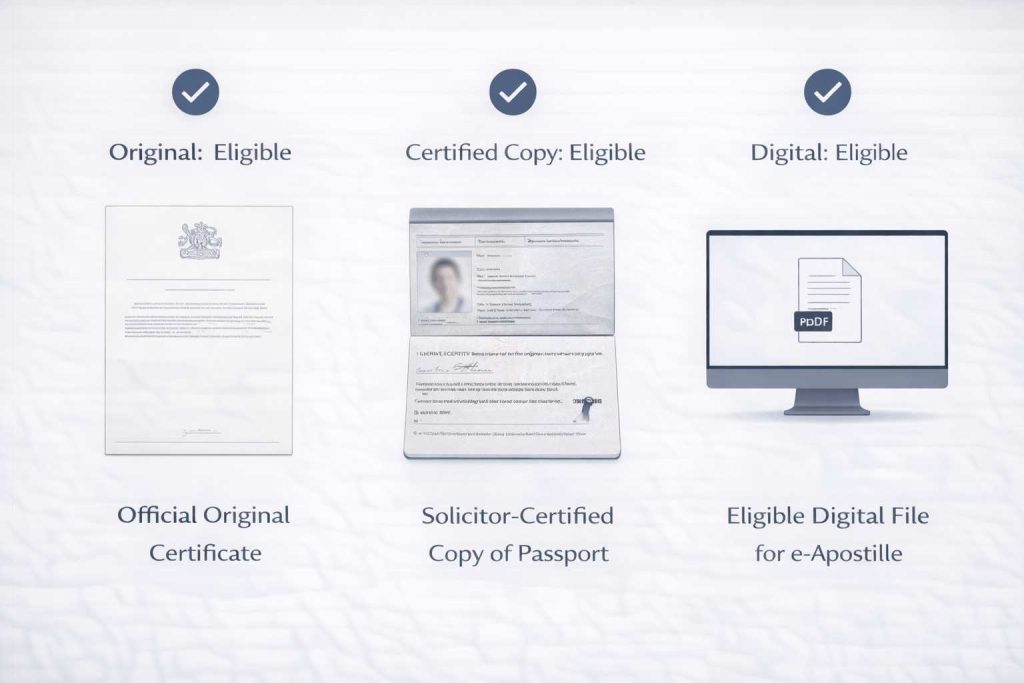
A lot of rework starts here.
Use the original when the authority expects the original
Official registry documents and other public documents often need to be legalised in their official form. If the authority expects the original, translating a scan first does not solve the real problem.
Use a certified copy where the authority accepts one
The FCDO confirms that certain copies, including copies of passports and driving licences, can be legalised once certified by a UK notary or solicitor. That route is often faster and less risky than trying to move the original identity document around unnecessarily.
Use e-Apostille only when the document is eligible and the recipient accepts it
The UK offers e-Apostilles, but not every document qualifies. The official guidance states that GRO birth, death, marriage, civil partnership, adoption certificates, ACRO police certificates, DBS certificates, disclosure certificates, fingerprint certificates, and ACCA membership certificates are not eligible for e-Apostille. If your document is eligible, it must also be digitally signed appropriately, and your receiving authority still needs to accept the electronic format.
The three most common real-world workflows
Workflow 1: UK birth certificate for use abroad
- obtain the correct official certificate
- confirm whether the receiving authority wants paper apostille
- submit the certificate for apostille
- translate the certificate and apostille together if the receiving authority wants the full pack in the target language
- send the completed pack for filing or consular processing
Workflow 2: Passport copy for an overseas application
- make a copy of the passport
- have the copy certified by a UK solicitor or notary
- obtain the apostille on that certified copy
- translate the final certified-and-apostilled copy if the foreign authority requires a translation
Workflow 3: Country-specific process where the translation has its own legal status
- apostille the underlying UK document if required
- prepare the translation according to the destination authority’s format
- have the translation notarised or legalised where required
- complete any consular step specific to that country
Italy is a useful reminder that some jurisdictions separate the legalisation of the original document from the legalisation of the translation. That is exactly why the receiving authority’s instructions should always control the sequence.
Timing tips that stop expensive delays
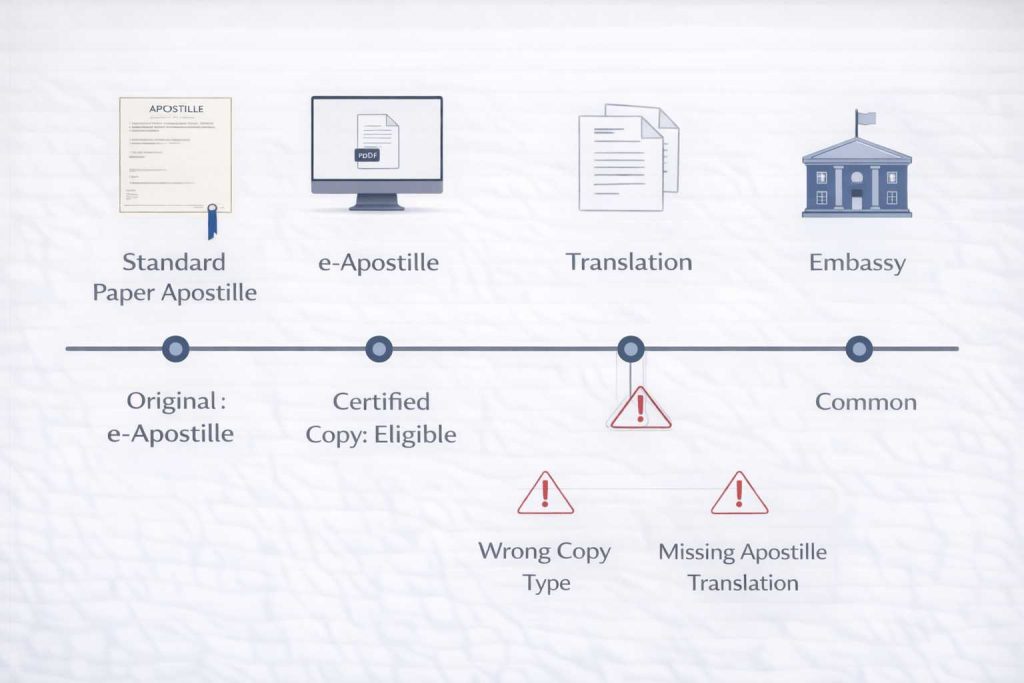
The biggest timing mistake is assuming translation is the first “productive” step. Often it is not. Often the most productive first step is confirming the document format and whether the receiving authority needs the apostille page translated as well.
A better timing plan looks like this:
- confirm destination country and authority before ordering anything
- decide whether you need original, certified copy, or eligible digital document
- decide whether you need paper apostille or e-Apostille
- only brief the translator once the apostilled pack is fixed, unless the translation itself is the item being legalised
- allow extra time for return shipping, embassy handling, or consular legalisation after the apostille
- keep a scan of the fully apostilled set before translation begins so layout, seals, page count, and attachment order are preserved accurately
For official UK legalisation, the current benchmark is up to 15 working days for standard paper apostilles and up to 2 working days for e-Apostilles, with faster options reserved for registered businesses. That timing alone is enough reason not to pay for a translation until you know which final pack you are actually getting back.
The safest question to ask before you order
Before you order either service, ask the receiving authority this:
“Do you want the translated document to reflect only the source document, or the full final pack including apostille, certifications, and any embassy or consular pages?”
That one question resolves most sequencing mistakes immediately.
A practical way to avoid rework with TS24 London
For clients dealing with FCDO legalisation, the smartest move is to send the file, destination country, and receiving authority name before paying for the wrong stage. TS24 can quickly tell you whether the job needs a standard certified translation, a notarised translation, or a legalised translation route so that you do not order a translation that has to be redone later. TS24 states that it provides certified translations in 200+ languages, has 15+ years in business, works with CIOL and ITI-qualified translators, is ATC-accredited, and offers certified translations from £30 + VAT.
That matters because apostille projects are rarely delayed by language work alone. They are delayed by poor sequencing, wrong document format, and unclear destination requirements. Getting the order right at the start is what keeps the whole pack submission-ready.
A good client experience also matters when deadlines are tight. TS24’s published review pages highlight a 4.9/5 Google review rating, “Excellent” review positioning, and multiple customer comments focused on speed, acceptance, and delivery within one day for urgent certified work.
A simple checklist before you start
- destination country confirmed
- receiving authority named
- original or certified copy confirmed
- paper apostille or e-Apostille confirmed
- whether apostille page must be translated confirmed
- whether translation itself must be notarised or legalised confirmed
- final courier or digital submission format confirmed
Once those seven points are clear, the correct order is usually obvious.
Conclusion
Most people search for “apostille and translation order” because they are worried about wasting time and paying twice. That worry is justified. The safest default is still apostille first, translation second. But the deeper rule is even more useful: translate the final submission pack, not the draft pack.
That approach works because it matches how legalisation really functions. The FCDO authenticates signatures, seals, and stamps on UK documents. Foreign authorities decide what they want to see. Your translation should come in at the point where the pack is stable, complete, and ready for submission.
Get the order right once, and everything downstream becomes easier: pricing, timing, certification, courier handling, and acceptance.
FAQs
Should I get an apostille before translating a document?
Usually, yes. For most UK-issued documents going abroad, the safer route is to apostille first and translate second, because the translation should reflect the final legalised version being submitted. The main exception is when the translation itself must be notarised or apostilled as a separate document.
Do I need to translate the apostille page as well?
Often, yes, when the receiving authority expects the full submission pack in the target language. The safest approach is to confirm this directly before ordering the translation. If the apostille will be attached to the final document you submit, leaving it untranslated can trigger rework later.
Can I apostille a scan or PDF?
Sometimes, but only where the document is eligible for e-Apostille and the recipient accepts that format. The UK e-Apostille system applies to eligible digital documents and requires appropriate digital signatures. Some common document types, including many registry certificates, are not eligible.
Do I need the original document or will a certified copy work?
That depends on the receiving authority and the document type. The FCDO states that some official documents can be legalised in original form, while other documents can be legalised once certified by a UK public official such as a solicitor or notary. Copies of passports and driving licences are specifically given as examples.
What happens if the destination country is not covered by the Hague apostille route?
The official UK guidance says there can be a three-step chain: first the FCDO apostille, then the destination country’s embassy in London, then approval by that country’s Ministry of Foreign Affairs. In these cases, translation planning should follow the final submission rules of that destination.
How long does the FCDO apostille process take?
The official guidance currently says standard paper apostilles usually take up to 15 working days plus return time, while e-Apostilles take up to 2 working days, subject to eligibility.

