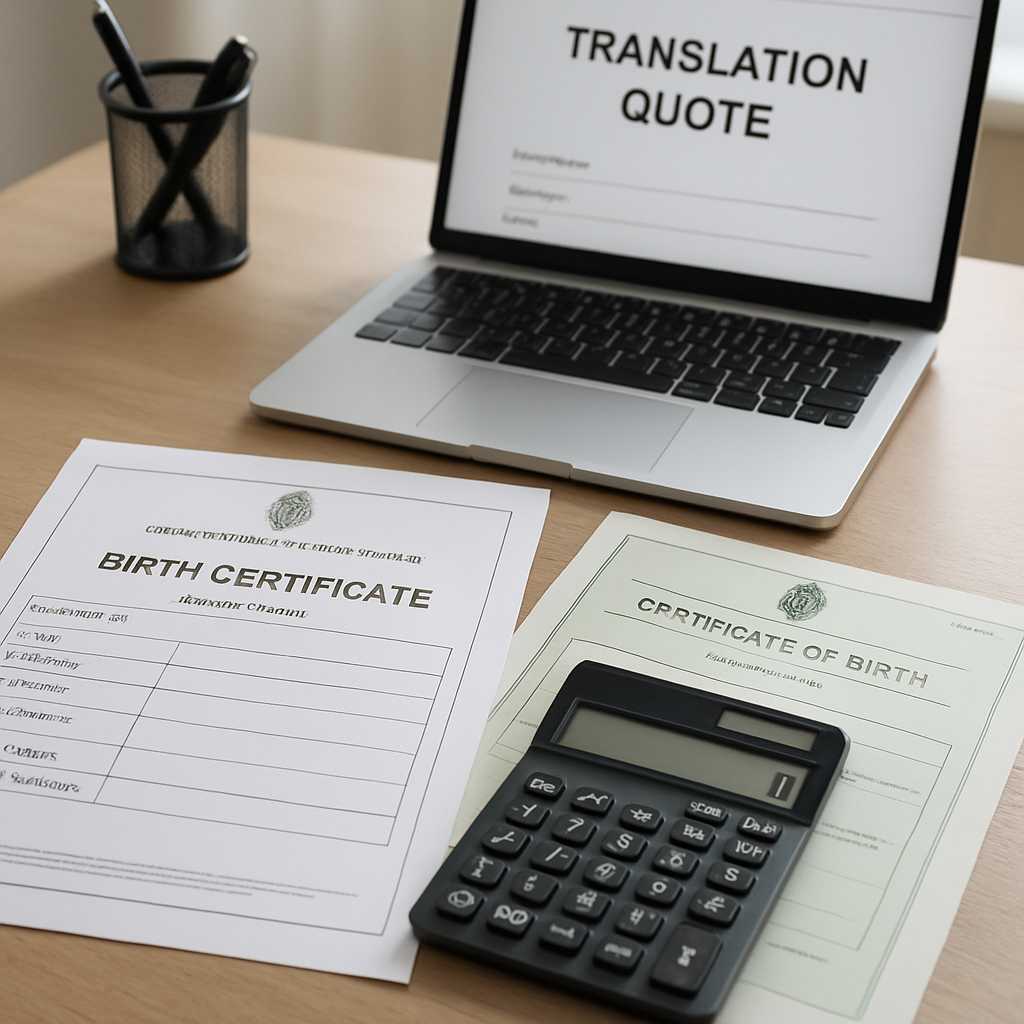
How Pricing Works in London: Per Page vs Per Word (Simple Examples)
If you are trying to budget for a certified translation in London, the biggest source of confusion is simple: some documents are priced per page, while others are priced per word. That is why one customer can pay a flat amount for a birth certificate while another receives a quote based on word count for a contract, bank statement pack, or academic transcript.
The good news is that the logic is straightforward once you know what agencies are looking at. In most cases, fixed-layout personal documents are easier to price per page, while text-heavy or longer files are fairer to price per word. The deadline, language pair, scan quality, and formatting work can then move the quote up or down.
At TS24’s certified translation service, clients usually come to us with one of two questions: “How much will this page cost?” or “Why is this one quoted by word count?” This guide answers both with simple examples, explains where rush and formatting costs come from, and shows how to estimate your likely budget before you even request a quote.
If you want an exact price straight away, you can check TS24’s translation prices, try the instant translation price calculator, or send your file for a fixed quote.
The simple rule: when agencies charge per page and when they charge per word
Per page is usually used for short, standard, fixed-layout documents
Per-page pricing is common when the document looks familiar and predictable, such as:
- birth certificates
- marriage certificates
- passports
- driving licences
- police certificates
- single-page statements
- standard academic certificates
These documents are often short, but they still require careful handling. The translator is not just converting words; they are also preserving names, dates, stamps, numbers, and the overall layout so the finished translation is submission-ready.
That is why a short certificate can still carry a meaningful base cost. You are paying for translation, checking, formatting, certification, and accountability, not just the number of lines on the page.
For example, if you need a birth certificate translation or a marriage certificate translation, a per-page quote is often the clearest and fastest way to price the job.
Per word is usually used for longer or text-heavy documents
Per-word pricing is more common when the document contains substantial running text, such as:
- contracts
- witness statements
- legal bundles
- company documents
- text-heavy bank statements
- academic transcripts with extensive module detail
- reports, policies, manuals, and correspondence
This is fairer because two pages can look similar on screen but contain very different amounts of text. A sparse one-page certificate and a dense two-page contract should not be priced the same way.
For that reason, longer projects are often better priced by word count. It allows the quote to reflect the real translation volume rather than just the number of sheets in the PDF.
If your file is dense, multi-page, or business-related, the instant translation price calculator is a useful starting point before you request a final quote.
What you are actually paying for
A certified translation quote is rarely just “translation only.” In London, the total usually reflects a combination of work layers.
1. Translation itself
This is the core language work: turning the source text into accurate, natural, legally usable English or another required target language.
2. Quality checking
A proper certified translation should be reviewed for:
- names and spellings
- dates and number formats
- consistency of terminology
- completeness
- obvious formatting mismatches
- submission-readiness
3. Certification
For official use in the UK, the translation normally needs certification wording confirming that it is a true and accurate translation of the original, together with the translator’s or agency’s details, signature, and date.
If you are new to this area, read TS24’s quick guide to certified translations in the UK or go straight to certified translation services.
4. Formatting and document presentation
Formatting work is often underestimated. A well-presented translation may need:
- mirrored headings and sections
- preserved tables
- seals, stamps, and handwritten notes marked clearly
- line-by-line document structure
- clean PDF output for submission
5. Deadline management
A standard turnaround is one thing. A same-day or next-day deadline is another. Compressing translation, checking, certification, and delivery into a shorter window usually changes the price because it becomes a priority job.
If time is tight, urgent translation services are often the right route.
Why short documents can still have a minimum price
This is one of the most misunderstood parts of certified translation pricing.
A one-page certificate might contain only a few lines, but the job still requires:
- secure file intake
- translator assignment
- terminology and detail checks
- certification wording
- signature and dating
- formatting and export
- final review before release
That is why very short official documents are often quoted from a minimum per-page rate rather than a tiny micro-price based on word count.
In other words, the minimum is not a penalty. It reflects the fixed production work that exists even when the text volume is small.
Simple examples: per page vs per word in real-world London scenarios
Below is the easiest way to think about it.
| Document type | Common pricing method | Why | Simple example |
|---|---|---|---|
| Birth certificate | Per page | Fixed layout, low word count, certification needed | 1 page from £30 + VAT |
| Marriage certificate | Per page | Standard personal document, layout matters | 2 pages from £60 + VAT |
| Passport or ID | Per page | Short but format-sensitive | Quote based on translated page count |
| Police certificate | Per page | Standard official format | Flat page-based quote is common |
| Bank statement pack | Per page or per word | Depends on density and page count | A short evidence pack may be page-based; a dense set may be quoted by text volume |
| Contract | Per word | Text-heavy, variable length, legal terminology | 1,200 words at £0.09–£0.14 per word = about £108–£168 + VAT before any special rush handling |
| Academic transcript | Often per word, sometimes hybrid | Multi-page but often dense and repetitive | Quote depends on text volume and layout complexity |
A faster way to estimate your likely cost
Before you request a quote, ask yourself three questions.
Is the document a fixed-layout personal document?
If yes, think per page.
Examples:
- certificate
- passport
- driving licence
- police check
A passport translation or drivers licence translation is usually easier to estimate by page count than by total words.
Is the document long, dense, or text-heavy?
If yes, think per word.
Examples:
- contract
- report
- company formation file
- transcript
- business correspondence
The denser the text, the more likely the quote will reflect word count rather than page count.
Is the deadline unusually tight?
If yes, expect a priority uplift.
Even if the document type is standard, a compressed schedule may require re-planning, queue-jumping, or extended working hours. That is where rush surcharges often come in.
What usually makes the price go up
A certified translation quote tends to rise when one or more of the following applies.
Rare or specialist language pairs
Common European language combinations are usually easier to resource than rarer languages or less common directions.
Dense legal or financial text
A straightforward certificate is not priced like a complicated contract or a detailed financial bundle. If your file contains legal clauses, technical terms, or specialist financial language, it may require a more specialist translator and a more detailed review.
For bank statements, tax papers, or supporting evidence packs, financial document translation services may be more appropriate than a basic personal-document workflow.
Poor scan quality
If the original is blurred, cropped, skewed, handwritten, or hard to read, the job can take longer and may involve more formatting or clarification work.
Heavy layout recreation
Tables, stamps, annotations, logos, marginal notes, and unusual formatting can all increase production time.
Same-day or weekend turnaround
Priority work nearly always costs more than standard turnaround because the job becomes operationally harder to deliver safely.
What usually keeps the price down
If you want the best value, these steps help.
- send a clear, complete scan
- include every page in the right order
- mention where the translation will be submitted
- confirm whether you need standard certified, notarised, or apostilled handling
- avoid splitting the same job across multiple emails
- request the quote before the deadline becomes urgent
A cleaner file and a clearer brief usually produce a quicker and more accurate quote.
The difference between rush charges and formatting costs
These are often mixed together, but they are not the same.
Rush surcharge
A rush surcharge reflects speed. It applies when the work needs to be completed faster than the normal schedule.
Typical triggers:
- same-day request
- 12-hour turnaround
- next-morning delivery
- late submission before an authority deadline
Formatting cost
A formatting cost reflects presentation work. It applies when the document is awkward to reproduce cleanly.
Typical triggers:
- low-quality scan
- handwritten notes
- unusual tables
- stamps and seals that need careful marking
- complex transcript or statement layouts
- combined PDF packs with mixed document types
One is about time pressure. The other is about production complexity.
The pricing mistake people make most often
The most common mistake is assuming that “short” means “cheap.”
That is not always true in certified translation. A one-page certificate can be priced higher than expected because it includes certification, checking, and presentation. Meanwhile, a longer but repetitive document may be priced more efficiently on a per-word basis.
The better question is not “How many pages is it?” It is:
- What kind of document is it?
- How much real text is on it?
- Does it need certification?
- How fast do I need it?
- How clean is the source file?
That is how experienced agencies quote accurately.
What a good quote should include
Before placing an order, make sure the quote is clear on the following points.
- whether pricing is per page or per word
- whether certification is included
- whether VAT is included or added
- turnaround time
- delivery format
- whether hard copies are optional
- whether notarisation or apostille is required
- whether formatting work is included
- whether the quote is fixed once the file is reviewed
If you need extra verification beyond a standard certified translation, review notarised translation services before ordering.
A practical London benchmark
For standard certified personal documents in London, many buyers expect a page-based quote. For longer or more specialist files, word-based pricing is often fairer and more accurate.
At TS24, the visible starting point for certified translations is from £30 + VAT, while the calculator for text-based translation uses standard per-word rates in the £0.09–£0.14 range depending on language pair and volume. That gives customers a useful mental model:
- standard personal document: usually think per page
- longer text-heavy file: usually think per word
- urgent deadline: expect a higher quote than standard turnaround
- complex formatting: expect the quote to reflect the production work involved
That is also why two translation jobs with the same page count can come back at very different prices.
When it is worth paying more
Sometimes the cheapest quote is not the lowest-cost decision.
If a document is for immigration, court use, university admission, a regulated employer, or a formal application, a weak translation can lead to delay, rejection, or rework. Paying for accuracy, proper certification, and reliable turnaround is often far cheaper than paying twice after a failed submission.
That is especially true for:
- visa and immigration packs
- court bundles
- academic admissions
- corporate filings
- police certificates
- translated financial evidence
If that sounds like your case, start with certified translation services and request a fixed quote based on the actual file.
Why clients choose TS24 for cost-sensitive certified translations
Pricing matters, but clarity matters more. Clients usually want to know three things:
- Will this be accepted?
- Will it arrive on time?
- Will the final invoice match the quote?
TS24’s current positioning gives strong confidence signals for that decision: certified translations from £30 + VAT, urgent and same-day options, calculator-led pricing for text-heavy jobs, 200+ languages, 15+ years’ experience, 8,000+ qualified translators, and a large review footprint across the site.
That combination is especially useful for customers comparing London providers who all say “competitive prices” but do not explain how the pricing actually works.
If you already have the file ready, the simplest next step is to upload it and get a fixed quote based on the real document, not a guess.
A simple takeaway
If your document is short, standard, and official, think per page.
If it is long, dense, or text-heavy, think per word.
If it is urgent, complex, or badly scanned, expect the price to move.
That is the real answer to certified translation cost in London. Not every document is priced the same way, because not every document creates the same amount of translation, certification, formatting, and deadline pressure.
The quickest way to avoid surprises is to send a clean file, explain where it will be used, and request a quote that clearly states what is included.
FAQs
How much does certified translation cost in London?
Certified translation cost in London usually depends on document type, language pair, and turnaround. Standard personal documents are often priced per page, while longer files are often priced per word. For many customers, the fastest route to accuracy is to request a fixed quote from the actual document.
Is certified translation priced per page or per word?
Both. Per-page pricing is common for fixed-layout documents such as certificates, passports, and police records. Per-word pricing is more common for text-heavy documents such as contracts, reports, transcripts, and business files.
Why can a one-page certified translation still cost more than expected?
Because the price covers more than translation alone. A one-page certified translation still requires checking, formatting, certification wording, signature, dating, and final review.
Do rush jobs cost more for certified translation in London?
Yes, in many cases. Same-day, 12-hour, or next-day deadlines often require priority handling, which can increase the quote compared with a standard turnaround.
Do formatting costs affect certified translation prices?
They can. Low-quality scans, handwritten notes, tables, stamps, seals, and layout recreation all add production work. That can affect the final quote even when the word count is modest.
Do I need notarisation or is certified translation enough?
For many UK uses, a standard certified translation is enough. Some authorities or overseas uses may ask for extra verification such as notarisation or apostille. Always check the destination requirement before ordering.

