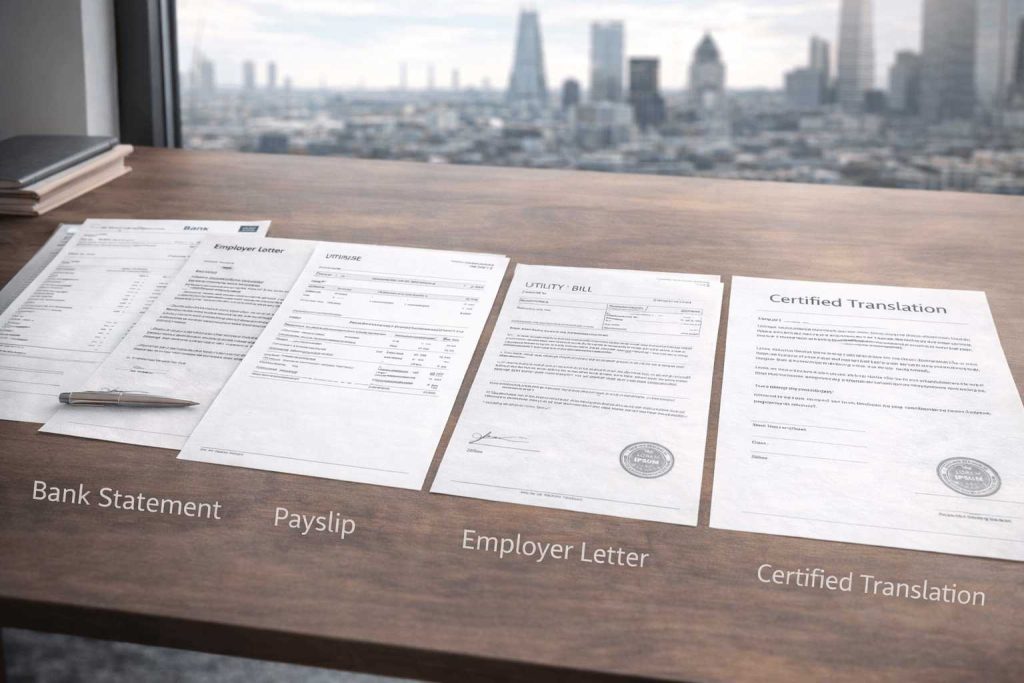
Most applicants remember the obvious documents. The passport. The birth certificate. The marriage certificate. The degree.
What gets forgotten is the evidence that quietly carries the application: proof of address, payslips, bank statements, employer letters, tenancy agreements, sponsor documents, and supporting records that explain how the case fits together.
That is where a proper home office translation checklist becomes useful. In many applications, the headline document opens the file, but the supporting evidence proves the point. If those supporting documents are not in English or Welsh, they can create avoidable delays, extra document requests, or confusion at the point where the application should feel straightforward.
The practical rule is simple:
Translate the documents that prove the claim, not just the documents that look official.
If you are preparing a bundle now, it helps to start with certified translation services in London and then review the full range of official document translation support available for personal, financial, immigration, and legal documents.
Why supporting documents cause more trouble than core certificates
A certificate usually proves a single fact. A supporting document usually proves context.
A birth certificate can confirm identity and family detail. But a bank statement may need to show available funds, regular income, a sponsor relationship, or continuity across several months. A utility bill may help show residence. A payslip may support employment and income. An employer letter may connect job title, salary, leave approval, and ongoing employment.
These documents are often more vulnerable to mistakes because they contain:
- multiple dates
- name variations
- addresses split across pages
- tables, codes, and abbreviations
- stamps, side notes, and reference numbers
- attached pages that only make sense when kept together
That is why supporting evidence often fails not because it is false, but because it is incomplete, cropped, selectively translated, or difficult to compare.
The home office translation checklist most people actually need
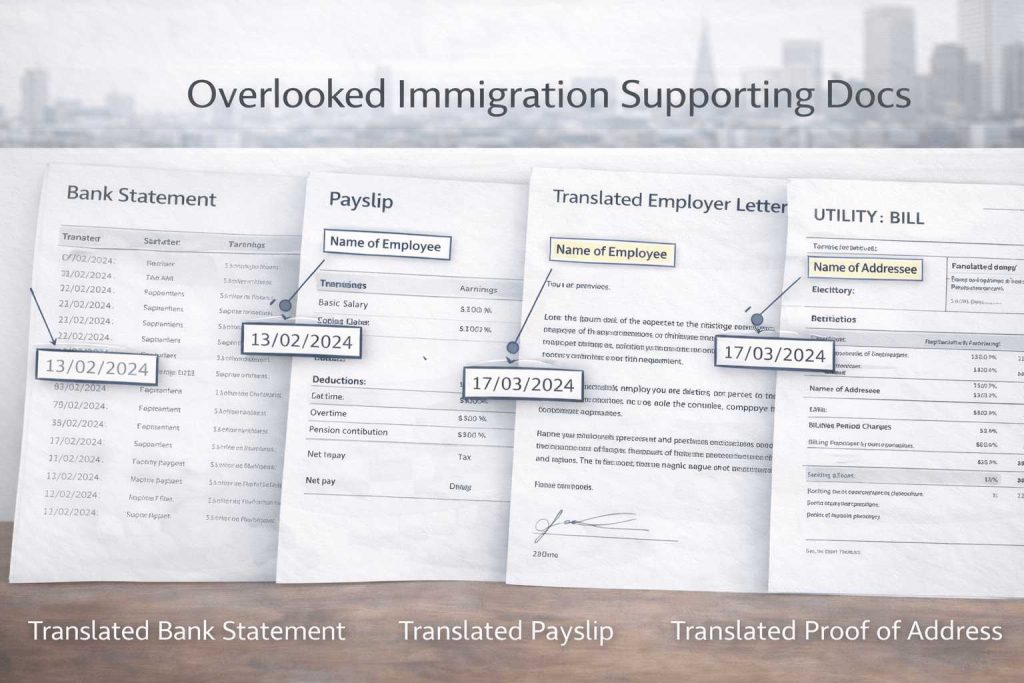
Use this as a practical starting point when reviewing a bundle.
| Document type | What it usually helps prove | What people often miss |
| Proof of address translation | Residence, cohabitation, accommodation history | Service dates, full address line, issuer details, account holder name |
| Bank statement translation | Funds, salary receipts, sponsor support, financial continuity | Statement period, transaction pages, currency, account holder details |
| Payslip translation | Employment income, regular salary, deductions | Pay period, employer name, gross/net pay, YTD figures, codes |
| Employer letter translation | Job role, salary, contract status, approved leave | Letterhead, signature block, contact details, contract wording |
| Tenancy agreement translation | Shared residence, accommodation, address history | Signature pages, start date, full property address, annexes |
| Sponsor letter or affidavit translation | Financial or accommodation support | Identity details, relationship wording, dates, signature |
| Tax or income summary translation | Ongoing earnings, declared income | Tax year, employer identifiers, totals, official reference numbers |
| School or enrolment letter translation | Dependent or study-related context | Dates of attendance, institution details, child or student identifiers |
The key is not to translate everything blindly. The key is to translate everything you are relying on.
If a document helps prove your address, income, relationship, employment, sponsorship, or timeline, it belongs in your review.
Proof of address translation: the document people underestimate most
Proof of address translation sounds simple until you look closely at how these documents are actually used.
A utility bill, council tax notice, tenancy agreement, bank letter, or official residence confirmation may be used to support:
- where you live now
- where you lived during a specific period
- whether two people live together
- who is responsible for the address
- whether accommodation is genuine and ongoing
A weak proof of address translation usually fails in one of four ways:
1. The address is translated, but the date is unclear
An address without a visible billing date, statement period, tenancy start date, or issue date does not show timing clearly.
2. The name is visible on one page, but the address is on another
This is common with multi-page bills and statements. If the identifying information is split, the translation should preserve that structure clearly.
3. Footnotes and side panels are ignored
Some documents place service address, mailing address, customer number, property reference, or occupancy notes in a sidebar, footer, or summary box. Those details matter.
4. The document is translated as a label, not as evidence
“Electricity bill” is not enough. The useful part is who it belongs to, which address it covers, and when.
What a strong proof of address translation should show
- full name of the account holder or tenant
- full address exactly as written
- date issued or billing period
- issuer or provider identity
- account or reference number where relevant
- notes that affect address interpretation
- stamps, signatures, or handwritten marks if present
Example:
A family application includes a tenancy agreement in one language and a utility bill in another. The marriage certificate is translated correctly, but the tenancy signature page is not translated and the utility bill summary omits the service period. The result is a bundle that shows the relationship but weakly shows shared residence.
That is the kind of gap people only notice after submission.
Bank statement translation: where financial evidence gets lost
Bank statement translation is rarely about translating a single balance. It is about preserving the financial story.
A statement may need to show:
- who owns the account
- which bank issued it
- the exact statement period
- regular salary payments
- savings level or available balance
- sponsor transfers
- ongoing activity that supports credibility
- currency and transaction descriptions
The common mistake
People often translate the first page and assume the rest is unnecessary.
Sometimes that works. Often it does not.
If the application depends on salary credits, sponsor transfers, or continuity across a period, the relevant transaction pages matter just as much as the summary page. A translated heading without the translated evidence underneath can leave the reader doing guesswork.
What should remain clear in a bank statement translation
- account holder name
- bank name and branch details where shown
- statement date and full date range
- opening and closing balance
- currency
- incoming salary lines or sponsor transfers
- recurring payment descriptions where relevant
- official notes, stamps, or certification marks
When a bank statement translation becomes especially important
- family and partner applications
- sponsor-supported applications
- visit applications where financial credibility matters
- settlement or nationality files with supporting residence or financial history
- any case where the statement is used alongside payslips or employer letters
A strong bank statement translation should make it easy to compare dates and amounts against other documents in the bundle.
If your salary date on the payslip is the 28th, but the statement shows incoming funds on the 30th, that may still be fine. What matters is that the documents can be read together without confusion.
Payslip translation: the small document with big consequences
Payslips look familiar, but they are packed with shorthand, payroll abbreviations, and employer-specific coding.
That is exactly why payslip translation is often mishandled.
A caseworker may need to understand:
- employee name
- employer name
- pay period
- payment date
- gross pay
- net pay
- tax and deduction lines
- year-to-date totals
- currency
- bonus, leave, unpaid absence, or adjustment notes
What people forget with payslips
- the payroll period is not the same as the payment date
- deductions can affect how income is interpreted
- abbreviations may change meaning across countries
- the employer name on the payslip should align with the employer letter
- the salary entering the bank statement should broadly align with the translated payslip evidence
If a payslip is being used as income evidence, partial translation can create a mismatch. The visible amount may be translated, but the pay period, employer details, or deductions may not be.
That is how a document can be technically translated but still not do its job.
Employer letter translation: the document that ties everything together
An employer letter translation often has more importance than applicants expect.
When drafted and translated properly, it can connect several parts of the file at once:
- who the employer is
- what role the person holds
- whether employment is ongoing
- what the salary is
- whether leave has been approved
- whether the person is expected to return to work
This makes employer letter translation especially valuable in applications where work status supports the overall picture.
A strong employer letter translation should preserve
- company letterhead
- employee name
- job title
- start date
- salary or compensation wording
- contract type where stated
- approved leave wording where relevant
- signature name and role
- company contact details
The most common weakness
The original letter is translated cleanly, but the translated version smooths out wording that actually matters.
For example, there is a difference between:
- permanent employee
- fixed-term employee
- contractor
- probationary employee
- employee on unpaid leave
- employee authorised for annual leave from specific dates
These distinctions should not be flattened into vague wording.
The evidence chain approach: a better way to prepare a Home Office bundle
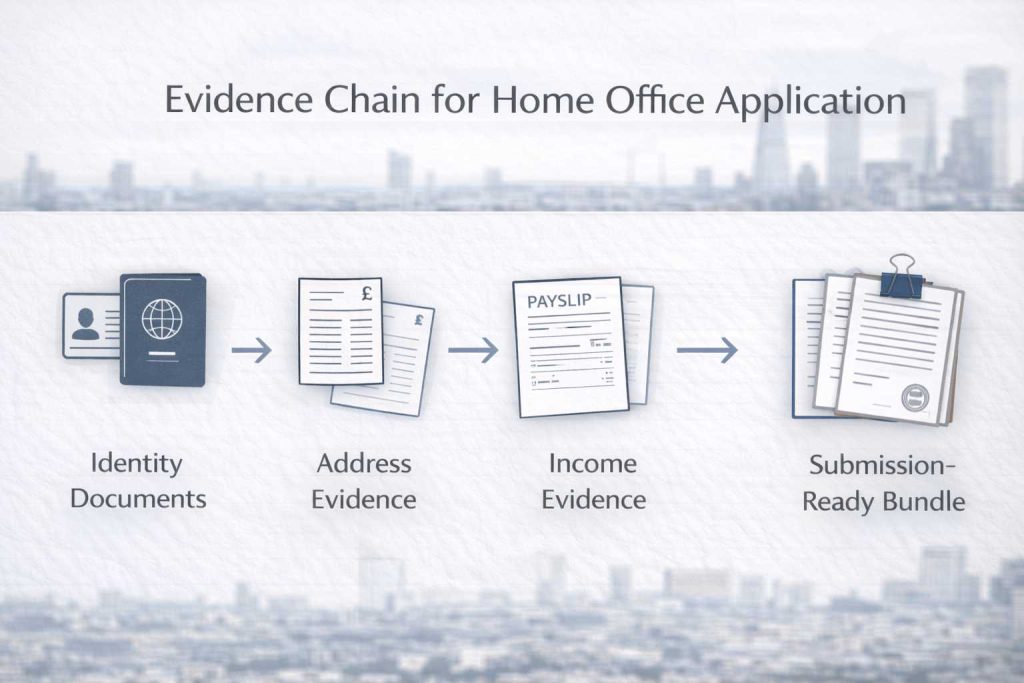
The easiest way to miss supporting documents is to think in document types.
A better way is to think in claims.
For each claim in your application, ask: which documents prove this?
Claim 1: Identity and civil status
Usually covered by core certificates and identity documents.
Claim 2: Address and residence
Often supported by utility bills, council tax letters, tenancy agreements, official correspondence, school letters, or bank letters.
Claim 3: Income and finances
Often supported by payslips, bank statements, tax summaries, sponsor letters, business records, or employer confirmation.
Claim 4: Work and continuity
Often supported by employer letters, contracts, HR letters, and salary evidence.
Claim 5: Relationship or dependency context
Often supported by shared address documents, enrolment letters, support letters, and linked financial evidence.
When you map the file this way, the missing translation becomes easier to spot.
A practical bundle check before you submit anything
Use this short process to reduce the chance of a weak file.
Step 1: Mark every non-English or non-Welsh document
Do not only mark the “important-looking” ones.
Step 2: Group documents by what they prove
Create simple groups such as address, income, employment, sponsorship, relationship, or study.
Step 3: Check whether each group can be read on its own
If a group depends on a document that is still untranslated, the group is incomplete.
Step 4: Compare names, dates, and addresses across the whole file
Look for:
- spelling changes
- reversed surnames
- old and new addresses
- short-form and full-form company names
- different date formats
Step 5: Keep multi-page evidence together
Do not separate summary pages from signature pages, or page one from the transaction pages that actually prove the point.
Step 6: Make sure the translation is prepared for official use
This matters just as much as the language itself.
If you want a second pair of eyes on the full set rather than a single document in isolation, request a certified translation quote and send the bundle together. That is often the safest way to catch small inconsistencies before they become bigger problems.
What the translation itself should include
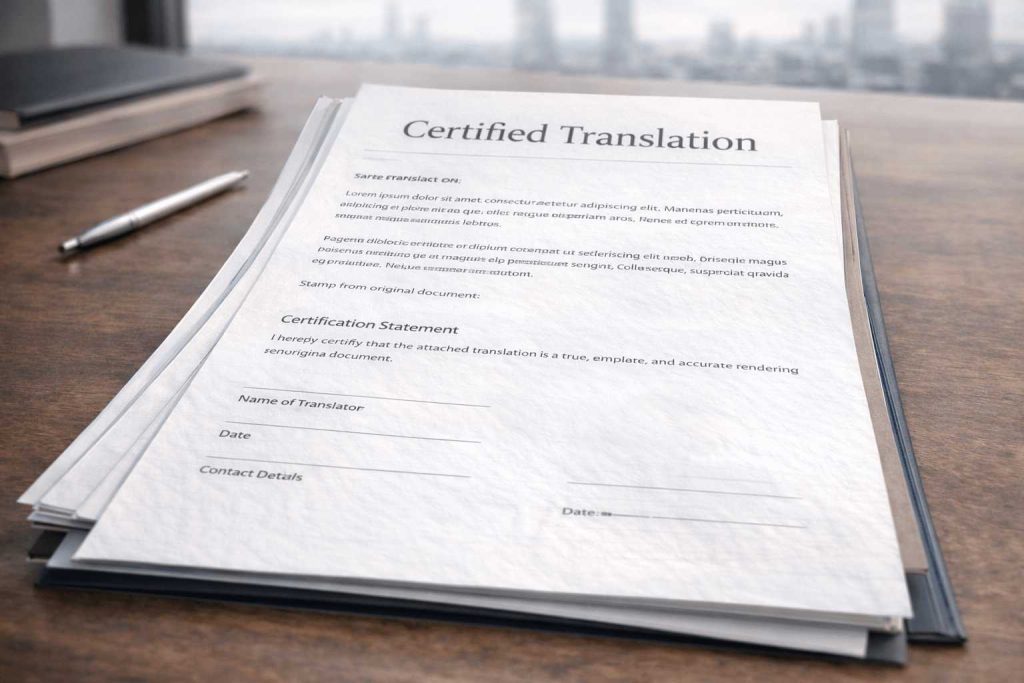
For official use, the translated document should not read like casual correspondence. It should be prepared clearly and formally.
A strong certified translation for Home Office use should make it easy to identify:
- that the translation is accurate
- the date of translation
- the translator’s full name
- signature details where required
- contact details for verification
It should also preserve visible structural elements from the original where relevant, including:
- stamps
- seals
- signatures
- headers
- reference numbers
- handwritten notes
- tables and formatting cues
That does not mean reproducing the design for design’s sake. It means preserving the evidence value of the document.
When not to assume a standard certified translation is the whole answer
Some applicants order a translation and only later discover that another step is needed for a different authority or destination.
If the document will also be used outside the Home Office process, confirm early whether the receiving authority wants:
- a standard certified translation
- notarisation
- sworn translation
- apostille or legalisation
- a hard copy rather than digital delivery
This is especially important where the same document may be reused for immigration, court, university, or overseas administrative purposes.
If you are unsure which format applies, review the scope first, then order the right service. The certified translation services in London page is a useful starting point, especially where official submission format matters as much as the wording itself.
Example bundles people often get wrong
Family or partner-style evidence bundle
People usually translate:
- marriage certificate
- birth certificate
But often forget:
- bank statement translation
- payslip translation
- proof of address translation
- tenancy agreement translation
- sponsor support letter translation
Work and income evidence bundle
People usually translate:
- contract or qualification document
But often forget:
- employer letter translation
- payslip translation
- tax summary translation
- statement pages showing salary receipts
Residence history bundle
People usually translate:
- one official certificate
But often forget:
- utility bills
- council or local authority letters
- school or enrolment letters
- address confirmations with different date ranges
The issue is rarely one missing translation in isolation. It is usually a broken chain.
Why this matters more than people think
Supporting documents are where credibility becomes readable.
A caseworker is not simply checking whether a document exists. They are checking whether the file makes sense as a whole.
That means your bundle should let the reader connect:
- the person
- the address
- the employer
- the income
- the dates
- the relationship between documents
If one part of that chain is unreadable, the rest of the file may suddenly feel weaker than it should.
A clearer way to order supporting document translations
The most efficient approach is usually this:
- List every document in the bundle.
- Mark which ones are not in English or Welsh.
- Circle the documents that prove address, income, employment, sponsorship, or relationship context.
- Keep grouped evidence together.
- Send the bundle for review as one job, not as disconnected items.
That is particularly helpful where the file includes different document types or multiple languages. If you are working with Arabic, Urdu, Spanish, Romanian, Bengali, Turkish, or another language pair, the languages page makes it easier to confirm coverage before you send the bundle.
Need the full set checked, not just one page?
TS24 London supports applicants, legal professionals, and businesses with submission-ready translations for official documents, financial records, immigration evidence, and urgent files across London.
If your bundle includes proof of address documents, bank statements, payslips, employer letters, or other supporting records, send the full file in one go and get a clear response on the next step.
Contact the TS24 London team for a fast quote, clear turnaround, and professional human translation prepared for official submission.
Quick final checklist
Before you submit, make sure you can answer yes to all of these:
- Have I reviewed every non-English or non-Welsh supporting document?
- Have I translated the documents that prove address, income, employment, sponsorship, or relationship context?
- Do the names match across the file?
- Do the dates make sense across the file?
- Are multi-page documents kept together?
- Are bank statement periods and payslip periods readable?
- Does the employer letter connect clearly with the payslips and statements?
- Does the proof of address document show both the name and the address clearly?
- Is the translation prepared for official use with proper certification details?
- Have I checked whether any extra certification is needed for another authority?
When those answers are clear, the whole file becomes stronger.
FAQs
Do bank statements need certified translation for a Home Office application?
If you are relying on bank statements as part of your evidence and they are not in English or Welsh, they should be translated clearly for official use. The important point is not just the balance. The translation should make the statement period, account holder details, and relevant transaction evidence readable.
Do payslips need translation for a UK visa or Home Office file?
Yes, if the payslips are part of the evidence and are not in English or Welsh. A payslip translation should preserve the employer name, employee name, pay period, gross and net pay, deductions, and other details that help the reader understand the income evidence properly.
Can I translate only part of a proof of address document?
Only translating a visible address line is risky if the rest of the document is needed to identify the person, the date, the issuer, or the service period. A proof of address translation should preserve the parts that make the document meaningful as evidence, not just the label at the top.
Does a Home Office translation need a stamp?
The safer focus is not the stamp by itself, but whether the translation is prepared as a proper certified translation for official use. The wording, date, translator details, and overall presentation matter more than a decorative stamp alone.
Do employer letters need certified translation?
If the employer letter is part of the evidence and it is not in English or Welsh, it should be translated for official use. This is especially important when the letter is being used to confirm role, salary, leave, contract status, or ongoing employment.
What is the most forgotten item on a home office translation checklist?
In practice, proof of address documents, bank statements, payslips, employer letters, and sponsor support records are among the most commonly missed items because applicants focus first on certificates and identity documents.

