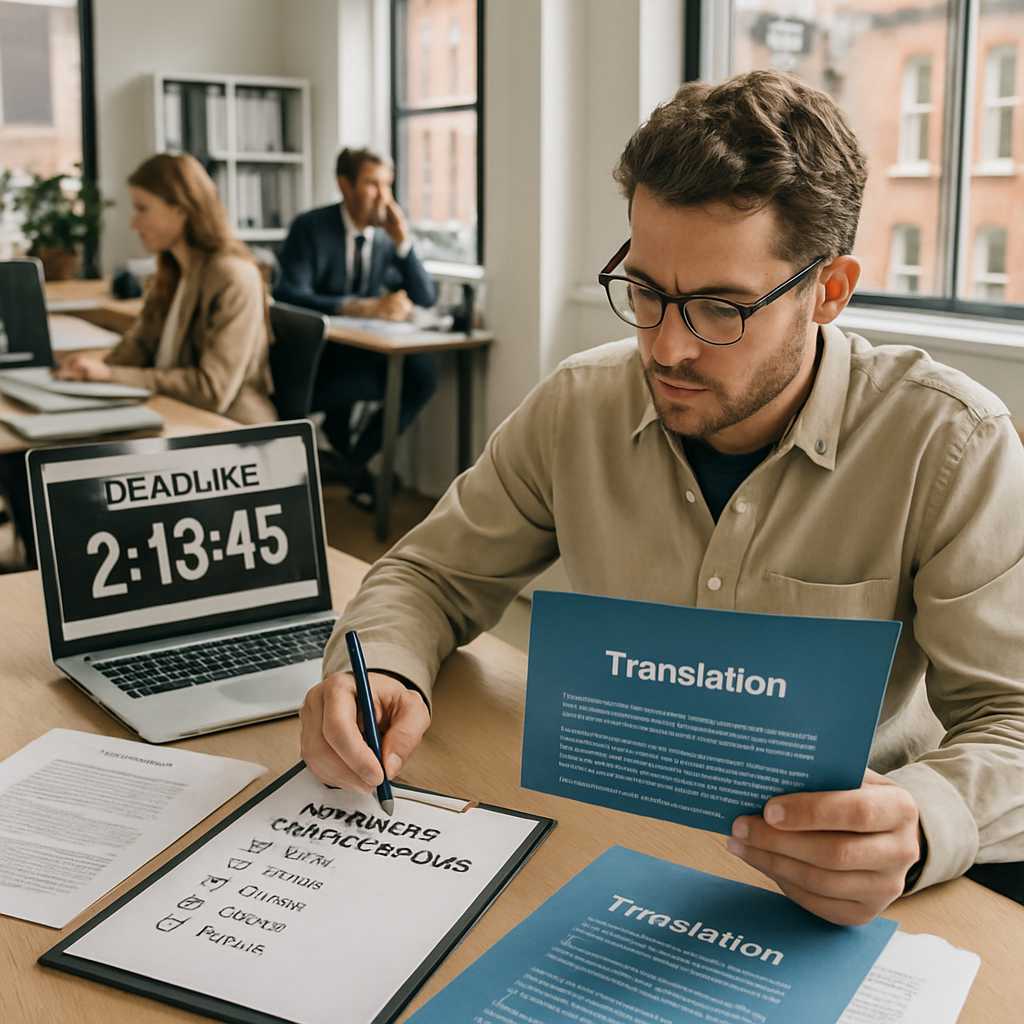
What Slows Down a “Fast” Translation? The Real Bottlenecks
When people ask why urgent translations delay, they often assume the problem is the translator working too slowly. In reality, the translation itself is only one part of the clock. Most urgent jobs lose time before the first line is translated or after the draft is technically finished.
A rush job usually slows down for four reasons: the file is incomplete, the scan is hard to read, the language pair needs a specialist, or revisions create a second round of checking. Add certification, formatting, stamps, handwriting, and last-minute instructions, and a “fast” order can stop feeling fast very quickly.
The good news is that most of these delays are preventable.
If your deadline is tight, the safest move is to send the final file, the target language, and the exact submission time at the start. A clear brief gives the team a realistic turnaround immediately instead of losing time to guesswork. For urgent jobs that need to be accepted the first time, that matters more than chasing the shortest headline turnaround.
If you already have a deadline in front of you, upload the file early and ask for the safest turnaround for that exact document set. That usually gets a better result than asking for “same day” before anyone has seen the pages.
Fast translation is not one task. It is a chain.
An urgent translation usually moves through a chain like this:
- File review
- Quote and deadline confirmation
- Translator allocation
- Translation
- Review and consistency checks
- Certification and formatting
- Delivery in the required format
- Final client check
A delay anywhere in that chain affects the overall turnaround. That is why a one-page passport scan can sometimes move faster than a three-page bundle with poor images, handwritten notes, mismatched names, and unclear instructions. The shorter file is not always the easier file.
The real bottlenecks behind urgent delays
1. Missing pages stop the job before it properly starts
One of the biggest reasons urgent translations delay is incomplete submission. Sometimes only page one is sent at first. Sometimes the final page appears later. Sometimes a supporting page looks unimportant but contains a stamp, note, or reference number that must be translated to keep the document complete.
That creates three problems at once:
- The quote may need to be revised
- The translator may need to restart the file sequence
- Names, dates, totals, and references may need to be rechecked across the whole set
A missing page is not only an extra page. It can trigger a second accuracy pass.
Common examples
- A bank statement arrives without the page that contains the account holder details.
- A certificate is sent without the reverse side that contains an authority stamp.
- A legal document is uploaded without the signature page.
- A transcript is missing the grading legend or final page total.
How to avoid it
Send the complete document set in one upload, in the correct order, before asking for a rush turnaround.
2. Unclear scans slow down reading, checking, and certification
Poor file quality is one of the most underestimated bottlenecks in urgent work. Blurry photos, shadows, cut-off corners, folded paper, glare, warped perspective, and low-resolution screenshots all force extra review. If the translator cannot read a number, stamp, handwritten note, or place name confidently, the team has to stop and verify it.
That is not wasted caution. It is exactly what protects urgent jobs from avoidable errors.
A scan problem does not only affect translation
It also affects:
- Page count confirmation
- Certification confidence
- Formatting accuracy
- Name and date verification
- Whether a stamp or handwritten note should be described
A scan that is “good enough to look at” is not always good enough for a submission-ready translation.
Fast file standard
For urgent jobs, the best file is:
- A flat PDF or straight photo
- Fully visible from edge to edge
- Free from shadow and glare
- High enough quality to zoom in on stamps and handwriting
- In the final version you actually intend to submit
If the image quality is weak, a rush service becomes a clarification service first.
3. Rare language pairs reduce instant availability
A fast deadline depends on the right linguist being available at the right moment. For common pairs, allocation is usually quicker. For rarer language combinations, the bottleneck is often specialist availability, not unwillingness to help. A translator may also need subject knowledge in legal, immigration, academic, or financial documents, which narrows the pool further.
This is especially important when the file is not a simple civil certificate. A rare language pair plus technical content is very different from a rare language pair plus a short standard document.
When rare language pairs create extra delay risk
- The document contains specialist terminology
- The file includes stamps, handwriting, or regional wording
- The job arrives late in the day
- Certification is required for official submission
- The delivery window is measured in hours, not days
Urgency does not remove the need to match the right expert to the job.
4. Revision loops add time even when the translation is already finished
Many clients assume the clock stops once the draft exists. In practice, the final stage often takes longer than expected because revisions are not just “small edits.”
A name change, date correction, spelling preference, or added instruction can affect multiple pages. The team may need to recheck consistency across the document, update the certification section, and regenerate the final PDF.
That is one of the clearest answers to why urgent translations delay: the job changes after production has already started.
Common revision triggers
- Passport spelling is shared after the draft has been prepared
- The receiving authority changes
- A hard copy is suddenly required
- The client wants an older translation matched
- A missing page is added late
- The file turns out to be for court, UKVI, university, or another authority with stricter presentation needs
The faster the deadline, the more expensive each revision loop becomes in time.
5. Certification and formatting are part of the turnaround, not extras outside it
A fast draft is not the same as a file that is ready to submit. Urgent official translations often need more than the translated text. They may need a certification statement, date, signature block, contact details, and formatting that makes the final file easy to compare with the original.
That matters especially for documents such as:
- Birth and marriage certificates
- Passports and IDs
- Bank statements
- Academic transcripts
- Court papers
- Immigration supporting documents
Where formatting adds time
Formatting pressure increases when the file contains:
- Tables
- Stamps and seals
- Annotations in the margin
- Signatures and initials
- Mixed printed and handwritten text
- Multiple short entries that must stay aligned
A document can be short but still formatting-heavy.
6. The quote is only reliable once the requirements are clear
A surprising amount of urgent time is lost before work is even approved. If the first message says only “Need this ASAP,” the team still has to ask:
- What language is it going into?
- When is the exact deadline?
- Is digital delivery enough?
- Is certification required?
- Who is the translation for?
- Is this the final file?
- Are all pages included?
That back-and-forth can consume the very hours the client is trying to save.
The fastest first message
For urgent work, send this at the start:
- Full document file
- Source and target language
- Exact deadline and time zone
- Who the translation is for
- Whether certification is required
- Whether digital or hard copy delivery is needed
- Preferred spelling of names if relevant
A clear brief speeds up quoting, allocation, and delivery.
7. Late-day uploads shrink the true working window
A same-day service is not an all-day promise for every file type. An urgent request sent early in the day usually has more real options. A request sent late afternoon may still be possible, but the practical window for review, certification, and delivery is smaller. That matters even more for multi-page files, rare language pairs, and anything that needs careful formatting.
The issue is not only how many hours remain on the clock. It is how many useful production hours remain once the file is confirmed as final.
8. Multi-document packs create cross-checking work
Urgent clients often send document sets, not single documents. A visa pack, court bundle, university application, or compliance file may contain names, dates, addresses, reference numbers, totals, and issue dates repeated across several pages. Those repetitions need to stay consistent.
Why packs slow down even when each page looks simple
- Names must match across documents
- Dates must stay in the right order and format
- Reference numbers must be carried over consistently
- Repeated institutions and authorities must be rendered the same way
- Totals and balances must not conflict from page to page
Urgent packs are manageable. They just need a slightly more realistic window than a single standard document.
A quick table: what delays urgent translations most?
| Bottleneck | Why it causes delay | What fixes it fastest |
|---|---|---|
| Missing pages | Re-quoting, rechecking, sequence issues | Send the full file in one go |
| Unclear scans | Harder reading, verification, and formatting | Upload a flat, sharp PDF or photo |
| Rare language pairs | Fewer instantly available specialists | Send early and confirm the language pair upfront |
| Revision loops | Changes trigger extra consistency checks | Finalise names, dates, and requirements before work starts |
| Formatting complexity | Tables, seals, and handwriting take longer to present clearly | Flag complex pages from the start |
| Certification needs | Final presentation takes time beyond raw translation | Confirm authority and certification requirement early |
| Multi-document packs | Cross-checking across pages adds review time | Upload the full pack in final order |
| Late-day submission | Fewer real production hours remain | Send the file as early as possible |
The Rush-Readiness Score
A useful way to judge whether a file is truly suitable for same-day handling is to score it before you send it. Give yourself one point for each “yes.”
- All pages are included.
- The scan is clear edge to edge.
- The document is final.
- The deadline is exact, not vague.
- The target language is confirmed.
- Certification requirements are known.
- Name spellings are confirmed from passport or ID.
- No handwritten notes or unclear stamps need explaining.
- The file is short or structurally simple.
- No follow-up pages are likely.
How to read the score
- 8 to 10: Strong rush candidate
- 5 to 7: Possible, but expect more caution around timing
- 0 to 4: High risk of delay unless the file is cleaned up first
This does not replace a professional review, but it helps explain why some urgent files move smoothly and others stall.
What people often misunderstand about “fast” service
“It’s only two pages”
Two pages can still be slow if they contain tables, stamps, handwriting, seals, and certification requirements.
“I’ll send the rest later”
That usually creates a second review loop and can break the original timing estimate.
“The photo is readable on my phone”
That does not mean every number, mark, and edge is clear enough for translation and certification.
“It only needs a few corrections”
Even small corrections can trigger a full consistency check on names, dates, layout, and the final certificate.
“Same-day means anything can be done safely in hours”
Speed depends on file quality, completeness, complexity, and specialist availability.
Typical urgent scenarios
Scenario 1: The clean one-page document
A passport or birth certificate, uploaded early, clearly scanned, with no missing corners and confirmed spelling. This is usually the strongest same-day candidate.
Scenario 2: The three-page bank statement with shadows
The file is short, but the photos are angled and one page is darker than the others. This often takes longer than expected because entries, balances, names, and issue details need checking more carefully.
Scenario 3: The visa pack sent in parts
A certificate is sent first, then a statement, then an extra supporting page 40 minutes later. This slows the workflow because the scope keeps changing.
Scenario 4: The rare language plus handwritten notes
The document is not long, but it needs a specialist and includes difficult marginal notes. This is where availability and verification become the bottleneck.
How to reduce urgent delays before they start
If you want the fastest safe turnaround, do these things first:
- Merge the full document set into one clean file if possible.
- Re-scan any page with glare, blur, shadow, or cut-off edges.
- Confirm the exact deadline and time zone.
- Confirm the target language and who the translation is for.
- Share passport spelling for names where relevant.
- Mention whether certification is required.
- Flag anything unusual such as handwriting, stamps, tables, or reverse pages.
- Send the final version only, not a provisional version.
Those eight steps often save more time than asking for a faster label.
Why a 12-hour or 24-hour option can be faster in practice
Many clients focus on the shortest headline turnaround. But in real submission terms, the best option is often the smallest rush window that still protects quality. A 12-hour or 24-hour service can be the better choice when:
- The file is multi-page
- The formatting matters
- The language pair is less common
- There are repeated names and numbers to check
- The receiving authority is strict
- A rejection would cost more than a few saved hours
The strongest urgent decision is not always the most aggressive one. It is the one least likely to create rework. If you are unsure whether your file is a genuine same-day candidate, start with a clear quote request and ask for the safest turnaround rather than the shortest possible one.
What to send for the quickest accurate quote
Copy, paste, and send this with your file:
Please quote for a certified translation from [source language] into [target language]. Deadline: [exact date and time, with time zone]. The translation is for [UKVI / court / university / solicitor / employer / other]. Digital copy [is / is not] enough. All pages are attached. Preferred spelling of names follows the passport/ID attached.
That message removes most of the friction that causes urgent delay.
Why clients under time pressure choose TS24 London
When the deadline is real, clients do not only need speed. They need clarity. TS24 London helps urgent orders move more smoothly by focusing on the issues that usually create friction:
- Clear upfront turnaround guidance
- Professional human translation prepared for official use
- Certification for documents that need formal submission support
- Careful handling of names, dates, numbers, stamps, and visible document features
- Straightforward communication when a file is suitable for same-day handling and when it is not
If your document is ready, send it early and get a clear answer before the bottlenecks build up.
Final takeaway
If you have been wondering why urgent translations delay, the answer is usually not “because urgent work is impossible.” It is because urgent work exposes every weakness in the file and every gap in the brief. Missing pages, unclear scans, rare language pairs, revision loops, certification needs, formatting demands, and late-day uploads all slow the chain down.
The fastest urgent translation is not the one with the boldest label. It is the one that starts with a clean file, clear instructions, and a realistic turnaround for the actual document in front of the team. If your deadline is close, upload the complete file now and get a clear turnaround based on the real bottlenecks before they become delays.
Frequently Asked Questions
Why urgent translations delay even when the document is short?
Because length is only one factor. A short file can still contain poor scans, stamps, handwriting, missing pages, or certification requirements that add review and formatting time.
Do unclear scans really slow urgent translation that much?
Yes. Unclear scans can delay reading, checking, formatting, and certification. If numbers, names, or stamps are difficult to read, the team must verify them before the file is safe to deliver.
Do rare language pairs always delay urgent translations?
Not always, but they often reduce instant availability. The tighter the deadline and the more specialised the content, the more likely allocation becomes the bottleneck.
Can revisions delay a same-day certified translation?
Yes. Even small revisions can affect multiple pages, certification wording, and final formatting. The later the change arrives, the more impact it usually has on delivery time.
What is the best way to avoid urgent translation delays?
Send the full final file, confirm the target language, give the exact deadline, share preferred spelling of names, and mention certification needs from the start.
Is same-day always the best option for urgent documents?
No. For many official submissions, a 12-hour or 24-hour turnaround is the stronger choice because it leaves more room for review, formatting, and certification without unnecessary rework.

