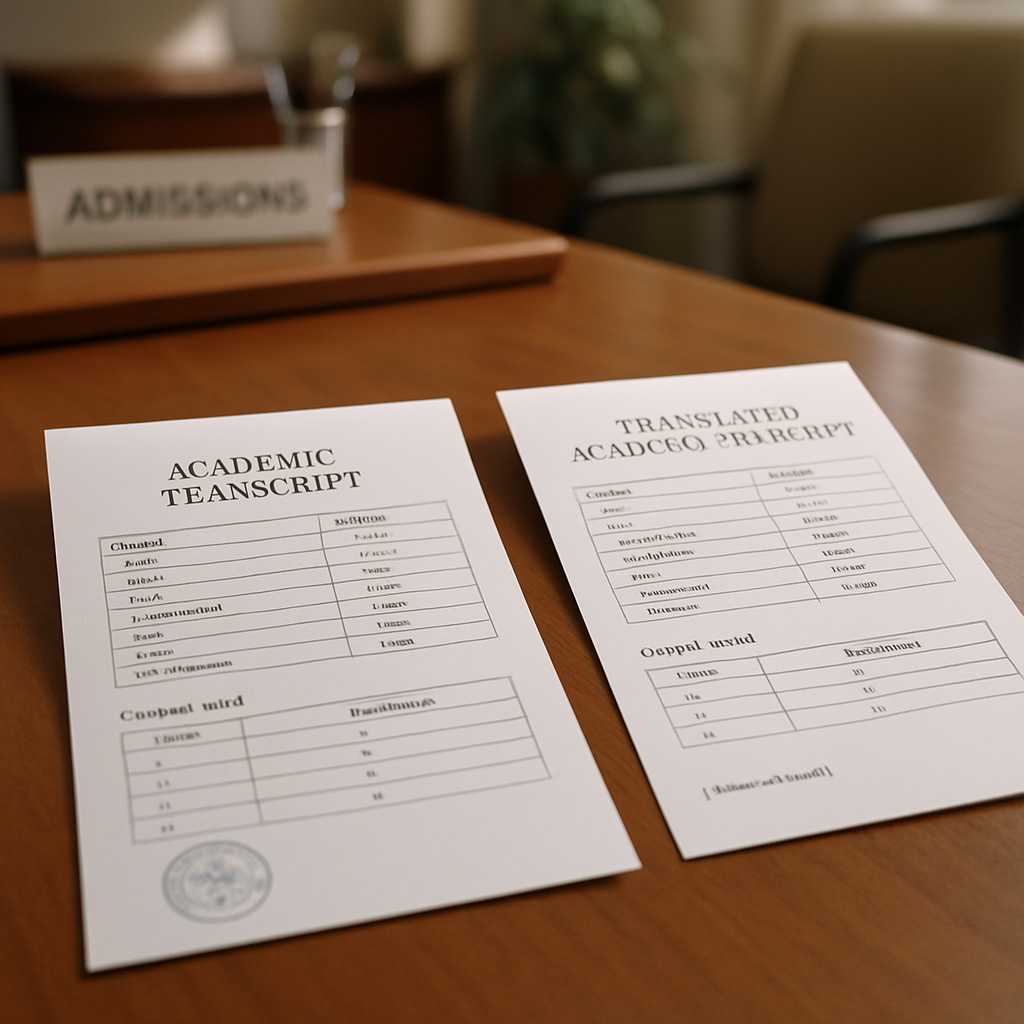
What a translator note is on an academic document
A translator note is a short, clearly marked clarification inserted into the translation to identify something visible in the original or to prevent a misleading reading in the target language.
In academic translation, the most useful notes are usually brief and factual, such as:
- [University seal]
- [Handwritten note]
- [Illegible signature]
- [Grading legend appears on reverse side]
- [Abbreviation in original]
The note should never blur the line between translation and evaluation. Translation carries the original text across languages. Evaluation explains what a qualification, grade, or academic level means in another system. WES draws that distinction directly: translation and credential evaluation are not the same task. (WENR)
The three-part test before adding any note
Before adding a note to academic documents, apply three checks.
1. Is the note necessary?
Add a note only if the reader would likely misunderstand the document without it.
2. Is the note neutral?
The wording must stay factual, not persuasive. It should describe, not interpret.
3. Is the note traceable?
The note must relate to something actually visible or documentable in the source file, not to assumptions or outside knowledge. If a proposed note fails any one of those tests, it usually should not be there.
When translator notes help academic documents
Unfamiliar grading scales
One of the most common reasons to add a note is to identify a grading scale or grading legend that may not be obvious to the receiving reader. That can help when the document uses a 20-point scale, a 5-point scale, a percentage system, descriptive grades, or institution-specific labels.
Useful note:
- [Grading legend on reverse side]
- [Passing grade shown in source grading key]
Not useful:
- [This 16/20 is equivalent to a UK first]
- [This GPA should be considered excellent in Britain]
That second type crosses into evaluation, not translation. A translator can identify the grading system shown on the source. A translator should not convert academic performance into a different country’s classification unless the receiving authority explicitly requires a separate evaluation service. Official university guidance often asks applicants to include grading legends or back pages precisely because reviewers want the original grading framework, not a translator’s reinterpretation of it. (Graduate Admissions)
Abbreviations, codes, and compressed labels
Academic records often contain tightly packed abbreviations:
- course codes
- module types
- pass/fail labels
- retake indicators
- attendance markers
- internal institutional shorthand
Sometimes the best choice is to translate the abbreviation directly if a clear equivalent exists. Sometimes a brief note is safer.
Examples:
- [Abbreviation in original]
- [Course code retained from source]
- [Retake notation in original]
This is especially helpful when a literal expansion would create false certainty. A short note protects accuracy better than an overconfident rewrite.
Seals, stamps, embossed marks, and signatures
Academic certificates often carry official marks that matter to admissions teams and credential evaluators. These should be identified clearly, not recreated as if they were part of the translated text. Current UK certified-translation guidance recommends marking such elements distinctly, commonly in square brackets, rather than reproducing logos, seals, or signatures as graphics.
Useful examples:
- [Embossed seal]
- [Round stamp: Registrar’s Office]
- [Signature]
- [Illegible signature]
A stamp with readable text may need to be translated. A stamp with unreadable text may need to be marked as partially illegible. What matters is that the note stays descriptive.
Handwritten annotations
Handwritten notes can be important on mark sheets, degree certificates, transcript amendments, and registrar letters. If the handwriting is legible and relevant, translate it and label it as handwritten. If it is not clear, say so.
Examples:
- [Handwritten: duplicate issued]
- [Handwritten note appears to read “retake”]
- [Handwritten text illegible]
This protects both the reader and the translator. It signals that the source contains extra information without pretending certainty where the scan does not support it.
Name variants already present in the source file
Academic packs often include small but important name differences across documents: initials on one page, full middle name elsewhere, maiden name on one certificate, transliteration variation on another.
A carefully worded note can help when the difference is visible in the submitted documents and needs to be flagged neutrally.
Example:
- [Name appears with alternate transliteration on accompanying record]
That is very different from adding a note that tries to solve the discrepancy by explanation alone. If the mismatch is material, supporting evidence should travel with the application.
When translator notes should not be added
Do not convert grades
A translator should not turn 82/100 into an A, 14/20 into a 2:1, or a local classification into a foreign academic equivalency. That is evaluation work, not translation. (WENR)
Do not explain academic prestige
Avoid notes like:
- [Top-ranked institution]
- [Equivalent to an Ivy League school]
- [Highly selective national university]
Even if someone believes that statement is true, it does not belong in the translation.
Do not interpret course difficulty or curriculum depth
A translator should not add:
- [Advanced-level mathematics]
- [Honours-level module]
- [More rigorous than standard course]
If the source document says so, translate it. If it does not, leave it out.
Do not repair source errors silently
If the original has a spelling mistake, odd date format, or inconsistent label, the translation should reflect that reality rather than quietly correcting it. A short note may be appropriate if the error could mislead the reader, but the translator should never rewrite the record without transparency.
Do not replace missing pages with notes
A note is not a substitute for the source document. If the grading key is on the reverse side, submit the reverse side. If the transcript continues on a second page, provide the second page. Several universities explicitly ask for the grading scale, legend, or back page because it forms part of the academic record. (africa.engineering.cmu.edu)
How this works on different academic documents
Academic transcripts
Transcripts usually justify the most careful use of notes because they combine tables, credit values, course titles, grades, legends, and administrative remarks.
Add notes for:
- grading legends
- course-code markers
- stamps and signatures
- handwritten amendments
- unreadable marks
Do not add notes for:
- foreign grade conversions
- “improved” course descriptions
- judgments about academic standing beyond the source wording
Degree certificates and diplomas
These usually need fewer notes. The most common note-related issues are seals, signatures, mottos, Latin phrasing, and distinctions.
Add notes for:
- embossed seal
- unreadable signature
- Latin or ceremonial phrase if a literal rendering alone would confuse layout or function
Do not add notes for:
- prestige explanations
- inferred degree level beyond what the certificate states
Mark sheets and semester records
Mark sheets often contain dense abbreviations and internal status labels. These are ideal candidates for restrained, factual notes if the meaning would otherwise be unclear.
Registrar letters and academic attestations
These documents often need almost no notes at all, because the text is usually continuous and self-explanatory. Use notes only where a stamp, handwritten notation, or unclear institutional abbreviation genuinely affects understanding.
Good translator notes vs bad translator notes
Good note:
- [Round stamp: Faculty of Medicine]
Why it works:
- It identifies a visible feature.
- It does not speculate.
Good note:
- [Grading legend on reverse side]
Why it works:
- It alerts the reviewer to the full record.
Good note:
- [Handwritten annotation appears to read “duplicate”]
Why it works:
- It signals uncertainty honestly.
Bad note:
- [This university is equivalent to a Russell Group university]
Why it fails:
- It is interpretive and promotional.
Bad note:
- [Grade average likely meets admission threshold]
Why it fails:
- It predicts an admissions outcome.
Bad note:
- [This result equals a UK 2:1]
Why it fails:
- It converts rather than translates.
The safest way to format translator notes
On academic documents, notes work best when they are:
- short
- visibly separate from translated text
- placed right where the issue appears
- written in plain language
- enclosed consistently, usually in square brackets
UK certified-translation guidance also stresses that translations should be readable, clearly marked as translations, and faithful to the original, with certification details confirming accuracy, date, and translator contact information.
A practical pattern looks like this:
Course Title: Applied Thermodynamics
Grade: 16/20
[Grading legend on reverse side]
[Registrar’s stamp]
[Signature]
That gives the reviewer clarity without clutter.
What causes problems in academic translation submissions
Most problems do not come from the note itself. They come from incomplete packs, rushed scans, or over-explained translations.
The most common avoidable issues are:
- Missing reverse pages or grading legends
- Notes that interpret instead of identify
- Reflowed tables that separate courses from grades
- Inconsistent spelling of names across documents
- Assumptions about illegible marks
- Sending only the translated file without the source copy
If your deadline is close, do not just send the front page of the transcript and hope the rest can be explained later. Upload the full set at the start: transcript, reverse side, degree certificate, and any accompanying academic notes.
A practical rule for grades, abbreviations, seals, and clarity
When in doubt, use this simple rule:
- Grades: identify the grading system; do not convert the result
- Abbreviations: clarify only when needed; do not guess
- Seals: describe what is visible; do not recreate graphics
- Clarity: help the reader understand the source; do not rewrite the record
That one rule solves most note-related decisions.
What receiving institutions usually care about most
Admissions teams and evaluators generally care less about elegant commentary and more about whether the translation is complete, reviewable, and trustworthy. They want to see:
- the original language document
- the full translation
- the grading legend if one exists
- consistent names and dates
- visible handling of seals, signatures, and handwritten content
- certification that confirms the translation is accurate
They do not want a translator to act as an academic assessor.
Need a note, or just a better translation pack?
Sometimes the real solution is not an extra note. It is a better-prepared submission.
If your academic documents contain tables, legends, seals, abbreviations, or handwritten remarks, order the whole pack together rather than one page at a time. That makes it easier to keep terminology, formatting, and certification consistent across the file.
If you are working to an admissions or visa deadline, send every page now, including the reverse side, and ask for the exact format your university or authority wants. If a hard copy, digital PDF, or additional certification may be required, confirm it before the job starts, because acceptance rules still vary by institution.
Final word
Translator notes on academic documents should be rare, useful, and disciplined. Add them when they prevent misunderstanding. Do not add them when they try to persuade, convert, or decorate the academic record.
The best academic translation is not the one with the most notes. It is the one that lets a reviewer see the original document clearly through the target language, with just enough guidance to avoid confusion and not a word more.
For transcripts, diplomas, mark sheets, and academic letters that need to be accepted without back-and-forth, the strongest approach is always the same: complete file, accurate layout, neutral notes, and certification done properly.
FAQs
Can translator notes be added to academic documents?
Yes, but only when they help identify or clarify something visible in the original document, such as a grading legend, seal, handwritten note, or abbreviation. They should stay factual and brief.
Can a translator explain a grading scale on academic documents?
A translator can identify the grading system or legend shown in the source, but should not convert grades into a UK or US equivalent unless a separate evaluation service is required.
Should translator notes be used for seals and stamps on academic certificates?
Yes. Seals, stamps, embossed marks, and signatures are common places for translator notes because they often matter to the receiving institution but should not be recreated as images in the translation.
Do I need to translate the back page of a transcript?
If the back page contains the grading scale, legend, institutional notes, or explanatory text, it should be included and translated. A note is not a substitute for the actual page.
Are translator notes acceptable on diplomas and degree certificates?
They can be, but far less often than on transcripts. Notes are usually limited to seals, signatures, Latin phrases, or other features that need neutral identification.
Will universities accept digital certified translations?
Some do, some still want a physically signed or otherwise specified version. Check the receiving institution’s current rules before ordering, especially for final enrollment or official verification stages.

