A revision actually is
A revision is a targeted correction to an existing translation. It is not always a full rewrite.
In practice, a revision request usually falls into one of these categories:
- a clear accuracy issue
- a spelling or name mismatch
- a number, date, or reference error
- a terminology preference
- a formatting or layout issue
- a consistency issue across repeated terms
- a new instruction that was not included in the original brief
That last point matters. If the source document has changed, the brief has changed, or the preferred terminology has changed after delivery, the task may no longer be a simple revision. It may be an update, retranslation, or expanded review. That is why the best change requests separate true errors from new preferences.
Why vague revision requests waste time
The slowest revision requests usually have one thing in common: they force the linguist or project manager to investigate before they can fix anything.
Common examples include:
- “Please review page 3.”
- “Some names look wrong.”
- “The wording does not sound right.”
- “Can you make this more formal?”
- “There are a few issues throughout.”
None of those comments tells the reviewer where to look, what standard to apply, or what outcome you want. A faster alternative is specific and anchored:
- “Page 3, second paragraph, line beginning ‘Mr’. Surname must match passport spelling: ‘Alhassan’, not ‘Al Hassan’.”
- “Certificate number on page 1 should mirror the source exactly, including slashes.”
- “Use ‘share capital’ consistently throughout instead of alternating with ‘capital stock’.”
- “Please prioritise names and dates first. Submission is at 10:00 am tomorrow.”
One unclear comment can create three extra steps: identification, clarification, and confirmation. One clear comment can go straight to correction.
The fastest method: use the CLEAR revision brief
A simple way to speed up the translation revisions process is to structure every request around five points:
Context
Say what the document is for. Examples include:
- visa application
- court bundle
- HR onboarding pack
- university submission
- bank compliance review
- internal company use
This helps the reviewer judge tone, formality, and risk.
Location
Identify exactly where the issue appears. Use:
- page number
- paragraph number
- line reference
- clause number
- heading
- highlighted screenshot
- tracked change in the file
The more precise your location reference, the faster the correction.
Exact issue
State what is wrong. Examples include:
- name does not match passport
- date format is inconsistent
- one sentence was omitted
- term does not match approved glossary
- number copied incorrectly
- translation sounds too informal for legal use
This keeps the reviewer focused on the real problem instead of guessing.
Approved correction
If you know the preferred fix, state it clearly. Examples include:
- “Use ‘Abdulrahman’ to match the passport.”
- “Replace ‘licence number’ with ‘registration number’.”
- “Use DD/MM/YYYY throughout.”
- “Keep the company name in English.”
If you do not know the correction, say what needs checking rather than guessing.
Required timing
Always include the deadline and the reason for it. Examples include:
- “Please return by 4 pm today for submission.”
- “Names and dates are urgent; terminology can follow.”
- “If the certified copy changes, we will need the final stamped version tonight.”
Fast revision work depends on deadline coordination just as much as language accuracy.
What to flag first when time is tight
When a deadline is close, do not send a loose list of comments in random order. Prioritise the issues that affect acceptance, identity, and meaning.
1. Names
Name checks should come first on official documents. Review:
- first names and surnames
- spacing and hyphenation
- middle names
- initials
- passport spellings
- company names
- university names
- place names
For official paperwork, the safest approach is to match the supporting document exactly. If the source document contains a spelling inconsistency, the translator cannot simply invent a correction. That usually needs either a note, supporting evidence, or an updated source file.
2. Dates, numbers, and IDs
These are easy to miss and high-risk when wrong. Check:
- birth dates
- issue and expiry dates
- certificate numbers
- passport numbers
- case numbers
- account numbers
- percentages
- amounts and currencies
- decimal formatting
If there is a preferred date format for the receiving authority, mention it clearly.
3. Terminology
This matters most in legal, financial, HR, medical, and technical documents. Instead of writing “please use better wording,” identify the exact term and the preferred replacement. Good example:
“Use ‘employment contract’ throughout, not ‘labour agreement’, to match our existing pack.”
4. Omissions and inconsistencies
Flag anything that appears missing, duplicated, or inconsistent across pages. Examples include:
- a stamp translated on page 1 but not page 4
- a job title rendered two different ways
- a repeated heading translated inconsistently
- a note or handwritten annotation left out
5. Formatting and certification elements
For certified or official translations, formatting issues are not always cosmetic. Flag:
- missing page labels
- missing annex references
- missing stamp descriptions
- incomplete signature blocks
- certificate wording that must stay aligned with the final version
- PDF pagination issues after amendments
If the document is certified, ask whether the revised file also needs an updated certificate page or reissued final PDF.
How to reference lines and sections properly
Referencing lines clearly is one of the easiest ways to reduce turnaround time. Use one of these formats consistently:
- Page 2, paragraph 3, line 1
- Page 4, section “Employment History,” second bullet
- Clause 7.2, sentence beginning “The tenant shall…”
- Certificate page, translator declaration, second line
- Footer, page 3 of 5
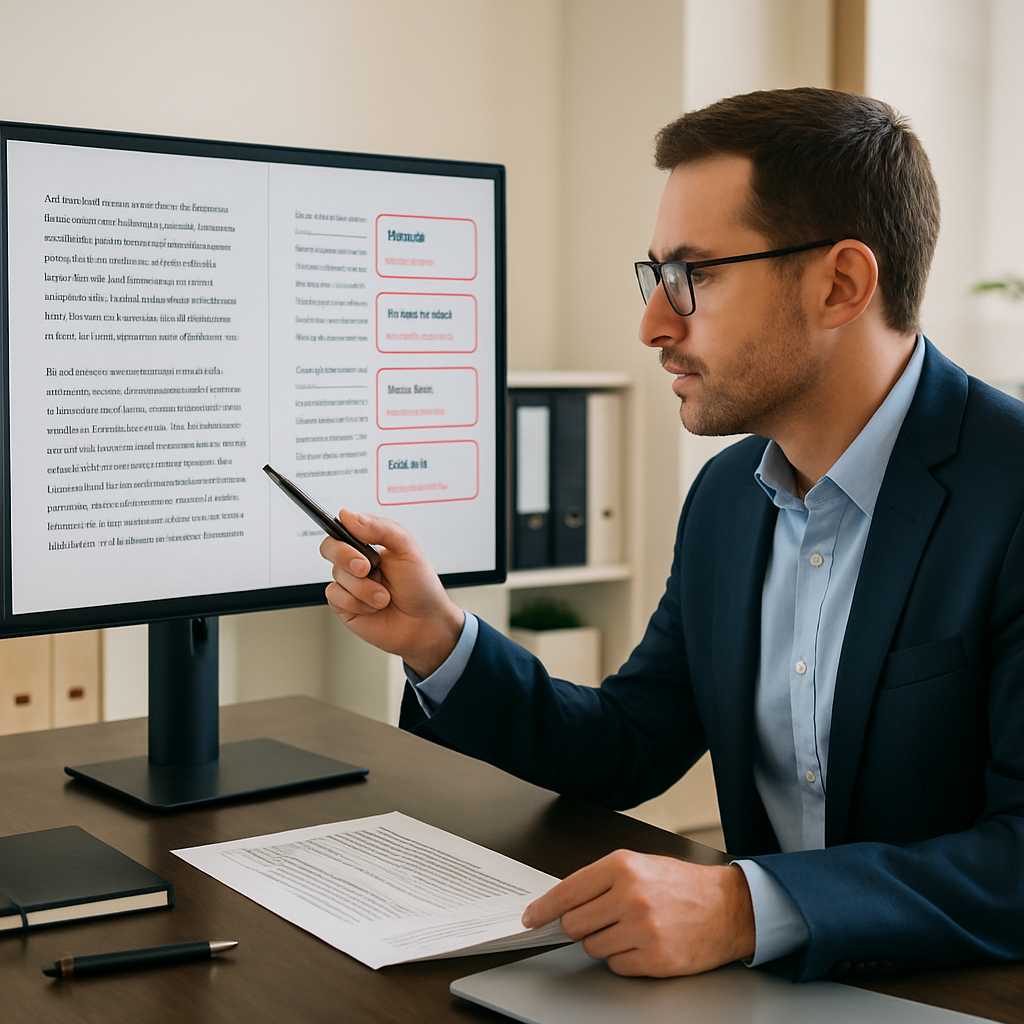
If you are working from a PDF, add a screenshot with a box around the exact sentence. If you are working from Word, use tracked changes and comments. If the file is short, a numbered issue list can also work well. The key is consistency. Do not mix screenshots, vague email notes, and unexplained file names across different messages if you can avoid it.
The best formats for change requests
Different revision formats suit different jobs.
Best for short documents
A simple numbered email or comment list works well. Example:
- Page 1, surname should read “Petrova” not “Petrov.”
- Page 2, date should match source: 14/09/2023.
- Page 3, please translate the round stamp text as well.
- Please return final certified PDF by 5 pm.
Best for Word files
Use tracked changes and comments. This is usually the clearest option when there are several changes across a document because each edit is visible and attached to the exact wording.
Best for PDFs or scanned documents
Use annotated screenshots plus a numbered issue list. This helps when the receiver cannot edit the file directly but still needs to show the exact location of the problem.
Best for larger projects
Use a revision table.
| Ref | Location | Issue Type | Current Text | Required Action | Priority |
|---|---|---|---|---|---|
| 1 | Page 1, line 4 | Name check | Al Hasan | Change to Alhassan | High |
| 2 | Page 2, para 2 | Terminology | labour agreement | Use employment contract | Medium |
| 3 | Page 3, footer | Formatting | Missing page count | Add page 3 of 4 | Low |
For large batches, this is often faster than long email chains.
A copy-and-send revision request template
Use this whenever you need fast, clean changes:
Subject: Revision request – [document name]
Please revise the attached translation.
Purpose of document: [visa / court / HR / university / bank]
Deadline: [date and time, with time zone if needed]
Priority: [names and dates first / all changes required / certified final copy needed]
Requested changes:
- [Page / line / section] – [issue] – [preferred correction]
- [Page / line / section] – [issue] – [preferred correction]
- [Page / line / section] – [issue] – [preferred correction]
Reference files attached:
- source document
- translated file
- passport / certificate / glossary / approved wording
Please confirm whether the final corrected version will also require an updated certified copy.
That message gives the reviewer everything needed to start work without a back-and-forth delay.
How to avoid turning revisions into rewrites
Not every suggested change improves the translation. Some comments simply reflect a different personal style. That is where revision requests often become slow, expensive, and frustrating.
A useful rule is this:
Good revisions fix one of the following
- accuracy
- completeness
- consistency
- compliance
- readability for the intended audience
- agreed terminology
- verified name or number data
Weak revisions often come from
- personal preference alone
- inconsistent reviewer opinions
- unclear ownership of brand tone
- no approved glossary
- no target audience guidance
- changing the brief after delivery
If you ask a reviewer to “make it sound better” without defining the audience or purpose, you are inviting subjective edits instead of controlled corrections.
The biggest mistakes clients make during the translation revisions process
They review without the source text
A correction that looks right in the target language may break the meaning of the original.
They send one comment at a time
Multiple short emails create version confusion. Collect the issues and send one organised request wherever possible.
They do not identify the approved version
Always say which file is current. Use clear version names. Examples include:
- contract-en-fr-v3-reviewed
- diploma-certified-final-marked
- hr-pack-es-v2-client-comments
They raise issues without evidence
If a name, number, or title must change, attach the document or approved reference that supports it.
They hide the true deadline
If the file must be submitted at 9 am tomorrow, say so. The team may be able to prioritise the highest-risk fixes first.
A smarter way to coordinate urgent deadlines
When time is short, break the request into two stages:
Stage one: critical acceptance checks
Prioritise:
- names
- dates
- IDs
- omitted text
- certification wording
- obvious terminology conflicts
Stage two: polish and consistency
Then handle:
- stylistic refinements
- repeated terminology cleanup
- formatting tidy-up
- optional wording improvements
This prevents a project from missing the deadline because low-priority style edits were mixed in with high-priority identity issues. If your submission window is tight, upload the file immediately and mark the critical lines first. A well-prioritised request is often faster than a longer, more detailed but unranked comment sheet.
What to do differently for certified translations
Certified work needs extra care because the final pack is often used as evidence. When requesting revisions on a certified translation, make sure you confirm:
- whether the change affects the certification statement
- whether page numbering changes
- whether the final stamped PDF must be reissued
- whether the receiving authority expects exact source-document spellings
- whether translator notes are needed for unclear handwriting, stamps, or source errors
For official submissions, never assume a translator can silently “correct” the source document. If the original document itself contains an error or inconsistency, that usually needs to be handled transparently.
What a strong internal review looks like
If a business, law firm, HR team, or compliance team is checking translations internally, the reviewer should not try to rewrite the whole file in their personal style. A useful internal review focuses on:
- technical accuracy
- correct names and titles
- approved terminology
- brand tone
- market suitability
- consistency with previously approved materials
Choose one reviewer with the right subject knowledge wherever possible. Multiple reviewers without a shared standard often create conflicting edits and extra delay.
A practical before-you-send checklist
Before sending a change request, check that you have included:
- the latest source file
- the latest translated file
- one final list of changes
- page or line references
- evidence for name or number corrections
- deadline and priority order
- confirmation of whether a revised certified copy is needed
If all of that is in one message, the revision can usually move much faster.
The real goal of fast revisions
Fast revisions are not about rushing blindly. They are about removing avoidable confusion. The clearer your instructions, the less time is spent locating issues, questioning preferences, and sorting versions. That means quicker corrections, cleaner final files, and less risk at the point of submission.
If you need a revised translation quickly, send the source, the translated version, and a single organised change list in one go. Mark the exact lines, highlight names and numbers first, and state the real deadline. That is what turns a slow revision loop into a smooth, reliable process. For urgent documents, send the file as soon as the issue is noticed rather than waiting to build the perfect email. Clear location references and priority notes can save more time than long explanations.
FAQs
How long should a translation revision take?
It depends on the number of changes, file format, and whether the request is targeted or vague. A short, well-marked request can be handled much faster than a broad request that requires investigation first.
What is the best way to request changes to a translation?
The best method is to identify the exact location, explain the issue, give the preferred correction if known, and state the deadline. Word comments, tracked changes, annotated screenshots, and revision tables are usually the clearest formats.
Can I ask for name checks and terminology changes in the same revision request?
Yes, but separate them clearly. Put high-risk identity items such as names, dates, and reference numbers first, then list terminology and style changes underneath.
What should I include in a translation change request?
Include the current file version, the document purpose, exact line references, the issue type, any approved wording or evidence, and the final deadline. If the document is certified, ask whether a revised certified copy is also required.
When does a revision become a new translation task?
A revision may become a new task when the source file has changed, the brief has changed, the preferred terminology was never supplied originally, or the document needs substantial rewriting rather than targeted corrections.
How do I speed up revisions for certified translations?
Send the source and translated files together, flag names and numbers first, provide evidence for corrections, and confirm whether the final corrected version must be re-certified or reissued as a new PDF.

