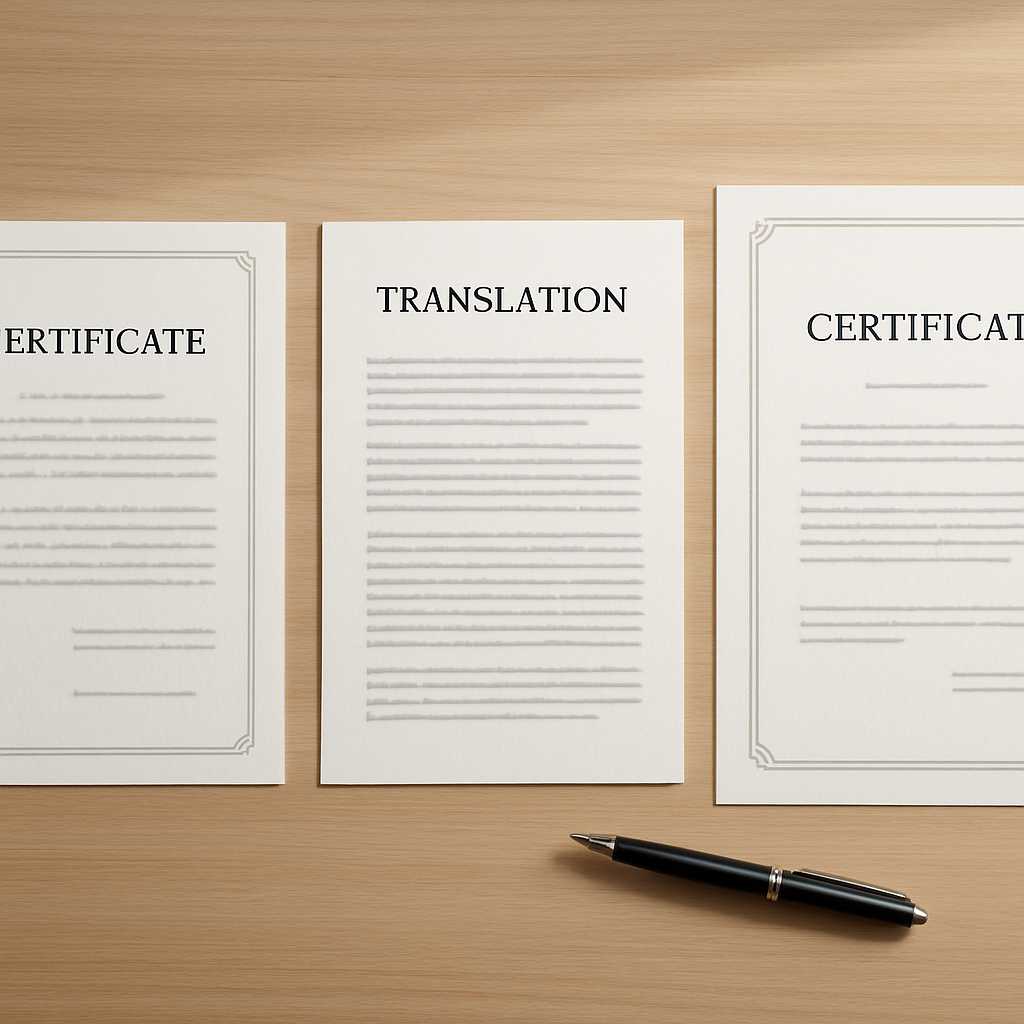
A submission ready certified translation is not just a translated document.
It is a complete pack that is prepared to be reviewed, verified, and accepted by the authority receiving it. That distinction matters. Many delays happen not because the translation is unreadable, but because something essential is missing: a certificate page, a signature, a date, the translator’s details, a missing back page, or the wrong delivery format.
If you are submitting documents for immigration, a university, a solicitor, a court, an employer, or an overseas authority, the safest approach is to think in terms of a complete submission pack. You should know exactly what you are paying for and exactly what you will receive before your order begins.
A simple rule helps: if your document is for official use, the job is not finished when the words are translated. It is finished when the full translation package is ready to submit without guesswork.
What “submission ready” actually means
A submission ready certified translation usually includes five core elements:
- The full translated document
- A certification statement or certificate page
- A signature, printed name, and date
- Contact details for verification
- Delivery in the format your receiving authority expects
That sounds straightforward, but this is where many people get caught out. A translation can look polished and still be incomplete for official use. A submission ready certified translation is a complete, verifiable, correctly formatted translation pack prepared for the authority receiving it.
What you should receive from a certified translation order
1. Fully translated pages
The first thing you should receive is the complete translation of the source document, not a summary, not an extract, and not “the important parts only.” That means:
- Every relevant page is included
- Front and back pages are translated where needed
- Stamps, seals, handwritten notes, side notes, headers, footers, and reference numbers are accounted for
- Names, dates, places, and document numbers are carried across consistently
A strong certified translation does not quietly skip awkward areas. If the original contains a faint stamp, a handwritten annotation, or a partially legible note, the translation should deal with it clearly rather than pretending it is not there. A weak deliverable often looks clean on the surface but leaves out the details that official reviewers actually notice.
2. A certificate page or certification statement
The second item is the certification itself. This is the part that turns a translation into a certified translation for official use. Sometimes this appears on a separate certificate page. Sometimes it appears at the end of the translated document. Either way, it should clearly confirm that the translation is a true and accurate rendering of the original document.
At minimum, the certification should never feel vague. It should be specific enough to reassure a reviewer that the document is not just translated, but formally certified for submission. A good certificate page does three things well:
- Confirms accuracy
- Connects the translation to the original document
- Makes the translator or translation company identifiable
3. A signature, printed name, and translation date
This is one of the most overlooked parts of the pack. When a client says, “I received the translation,” the follow-up question should be, “Did you receive the signed and dated certification too?” A submission ready certified translation should show:
- The date of translation
- The full name of the translator or authorised representative
- A signature or authorised sign-off
Without those elements, a receiving authority may have no clear way to treat the translation as a formally certified document.
4. Contact details that make verification possible
A reviewer may never contact the translator. But the document should still make verification possible. That is why the pack should include contact details for the translator or translation company. This matters because official bodies often need confidence that the translation can be independently traced back to a real provider. This is also one of the easiest ways to spot a weak service. If the translation arrives as plain text with no meaningful provider details attached, it is not a strong official-use deliverable.
5. Clear handling of stamps, seals, marks, and handwriting
Official documents rarely contain only neat printed text. Many contain stamps, registration marks, signatures, faded notes, or handwritten additions. A proper submission pack should show that these were noticed and handled carefully. They do not have to be made pretty. They do have to be acknowledged accurately. For example:
- A stamp should not disappear
- A handwritten remark should not be ignored
- A signature line should still be identified
- An unreadable section should be flagged honestly rather than guessed
This is where experienced official document translators separate themselves from generic language providers.
6. The correct delivery format
Delivery format is not an afterthought. It is part of the deliverable. Before ordering, you should know whether you need:
- A PDF for online upload
- A printed hard copy
- A signed and stamped copy
- Both digital and physical versions
- Extra certification such as notarisation or apostille support
Many clients assume a PDF is enough because the translation itself is correct. Sometimes that is true. Sometimes it is not. A solicitor, court, embassy, university, or overseas authority may ask for a physical version, an original signature, or an additional authentication step. The safest practice is to confirm format before the translation starts, not after the deadline is close.
7. Any extra authentication required for the destination
Certified translation is often the right level for UK official use, but not always the final level for every destination. Depending on where the document is going, you may need:
- Certified translation only
- Notarised translation
- Legalisation or apostille
- A sworn translation produced under another country’s legal system
This is why a strong provider asks where the document will be submitted. “Official use” is not one universal standard. The right package depends on the destination.
What a strong certificate page should look like
A certificate page does not need complicated legal language. It needs clarity. A practical version usually includes:
- Certificate of Translation Accuracy
- I certify that this is a true and accurate translation of the original document to the best of my knowledge and professional ability.
- Translator or authorised representative name
- Signature
- Date
- Company name
- Contact details
That structure is simple, readable, and practical. It gives the receiving authority the key details without turning the certificate into a wall of text.
The safest way to think about delivery format
Here is a practical comparison:
- Submission route: Online application portal
Safest format to request: Certified PDF - Submission route: University or admissions team
Safest format to request: Certified PDF, plus hard copy if requested - Submission route: Solicitor or court bundle
Safest format to request: Ask whether wet-ink signed hard copy is required - Submission route: Embassy or overseas authority
Safest format to request: Confirm whether notarisation or apostille is needed - Submission route: Multi-use pack for more than one destination
Safest format to request: Request both PDF and hard copy
When timing is tight, ordering both formats at the outset often prevents last-minute repeat costs.
The most common reasons a translation is not submission ready
A translation is more likely to cause problems when one or more of the following happens:
- The translation is partial rather than complete
- The certificate wording is missing or too weak
- No date appears on the certification
- No signature or authorised sign-off appears
- Contact details are missing
- Stamps, seals, notes, or handwritten text are ignored
- Names or dates are inconsistent across pages
- The wrong delivery format is supplied
- The client needed notarisation but only ordered certified translation
- The translation arrived as text only, with no formal certification attached
These are avoidable problems. The key is to ask what the final submission pack includes before placing the order.
The 60-second self-check before you submit
Before you upload, post, or hand over your documents, run this check:
- Do you have the original document or a clear scan of it?
- Have all relevant pages been translated?
- Are names, dates, places, and reference numbers consistent?
- Is there a certification statement or certificate page?
- Is the certification signed?
- Is the date shown?
- Is the translator or company named clearly?
- Are contact details visible?
- Are stamps, seals, signatures, and handwritten notes accounted for?
- Do you have the format your receiving authority asked for?
If any answer is no, pause before submitting.
Certified, notarised, apostilled, or sworn: which one applies?
This is where many people overspend or under-order.
Certified translation
This is often the correct option for UK official use, including many immigration, academic, legal, and administrative submissions.
Notarised translation
This is used when a notary’s involvement is specifically required. It is not automatically better than certified translation. It is simply a different level of formalisation for the right cases.
Apostille or legalisation
This is usually about international recognition of a document or signature, not about improving the translation itself. It tends to matter when a document is being used abroad.
Sworn translation
This is generally tied to legal systems in specific countries. It is not the same thing as certified translation in the UK. The right question is not, “What sounds most official?” The right question is, “What does the receiving authority actually require?”
What to ask before you order
A fast way to avoid delays is to ask these questions up front:
Where is the document being submitted?
A university, a Home Office route, a solicitor, a court, and an overseas ministry may all expect different pack formats.
Do you need a full translation or only certain pages?
For official submissions, full translation is usually the safer route unless the receiving body has confirmed otherwise.
Is a digital PDF enough?
Never assume. Ask.
Will you need a hard copy as well?
This matters more often than people expect.
Do you need notarisation or apostille support?
If the document is going overseas, ask before ordering certified translation alone.
What good service feels like from the client side
A strong translation process feels clear before the order starts. You should know:
- What is included
- What is not included
- What format you will receive
- Whether your destination needs anything more than certification
- Whether missing pages, low-quality scans, or unclear sections will create issues
That clarity is part of the service. A provider that talks only about language but not about submission format is leaving the most important part unaddressed.
A better way to order official document translation
The most efficient orders usually follow this pattern:
- Send clear scans of every page
- State exactly where the documents will be submitted
- Confirm whether you need PDF, hard copy, or both
- Ask whether notarisation or legalisation is relevant
- Review the quote based on the final required pack, not just the translation itself
That process reduces rework, repeat fees, and deadline panic. Submitting a document pack for immigration, study, legal work, or overseas use? Start with the end point. Ask for the complete certified translation package in the format your authority expects.
Final thought
The easiest way to judge a certified translation is not to ask whether it looks professional. It is to ask whether it is ready to leave your hands and go straight into a formal review process. That is what submission ready means. Not just translated. Not just certified. Complete, verifiable, and correctly formatted for the place it is going. If your deadline matters, send the document first, confirm the destination, and order the pack you actually need rather than the minimum you hope will pass.
FAQs
What is a submission ready certified translation?
A submission ready certified translation is a complete official-use translation pack. It normally includes the fully translated document, a certification statement or certificate page, signature, date, provider details, and delivery in the format required by the receiving authority.
Should a submission ready certified translation include a certificate page?
Yes. A submission ready certified translation should include a certification statement, often on a separate certificate page or at the end of the translation. That statement should confirm accuracy and identify the translator or translation company.
Does a certified translation need a signature and date?
For official use, a certified translation should include a signature or authorised sign-off and the date of translation. These details help make the document formally usable and verifiable.
Is a PDF enough for a submission ready certified translation?
Sometimes, yes. Sometimes, no. A PDF may be enough for online applications and email submissions, but some authorities ask for a physical signed copy or an additional formal step such as notarisation.
What delivery format should I ask for with a certified translation?
Ask for the format your receiving authority expects: PDF, hard copy, or both. If the document is going overseas, also check whether notarisation, apostille, or another country-specific requirement applies.
What is missing when a certified translation is not submission ready?
The most common missing items are a certificate page, signature, date, contact details, full page coverage, or the correct delivery format. Even a strong translation can be delayed if one of these is missing.

