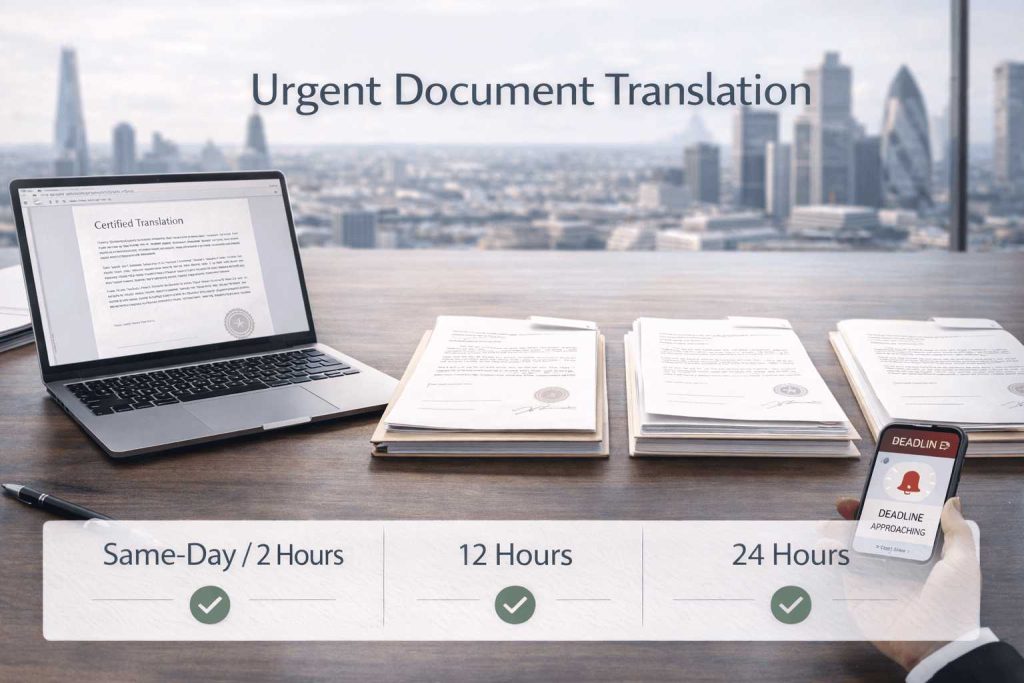
When a deadline is closing in, most people search for the fastest option they can find and hope that speed alone will solve the problem. In practice, choosing the right rush window matters more than choosing the most aggressive one. For anyone looking for same day translation London support, the smart question is not “What is fastest?” but “What is fast enough without creating avoidable risk?”
A 2-hour or same-day turnaround can be perfect for a short, standard document. A 12-hour option can be the better choice when timing is tight but the file still needs proper checking. A 24-hour turnaround often gives the strongest balance of speed, cost, formatting control, and peace of mind. The real goal is not just getting words translated quickly. It is getting a submission-ready file delivered on time, in the right format, with the right certification, for the right authority.
Why rush translation choices go wrong
Most deadline problems do not start with the translation itself. They start with unrealistic timing assumptions.
People often assume that a “same-day” service means any document, any language pair, any file quality, any time of day. That is rarely how urgent work operates in the real world. Turnaround depends on:
- document length
- language pair
- scan quality
- handwriting, stamps, and seals
- formatting complexity
- certification needs
- delivery format
- the exact time the final file is approved
That last point matters. The clock usually starts when the file is confirmed as final and ready to process, not when the first enquiry is sent.
The fastest option is not always the safest option.
The safest rush option is the one that leaves enough time for translation, checking, certification, and delivery.
What each rush option is really for
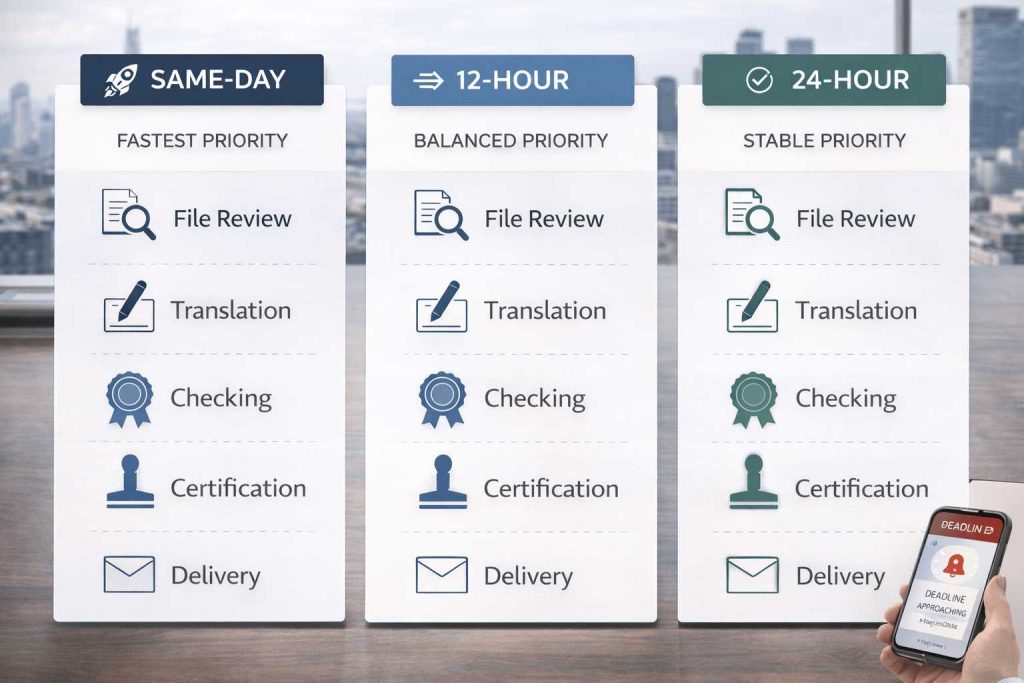
Same-day or 2-hour translation
This is the sharpest rush window. It works best when the document is short, clear, standardised, and easy to format quickly.
Typical good candidates include:
- birth certificates
- marriage certificates
- passports
- ID cards
- police certificates
- short bank statements
- standard letters
- simple academic records
This option is strongest when:
- the file is submitted early in the working day
- the scan is clean and readable
- the language pair is common
- the document has little handwritten content
- no complex desktop publishing is needed
This option is weaker when:
- the file is long
- multiple pages need cross-checking
- names must be transliterated carefully
- the document contains stamps, annotations, or handwritten notes
- the receiving authority is strict and the risk of rejection is high
Same-day translation is a priority window, not a miracle cure. It is ideal for speed, but only when the job itself is genuinely suitable for speed.
12-hour translation
A 12 hour translation option is often the most underrated rush service.
It gives enough room for urgent handling while preserving more control over review, formatting, and certification. For many clients, it is the sweet spot between panic and practicality.
This option is often the right fit for:
- two- to five-page document sets
- evening uploads needed by the next morning
- immigration packs with several supporting pages
- academic documents that need careful consistency
- legal or business documents that are urgent but not instant-emergency urgent
Choose 12-hour turnaround when:
- the deadline is fixed for the next morning
- accuracy matters more than claiming the absolute fastest label
- the file needs a proper second look
- the document is short enough to move fast but important enough to deserve breathing room
If your appointment is tomorrow at 9:00 a.m., a 12-hour turnaround confirmed tonight can be far more sensible than chasing a vague “same-day” promise late this afternoon.
24-hour translation
A 24-hour turnaround is not slow. For many official submissions, it is the most efficient decision.
It usually gives the best mix of:
- reliable review time
- cleaner formatting
- lower rush pressure
- more stable pricing
- better suitability for multi-page files
This option is often the best choice for:
- longer supporting packs
- contracts and legal paperwork
- company records
- academic bundles
- mixed-content documents with seals, tables, signatures, and notes
- less common language pairs
- files that must look polished and easy to compare with the original
A 24-hour service is often what prevents small deadline issues from turning into expensive rework.
A simple way to choose the right rush option
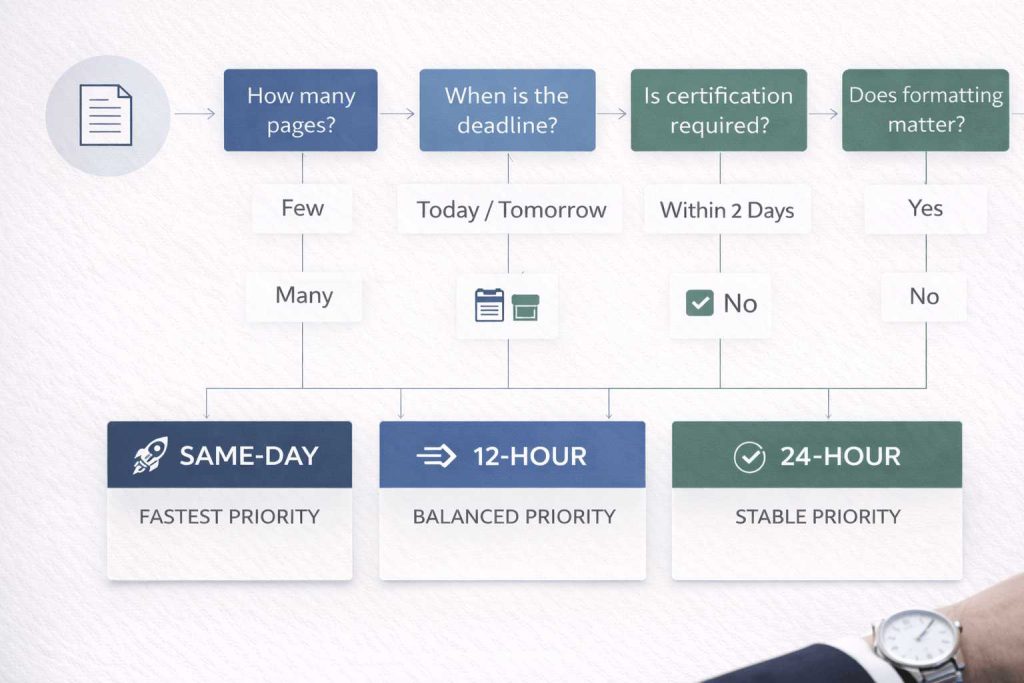
Pick same-day when all of these are true
- your file is short
- the text is standard and easy to read
- you need digital delivery fast
- certification is straightforward
- the submission is urgent enough that every hour matters
Pick 12-hour when most of these are true
- the deadline is tonight or tomorrow morning
- the file is still relatively compact
- the wording, names, or formatting need careful review
- you want speed without stripping out checking time
- you need a more dependable middle ground
Pick 24-hour when any of these are true
- the document is multi-page
- the formatting matters
- the language pair is harder to source quickly
- the content is legal, academic, or business-critical
- a rejection would cost more than the extra hours saved by rushing harder
The hidden difference between “fast” and “submission-ready”
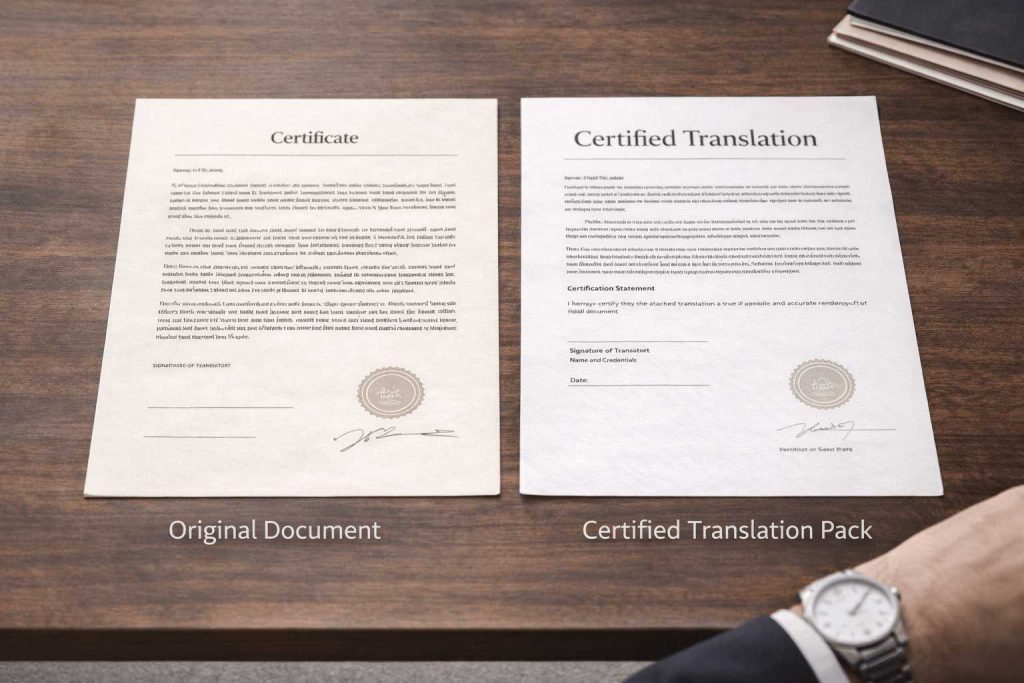
A translation can be delivered quickly and still create problems if it is not ready for use.
That is the real difference between raw turnaround and deadline-safe turnaround.
A submission-ready rush translation should account for:
- complete translation of all relevant visible text
- correct names, dates, and numbers
- clear indication of stamps, signatures, and handwritten notes where relevant
- consistent formatting
- certification wording where required
- delivery in the format the receiving body expects
For official documents, rushing the process without protecting these basics is where avoidable delays happen.
Real deadline scenarios in London
Scenario 1: Visa appointment tomorrow morning
You have a birth certificate and a bank statement to submit for an appointment early tomorrow.
The smarter choice:
- same-day for the certificate if it is short and clean
- 12-hour if the bank statement is lengthy, contains many entries, or includes pages that need careful checking
Scenario 2: Court or solicitor deadline this afternoon
You have a short witness statement and one supporting certificate.
The smarter choice:
- same-day only if the pages are final, readable, and approved immediately
- otherwise, reduce scope to the essential pages first and prioritise the urgent subset
Scenario 3: University or professional submission due tomorrow
You need a degree certificate, transcript, and a supporting letter.
The smarter choice:
- 12-hour if the set is compact
- 24-hour if formatting clarity and consistency are important across multiple pages
Scenario 4: Business contract needed before a morning call
You have a multi-page agreement with tables, clauses, signatures, and tracked structure.
The smarter choice:
- 24-hour in most cases
- same-day only if the document is short, final, and the language pair is straightforward
What actually slows urgent translation down
If you want the fastest safe turnaround, remove the friction points before they become problems.
The most common delay triggers are:
Poor scans
Blurry photos, cut-off corners, shadows, and warped pages waste urgent time.
Missing pages
Rush quoting is slower when the page count changes after work starts.
Unclear deadline instructions
“ASAP” is not as useful as “Needed by 8:30 a.m. tomorrow, London time, for UKVI upload.”
Unconfirmed spelling
Names on passports, certificates, bank statements, and previous translations should match exactly where appropriate.
Complex formatting
Tables, seals, stamps, handwritten notes, and side annotations take time to present clearly.
Rare language pairs
Some language combinations can still move quickly, but they are less suitable for last-minute guesswork.
The deadline-backward method that prevents panic orders
Here is the simplest way to choose a rush window without overpaying or underestimating the job.
Step 1: Start from the submission time
Do not start from “today.” Start from the exact time the file must be uploaded, emailed, printed, or presented.
Step 2: Subtract your safety buffer
Leave room for:
- final review
- downloading and checking files
- printing if needed
- sending to a solicitor, employer, university, or family member
- any last correction on names or dates
Step 3: Subtract approval time
Rush work does not begin properly until the quote, file, and requirements are confirmed.
Step 4: Choose the smallest rush window that still protects quality
That is usually the best-value decision.
In other words:
- use same-day for urgency
- use 12-hour for urgency plus control
- use 24-hour for urgency plus stability
When same-day is worth paying for
Same-day is worth it when the cost of missing the deadline is higher than the rush premium.
That usually applies when:
- you have an appointment booked
- travel depends on the document
- legal or immigration timing is fixed
- the file is short enough to move safely
- you need the translation today, not simply “soon”
It is not worth it when the job is complex, the deadline is actually tomorrow, and a 12-hour or 24-hour service would achieve the same result with less pressure and lower risk.
When 24-hour is the stronger professional decision
Many people feel guilty choosing 24-hour when they are already under pressure. In reality, it is often the most professional choice.
A 24-hour turnaround is often the better option when:
- the document matters more than the marketing label
- formatting and certification must be clean
- you want fewer correction loops
- multiple pages need consistency
- the receiving institution may look closely at the details
Speed matters. But credibility matters too.
What to send if you want the fastest accurate quote
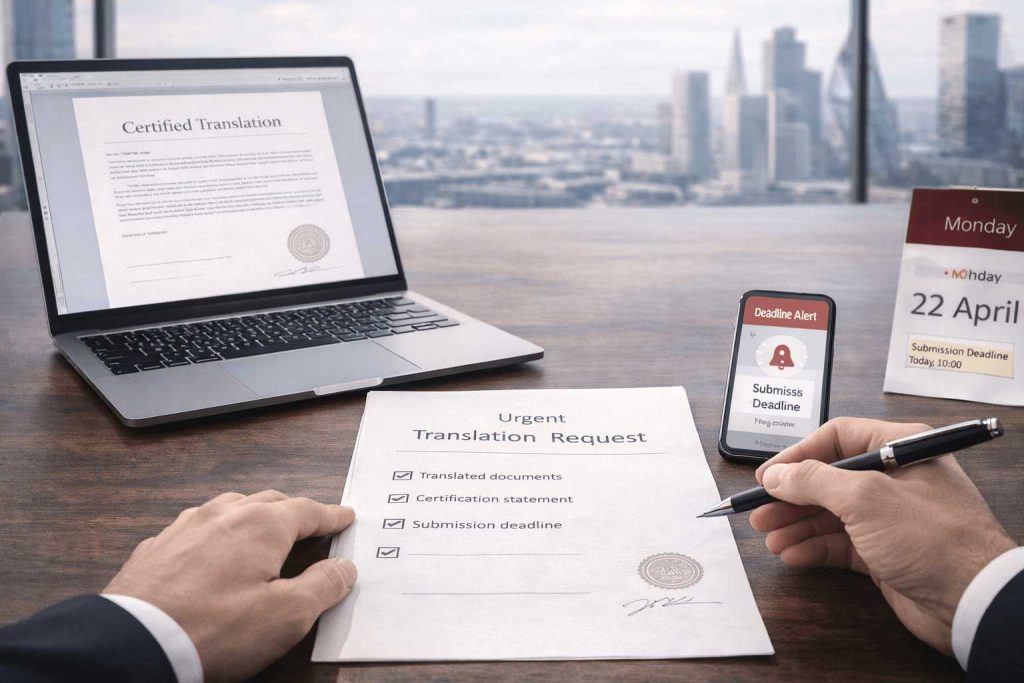
To avoid losing time, send everything in one go:
- clear scan or PDF
- source language and target language
- exact deadline and timezone
- who the translation is for
- whether certification is needed
- whether digital delivery is enough
- whether a hard copy is required
- preferred spelling of names if relevant
- any existing version that must be matched
The more complete the first message, the faster a reliable turnaround can be confirmed.
A better question than “Can you do it today?”
Ask this instead:
What is the safest rush option for this exact file and deadline?
That question usually gets you a better outcome, a more realistic promise, and a translation you can actually use.
If your deadline is close, send the document, the target language, the authority you are submitting to, and the exact submission time as early as possible. That is the fastest way to move from urgency to certainty.
Final takeaway
The right rush service is the one that protects the deadline without creating fresh risk.
- Choose same-day when the file is short, standard, and genuinely suitable for rapid handling.
- Choose 12-hour when the job is urgent but still needs proper checking.
- Choose 24-hour when clarity, formatting, and consistency matter just as much as speed.
For most clients, the smartest move is not chasing the fastest label. It is picking the window that gets the file accepted the first time.
If your document needs to move today, send it now with the deadline, target language, and certification requirements so the safest turnaround can be confirmed immediately.
FAQs
Can I get same day translation in London for official documents?
Yes, same-day turnaround can work well for short, standard official documents such as certificates, IDs, and simple supporting papers. Suitability depends on document length, language pair, file quality, and how early the final file is approved.
Is a 12 hour translation safer than a 2 hour translation?
In many cases, yes. A 12 hour translation gives more room for review, formatting, and certification while still meeting tight deadlines. It is often the better option for multi-page or higher-risk documents.
Which documents are best suited to same day translation London services?
The best candidates are short, clear, standard-format documents such as birth certificates, marriage certificates, passports, ID cards, police certificates, and simple letters. Longer files or documents with complex formatting are often better suited to 12-hour or 24-hour turnaround.
Does urgent translation cost more than standard turnaround?
Usually, yes. Faster turnaround means priority handling, tighter scheduling, and less flexibility in workflow. The right question is whether the faster window is actually necessary for the deadline you have.
Can a certified translation still be accurate on a rush deadline?
Yes, provided the document is suitable for urgent handling and the turnaround leaves enough time for review and certification. The safest urgent jobs are usually short, clear, and submitted with complete instructions.
Should I choose same-day, 12-hour, or 24-hour translation?
Choose same-day for short emergency files, 12-hour for urgent but quality-sensitive work, and 24-hour for longer or more complex documents where formatting, consistency, and lower correction risk matter.

