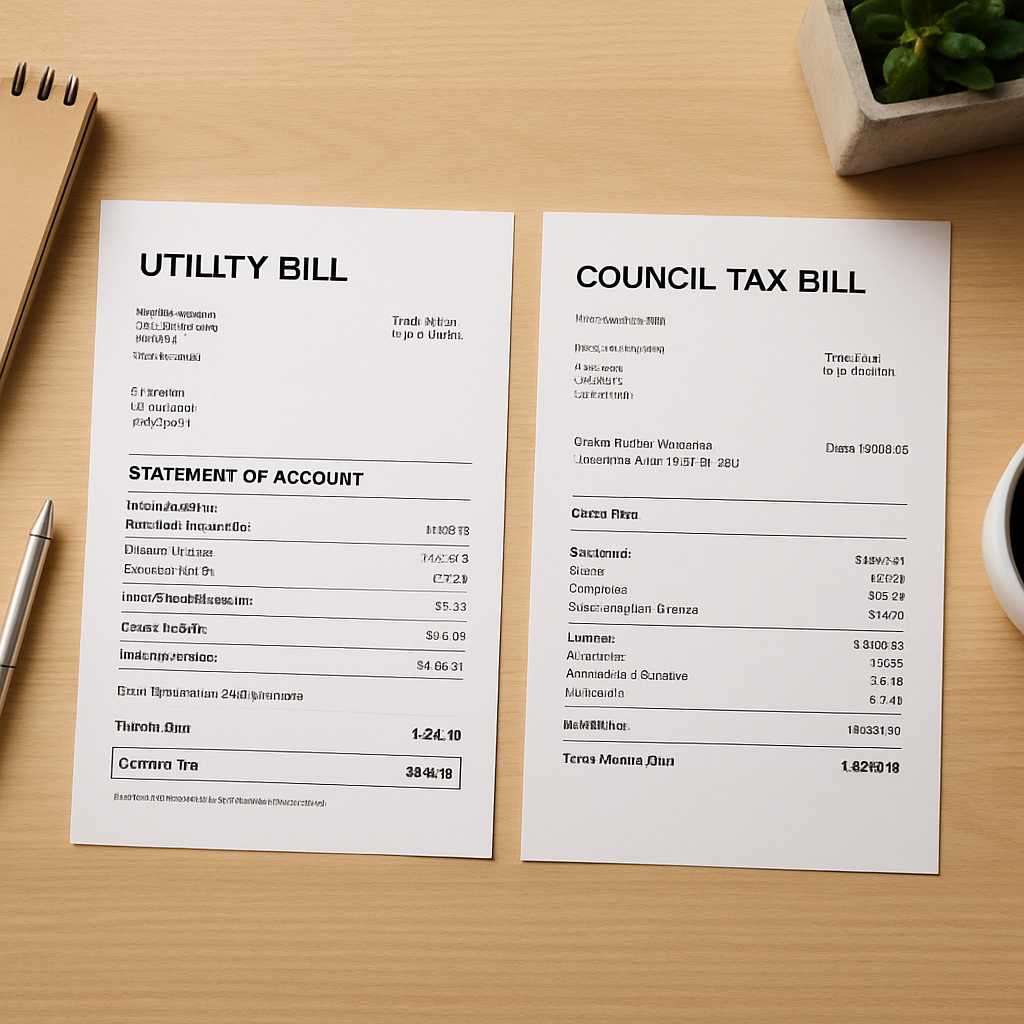
When someone is asked to prove where they live
The document itself often looks simple. The problem is that “simple” proof of address documents are some of the easiest to get wrong in translation. A missing flat number, an untranslated discount note, a cropped billing period, or a provider reference left in the original language can turn a routine submission into a delay.
That is why proof of address translation utility bill requests are so common, and why council tax translation is often requested alongside them. People use both, but they do not use them for exactly the same reason.
In most real-world cases, utility bills are chosen when someone needs recent, day-to-day evidence of address. Council tax bills are often preferred when the receiving body wants a broader view of residence, a local-authority document, or a document that covers a longer period. The strongest option is not always choosing one over the other. Often, it is choosing the document that matches the purpose of the application and translating it completely, cleanly, and in a format that can be checked quickly.
If you are sending a proof-of-address document for a visa, tenancy, bank check, school admission, HR onboarding, or another formal process, the safest route is to submit a certified translation that mirrors the original closely and makes every important field easy to verify.
The quick answer: which one gets used most?
A utility bill is usually the more common everyday proof of address document because people already have one and it is often recent. A council tax bill is often the stronger choice when the organisation wants something tied more clearly to residence over time, local authority records, or the current council tax year.
The better question is not “Which one is best?” It is “Which one best matches the rule I am trying to satisfy?”
Situation
- Document people often use first: Utility bill
- Why it works: Easy to access and usually recent
- What the translation must show clearly: Name, full service address, issue date, billing period, provider details
Tenancy or landlord check
- Document people often use first: Utility bill
- Why it works: Quick recent evidence
- What the translation must show clearly: Account holder, address, provider, dates, reference numbers
School or council application
- Document people often use first: Council tax bill
- Why it works: Strong local-address evidence
- What the translation must show clearly: Liable person, property address, billing authority, tax year, instalments
Visa or immigration pack
- Document people often use first: Utility bill or council tax bill
- Why it works: Depends on the route and what period must be shown
- What the translation must show clearly: Full document, certification statement, dates, all notes and side text
Higher-stakes submission where address history matters
- Document people often use first: Council tax bill, sometimes with a utility bill too
- Why it works: Combines broader residence evidence with recent activity
- What the translation must show clearly: Consistency across names, address lines, dates, and document periods
Why utility bills are so commonly used
Utility bills are familiar. Most people can find one quickly, and many receiving bodies ask for something recent. That makes utility bills a practical first choice for proof of address.
A translated utility bill is often useful when the document shows:
- the account holder’s name
- the full service address
- the provider’s identity
- the issue date
- the billing or service period
- key account or customer reference numbers
This is also why formatting matters so much. Utility bills often include side columns, mini tables, payment summaries, footnotes, barcodes, service references, and separate mailing and service addresses. When those elements are left out, the translation stops looking complete even if the main address has been translated correctly.
A common mistake is assuming the amount due is the important part. For proof of address purposes, the amount is rarely the main point. The real value is in the name, address, date window, and document structure.
If your bill is being used for a formal submission, send the clearest possible scan and make sure the full page is visible. Cropped screenshots slow everything down.
Why council tax can be stronger than a utility bill
Council tax documents tend to feel more formal because they come from a local authority and usually relate to a defined tax year or structured billing period. That makes them especially useful when the person reviewing the file wants something more stable than a single monthly bill.
In practice, a council tax translation can be a better fit when:
- you need evidence tied to a UK property over a longer period
- the receiving body prefers local-authority documents
- you want a document that is less “transactional” and more “residence-based”
- you need to show the liable person and the property more explicitly
This does not make council tax automatically better. A recent utility bill can still be the right choice when recency matters most. But if someone is comparing the two, council tax often carries more weight because it can speak more clearly to residence rather than just service usage.
That is why many applicants submit both when the stakes are higher: one document for recent activity, another for broader residence context.
Utility bill vs council tax: what usually matters in real submissions
The document name matters less than five practical checks:
1. Is it recent enough?
A document can be perfectly translated and still be unusable if it falls outside the date window.
2. Does the name match the rest of the file?
Small differences in spelling, order of surnames, accents, or transliteration can trigger questions.
3. Does the address match exactly?
Flat numbers, building names, district names, and postcode formatting must line up with the rest of the application pack.
4. Is the document complete?
Headers, footers, side notes, legends, and instalment sections matter more than people expect.
5. Is the translation easy to verify?
A reviewer should be able to compare the original and the translation line by line without hunting for missing information.
That is where certified translation earns its value. It is not just about changing one language into another. It is about making the document readable, checkable, and submission-ready.
What must be translated on a utility bill
A proof of address translation utility bill should usually include far more than the top section.
Core fields that should appear in the translation
- account holder name
- full service address
- provider or supplier name
- statement or issue date
- billing period or service period
- account or customer number
- meter or reference numbers where shown
- balance, amount due, or payment status where relevant
Supporting fields people often forget
- mailing address if different from the service address
- side notes and callout boxes
- tariff or service type labels
- footnotes
- remarks about occupancy, installation, or account status
- stamps, seals, annotations, or handwritten notes if present
The main formatting goal
The translation should make it obvious which address is being relied on. If the original contains both a service address and a correspondence address, both should be translated and clearly labelled. Guesswork here causes unnecessary re-submissions.
What must be translated on a council tax bill
Council tax bills often look straightforward at first glance, but they contain details that matter for acceptance.
Core fields that should appear in the translation
- liable person or taxpayer name
- property address
- billing authority or council name
- council tax year
- band or property category where shown
- bill date
- instalment schedule
- total due and payment arrangement
Supporting fields that should not be skipped
- discount notes
- exemption wording
- single-person discount references
- arrears, credits, or adjustments
- account reference numbers
- explanatory notes that affect the status of the bill
If one of these sections is left untranslated, a reader may not understand whether the bill is current, amended, discounted, partly paid, or linked to the applicant in the way the original intended.
Accepted documents vary more than people think
One reason this topic causes confusion is that “accepted documents” is never one universal list. A bank may ask for one thing. A school or local authority may ask for another. A landlord or visa team may have their own date rules and format preferences.
That is why the safest workflow is:
- Identify the exact document the receiving body wants.
- Check the date window.
- Confirm whether a digital certified PDF is enough or whether a printed copy is preferred.
- Translate the whole document, not just the address panel.
- Make sure the certification wording and translator details are included.
If you already have an email or checklist from the authority, send it with the file. That small step often saves a full round of revisions.
The most common pitfalls
Most problems are not caused by the language itself. They are caused by omission, inconsistency, or layout shortcuts.
Common pitfalls that delay acceptance
- sending a cropped photo
- translating only the first page or “important section”
- omitting the billing period
- leaving side notes or footnotes untranslated
- confusing mailing address with service address
- missing discount or exemption notes on a council tax bill
- failing to mirror tables or instalment schedules clearly
- using an outdated document
- submitting a document in a format the receiving body does not accept
- forgetting that the translation must match the spelling used elsewhere in the application
A good translation does not simply look polished. It removes reasons for doubt.
Formatting tips that make proof-of-address translations easier to accept
A clean translation is easier to trust. That matters when the reviewer is moving quickly through a stack of documents.
Keep the original order
Do not reshuffle the content just to make it look “nicer”. The reader should be able to compare both versions easily.
Preserve labels and tables
If the original has a table, the translation should show a table or a clear equivalent structure.
Translate every visible text element that carries meaning
This includes stamps, notes, legends, references, and status labels.
Keep names, dates, and numbers exact
Do not normalise them unless there is a good reason to do so. Precision is more important than style.
Use clear notes only when necessary
If a field is unclear in the original, the translation can flag that carefully. It should never invent missing information.
Make the certification easy to find
The certification statement should be attached to the translation and easy to verify.
What to send for a faster and cleaner quote
If you want the job done efficiently, do not just send a photo and write “Please translate this.”
Send:
- the full document, uncropped
- the target language
- the deadline
- the name of the receiving body
- any instructions they gave you
- whether you need a digital copy, printed copy, or both
- any related document that must match the same spelling of your name and address
That last point matters more than most people realise. Address documents are often reviewed together with passports, tenancy agreements, bank statements, or visa forms. Consistency across the whole pack is what makes the submission feel reliable.
A practical way to choose between a utility bill and a council tax bill
Use this decision rule:
Choose a utility bill when:
- you need a recent document quickly
- the receiving body accepts recent household-service evidence
- the bill clearly shows your name and service address
- the document is clean and complete
Choose a council tax bill when:
- the reviewer wants stronger residence evidence
- a current-year or broader-period document is more persuasive
- you want a local-authority document rather than a service-provider document
- the council tax bill is clearer than the utility bill
Submit both when:
- the application matters enough that you want to reduce avoidable questions
- the receiving body has not been precise
- one document proves recency and the other proves residence more strongly
- you want the pack to feel complete on first review
Why this topic matters more than people expect
Proof-of-address documents are rarely dramatic. They do not look like court orders or degree certificates. But they can still decide whether a file moves forward smoothly.
That is why attention to detail matters here. On these documents, the small things are the big things:
- whether the flat number is visible
- whether the date window is clear
- whether the right address has been translated
- whether a council tax discount note changes the interpretation
- whether the translation can be independently checked
A rushed translation may still read well. That is not the same as being submission-ready.
If you are preparing a proof-of-address submission now, send the document while it is still within the required date range and get the format checked against the receiving body’s wording before it becomes urgent.
Need a certified proof-of-address translation?
If your utility bill or council tax bill is being used for a formal application, do not wait until the document is about to expire or the deadline is already close. Send a clear scan, include the destination authority, and get the translation prepared in a format that is easy to verify from the start.
For straightforward cases, a clean certified translation can be the difference between a quick approval and an avoidable back-and-forth. For more sensitive files, sending both the proof-of-address document and the related supporting document pack is often the smarter move.
A good submission feels obvious to the person reviewing it. That is the standard to aim for.
Frequently Asked Questions
Does a utility bill translation count as proof of address in the UK?
It can, provided the receiving organisation accepts utility bills and the document is recent enough. The translation should clearly show the account holder, full address, issue date, billing period, and provider details.
Is a council tax translation better than a utility bill translation?
Not automatically. A council tax bill is often stronger when the reviewer wants broader residence evidence or a local-authority document. A utility bill can still be the better choice when recency is the key requirement.
What must be included in a proof of address translation utility bill?
The translation should include the full service address, account holder name, provider, issue date, billing period, reference numbers, and any notes or labels that affect the meaning of the document.
Do I need a certified translation for a council tax bill or utility bill?
If the document is being submitted to a bank, landlord, government body, university, employer, or visa authority and it is not in English, a certified translation is often the safest choice. The exact requirement depends on the receiving body.
Can I send a photo of my utility bill for translation?
Usually yes, as long as the image is clear, complete, and uncropped. Blurred photos, screenshots with missing edges, or images that cut off the billing period often create delays.
How fast can a proof of address translation be completed?
It depends on the language pair, document length, and whether you need standard or urgent turnaround. The fastest route is to send a full clear copy, the target language, and the receiving body’s requirements in the first message.

