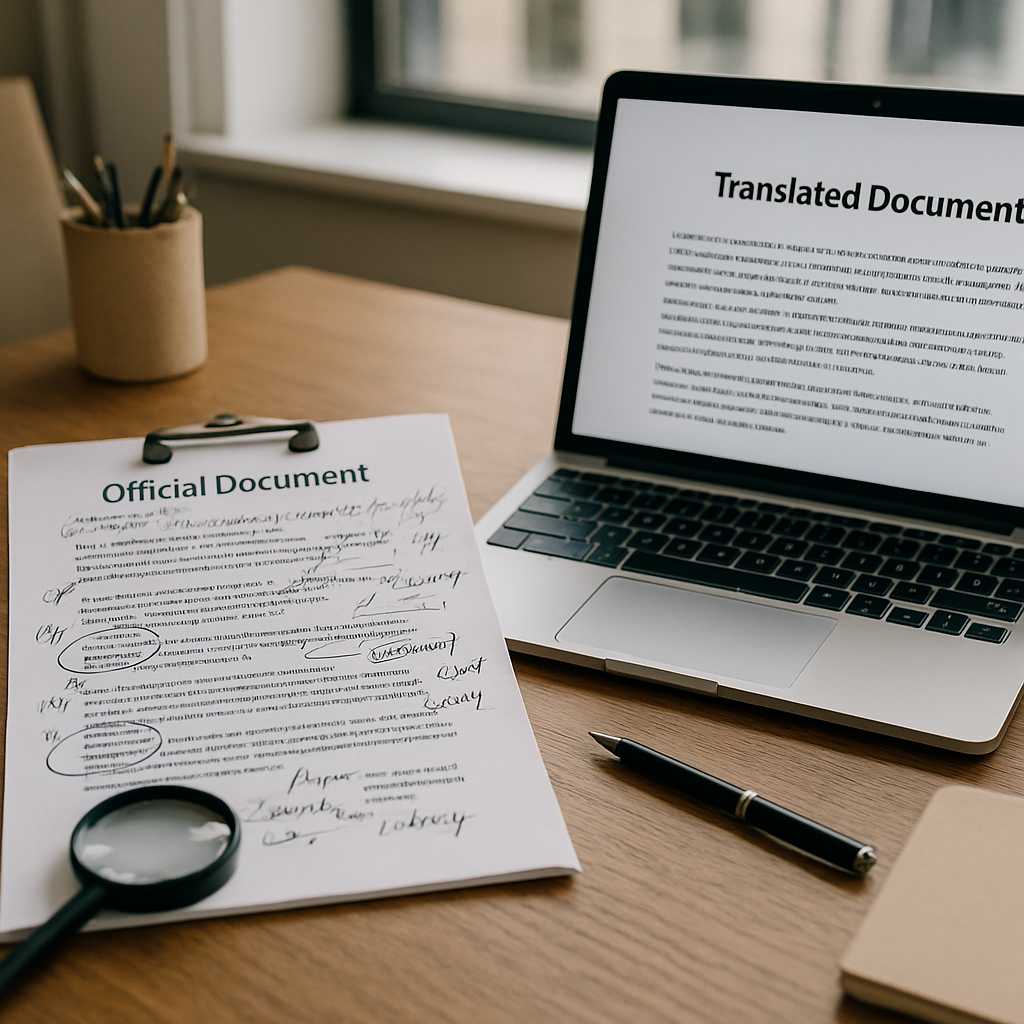
Translating Handwritten Notes: How Professionals Handle Annotations
Handwritten notes may appear small on the page, but they can carry significant importance. A margin comment can alter the meaning of a clause, while a scribbled correction can impact a legal interpretation. A faded note on a certificate can determine whether a submission is accepted, queried, or delayed. Thus, handwritten note translation involves more than merely converting words from one language to another; it requires reading layers of meaning, conveying uncertainty honestly, and presenting the result in a format that is comprehensible to the reviewer. When documents are submitted to UK authorities, a complete translation typically needs to be independently verifiable and include an accuracy statement, date, translator identity, signature, and contact details.
For straightforward typed documents, translation primarily involves language skills. However, handwritten annotations necessitate a combination of language, formatting, and evidence-preservation tasks. Competent professionals do not excessively “clean up” the source material to the point of obscuring the original meaning. Instead, they preserve essential details, indicate uncertainties, and maintain a layout that is readable for the receiving authority, employer, solicitor, university, or caseworker. UK guidelines also stress that translations should be clearly identifiable as translations, maintain a readable layout, and remain faithful to the source rather than pretending to replicate the original.
Why Handwritten Note Translation is Harder Than Most People Expect
Handwritten annotations present challenges that typed text does not:
- Handwriting varies from person to person.
- Notes may be added in margins, between lines, or over stamps.
- The page may contain arrows, circles, underlining, or strike-throughs.
- Some words may be partially readable but not fully certain.
- Typed and handwritten content may coexist on the same page.
- The receiving authority may be concerned about the placement of annotations and their impact on meaning.
This is particularly crucial for wills, contracts, medical records, school files, immigration paperwork, and older personal documents. Joint UK guidance on certified translations specifically notes that handwritten text can be indicated with italics or bracketed notation such as “[handwritten],” and that annotations may need to be translated in full where they could be significant in legal proceedings.
The Professional Standard: Preserve Meaning, Not Guesswork
A strong handwritten note translation adheres to a fundamental principle:
Translate what is readable. Mark what is uncertain. Never invent clarity that is not present in the source.
This approach safeguards both accuracy and credibility. Archival transcription guidance from the U.S. National Archives and Library of Congress employs clear bracketed conventions such as “[illegible]” and “[word?]” to differentiate between what can be read and what remains uncertain. This discipline is equally valuable in handwritten note translation, as it prevents false certainty and enhances the transparency of the translator’s judgment.
How Professionals Handle Handwritten Annotations in Practice
1. They Assess Legibility Before Promising Speed
Professionals first evaluate whether the note is sufficiently legible to translate responsibly. They consider image quality, pen color, contrast, page curvature, cropping, shadows, and whether the note overlaps printed text. Many competitors merely state that “it must be legible,” but the real issue is whether the document is legible enough for a defensible translation and whether uncertain areas can be marked without compromising the overall submission.
2. They Separate the Layers on the Page
A handwritten page is rarely just “text.” It may contain:
- The base document text
- Marginal notes
- Inserted words
- Corrections
- Arrows or circles linking one section to another
- Stamps, seals, initials, or signatures
- Strike-throughs and replacements
A professional translator identifies each layer before translating, reducing the risk of misplacing a marginal note or misinterpreting a visual marker as ordinary body text.
3. They Reproduce Function, Not Handwriting Style
A translation does not need to mimic the exact handwriting style; it should indicate that the source was handwritten and where that handwritten content appears. UK best-practice guidance states that handwritten sections can be shown using italics or bracketed notation like “[handwritten]”; the signal is what matters, not the penmanship.
4. They Mark Uncertainty Clearly
When a word is unclear, a professional may translate the rest while marking the uncertain portion. If a word is entirely unreadable, it is better to state that directly rather than guess. This approach protects the client, the end user, and the credibility of the translation itself. Archival guidance explicitly recommends “[illegible]” for unreadable text and bracketed question-mark conventions for uncertain readings.
5. They Decide Whether Every Mark Needs Translating
Not every arrow or circled phrase requires a full explanatory note. However, when a handwritten addition could affect legal, medical, academic, or administrative meaning, it should typically be translated. UK guidance emphasizes this point for legal documents such as wills and contracts, where handwritten additions may signify intention.
What a Professional Handwritten Note Translation May Look Like
A reliable handwritten note translation often employs short, neutral markers such as:
- [handwritten note in left margin]
- [illegible]
- [surname?]
- [arrow pointing to paragraph 3]
- [circled in source]
- [text struck through in source]
- [stamp]
- [signature]
These notations help the reader understand what occurred on the original page without rendering the translation unreadable. UK guidance also recommends bracketed descriptions for non-text elements such as logos, seals, signatures, and photos instead of reproducing them.
The Workflow That Produces a Dependable Result
Step 1: Read the Whole Document Before Translating Any Note
Context is crucial. A handwritten word that appears ambiguous in isolation often becomes clear when the translator reads the entire document, identifies repeated names, compares letter shapes, and understands the file’s purpose.
Step 2: Compare Repeated Letters and Words
Experienced professionals do not decode a challenging note as a one-off guess. They compare similar letters elsewhere on the page or within the same file, a method also recommended in archival transcription guidance for difficult handwriting.
Step 3: Build a Clean Transcript First
For difficult handwriting, the safest approach is to:
- Transcribe what is there
- Flag uncertain portions
- Translate the confirmed reading
- Preserve the status of anything doubtful
This prevents the translation stage from obscuring transcription uncertainty.
Step 4: Keep Layout Clues That Affect Meaning
A handwritten translation should maintain the document’s logic, not just its text. This may involve showing:
- That a note appears in the right margin
- That a phrase is inserted above a line
- That text is crossed out and replaced
- That a stamp overlaps a date
- That a note points to a specific sentence
UK guidance also stresses readable formatting, clear headings indicating that the document is a translation, and consistency with the source where practical.
Step 5: Add Certification When the Receiving Party Requires It
If the note is part of a document being filed for immigration, legal, academic, or official use, the translation may require certification. Government guidance outlines the core elements expected on certified translations, and UK professional bodies recommend using qualified, registered professionals for these higher-stakes documents.
When Handwritten Notes Are Especially Important
Legal Documents
In contracts, wills, declarations, powers of attorney, and court-related files, handwritten changes can alter meaning. A crossed-out phrase or last-minute insertion can be as significant as the main body text. Therefore, legal handwritten note translation demands caution, consistency, and explicit marking of edits or additions.
Medical Records
Medical files often contain brief handwritten additions, abbreviations, initials, dosage notes, or comments written around printed forms. These should be managed by a linguist who understands both handwriting ambiguity and subject terminology, as a confident-sounding guess is far riskier than clearly marked uncertainty.
Immigration and Official Documents
A birth certificate, police record, school paper, affidavit, or supporting document may include handwritten entries, marginal corrections, seals, or notes added by an official. If those details are part of the record, they typically need to be reflected in the translation. UK government pages clarify that untranslated foreign-language documents cannot be relied upon where a full translation is required.
Historical and Personal Records
Family letters, certificates, diaries, and archive papers often hold significance not because they are official, but because they are irreplaceable. In these cases, tone and relationship cues are vital. A good translation should preserve meaning and emotional register without overstating uncertain readings.
Common Mistakes That Weaken Handwritten Note Translation
Guessing Instead of Flagging Uncertainty
This is the most damaging mistake. A guessed word can become a false fact.
Ignoring the Placement of Annotations
A margin note beside clause 4 is not equivalent to a general note at the bottom of the page.
Translating Only the Typed Text
In mixed-format documents, the handwritten additions may be the most critical part.
Cleaning Up Strike-Throughs
If text was deleted or replaced in the source, the translation should reflect that. UK guidance specifically addresses struck-through text and advises indicating amendments or replacements rather than silently normalizing it.
Sending Poor Scans and Expecting Precise Output
Blurry phone photos, cropped margins, page curl, and low contrast can turn a solvable note into an unsafely ambiguous one. Several translation providers state plainly that poor image quality delays or prevents reliable handwritten translation.
A Simple Comparison: App Output vs. Professional Handwritten Note Translation
| Issue | Quick App/OCR Approach | Professional Approach |
|---|---|---|
| Faded or Messy Handwriting | Often guesses or drops words | Checks context and marks uncertainty |
| Margin Notes | May ignore position | Shows where the note appears |
| Arrows, Circles, Strike-Throughs | Usually flattened or omitted | Described when relevant |
| Mixed Typed + Handwritten Text | May merge layers | Separates layers clearly |
| Certified Submission | Not suitable on its own | Prepared for official use when required |
| Legal or Evidential Relevance | High risk of oversimplification | Preserves edits, additions, and ambiguity |
How to Prepare Your File Before Sending It for Translation
To achieve better results, send a better source file. Before uploading:
- Photograph or scan the full page, not just the center.
- Include every margin, stamp, and handwritten addition.
- Avoid shadows, glare, and angled shots.
- Send the back page too, if anything appears there.
- Keep one page per image where possible.
- Indicate the purpose of the translation: court, visa, university, employer, family record, or internal use.
- Specify whether you need certification, urgency, or printed copies.
For scanned files, TS24 advises clients to send clear scans or photos for review and quoting, and its urgent and certified service pages clarify that deadlines, formatting, and document type affect handling.
What Clients Usually Want to Know Before They Order
Clients are rarely asking only, “Can you read this?” They typically have four deeper questions:
- Will you preserve the meaning without guessing?
- Will the annotations be shown clearly?
- Will the layout still make sense?
- Will the final translation be usable for my deadline and purpose?
This is where a professional process becomes essential.
Why This Matters for Acceptance, Not Just Readability
A handwritten note translation is not deemed successful merely because it “sounds right” in English. It succeeds when the reader can see what was added, what was uncertain, and what was formally certified. For official use, structure and presentation are nearly as critical as language accuracy. Government guidance and UK professional-body guidance both emphasize clarity, completeness, translator accountability, and a format that is visibly a translation of the source.
Why Clients Choose TS24 London for Difficult Document Work
TS24 positions itself as a London-based provider covering over 200 languages, with more than 15 years in business, a network of over 8,000 translators, and more than 25,000 companies served. With over 250,000 documents translated on its certified translation pages, this scale is vital when a project requires the right combination of language pair, subject knowledge, formatting control, and turnaround speed.
For handwritten files, the value extends beyond mere “translation.” It encompasses triage, interpretation, formatting judgment, and honest treatment of uncertainty. This distinction separates a translation that appears polished from one that genuinely withstands scrutiny.
If your document includes handwritten annotations, faint margin notes, crossed-out sections, or mixed typed and handwritten content, please send the complete file for assessment before any assumptions are made. A thorough initial review is the most effective way to avoid rework later.
Ready to Move Forward?
If your handwritten notes require translation for a visa file, court bundle, academic submission, medical record, or personal archive, upload the clearest scan you have and request a review of the handwritten sections specifically. The more accurately the notes are addressed at the outset, the less risk you carry at the submission stage.
For urgent cases, it is advisable to flag three key points immediately with your request:
- Where the handwritten notes appear
- Whether anything is unclear or partially cropped
- Whether the translation is for official use
This allows the project to be scoped correctly from the beginning rather than corrected at the end.
FAQs
Can handwritten notes be included in a certified translation?
Yes. If handwritten content forms part of the document being submitted, it can be included in a certified translation. The crucial point is that the translation should clearly indicate what was handwritten, what was typed, and what is uncertain, while also including the certification details required by the receiving authority.
What happens if the handwriting is unclear?
A professional translator should not guess. If a word is partially readable, it may be marked as uncertain. If it cannot be read, it can be labeled clearly as illegible. This approach is more accurate and defensible than creating a smooth translation where the source is unclear.
Do margin notes, arrows, circles, and strike-throughs need to be translated?
Often, yes. If those marks affect meaning, emphasis, or legal interpretation, they should be reflected in the translation. UK guidance specifically notes that handwritten additions in documents such as wills and contracts may need to be translated because they can be evidence of intention.
Will the translated file keep the same layout?
It should maintain the same logic, even if not every visual detail is replicated exactly. A good translation preserves the reading order, note placement, edits, and structure so that the reviewer can understand how the original page functioned.
Can you translate handwritten notes from a photo or scanned PDF?
Yes, provided the file is clear enough for proper assessment. Most providers accept scans, PDFs, and clear phone images, but quality is essential. Poor contrast, cut-off edges, and shadows can render a note impossible to translate safely.
How fast can handwritten note translation be completed?
Timing depends on legibility, length, formatting, subject matter, and whether certification is required. Handwritten work usually necessitates more checking than typed text, especially when notes are faint, inserted between lines, or mixed with official formatting.

