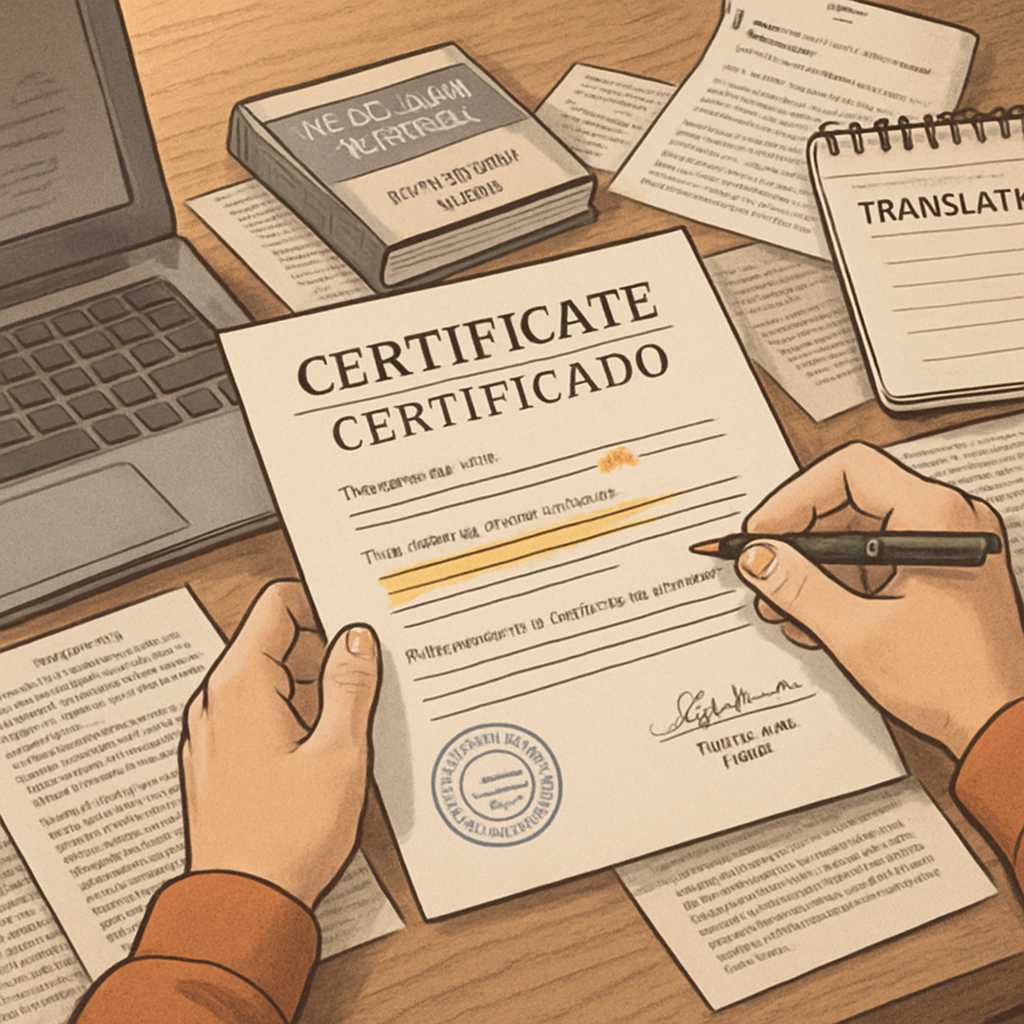
Bilingual Documents: What to Translate and What to Leave
A bilingual document translation is often misunderstood because people assume that once English appears anywhere on the page, the document is ready to submit. In practice, that is where many problems start. A certificate, transcript, statement, or civil record may look bilingual at first glance, but the parts that matter most for acceptance are often the parts still left in the other language: stamps, registrar notes, amendments, footnotes, handwritten comments, or reverse-side entries. UK authorities commonly expect a full translation that can be independently verified, and professional bodies also stress the need for a complete and accurate English version rather than a partial summary. (GOV.UK)
The safest way to think about a bilingual document is this:
- The question is not “Does this page contain English?”
- The real question is “Can every relevant element be understood and verified in English without guesswork?”
That single distinction is what separates a clean submission from one that creates delays, follow-up questions, or outright rejection.
If you are unsure whether your document needs a full translation or a targeted certified translation of the non-English sections, the smartest first step is to get the file reviewed before ordering. A pre-check is often faster and cheaper than correcting a rejected submission later.
The short answer
For most official purposes, use this rule:
- Translate any text that appears only in the foreign language.
- Translate stamps, seals, handwritten notes, annotations, side notes, and reverse-side entries if they contain meaningful information.
- Keep duplicated English text where it already appears clearly and matches the foreign-language version.
- Use translator’s notes where something is illegible, abbreviated, crossed out, or represented visually rather than as normal text.
- Do not assume a bilingual layout automatically removes the need for certification.
- Where an authority asks for a full translation, treat that literally. Where a document is already bilingual but not fully mirrored, treat every foreign-language-only element as content that still needs to be translated. That approach aligns with how official bodies describe completeness and certification. (GOV.UK)
Why bilingual documents still get rejected
A bilingual document can fail for five common reasons.
1. The two language versions are not actually identical
Many documents are only partly bilingual. The field headings may appear in two languages, but the actual entries, notes, or issuing authority details may appear in only one.
2. The most important information is hidden in stamps or notes
A round seal, registry stamp, margin annotation, or handwritten amendment can carry the very detail the receiving authority wants to verify.
3. The reverse side is ignored
Civil records, police certificates, transcripts, and bank documents often carry extra text on the back. If it matters, it needs to be translated too.
4. The translation is treated like a summary
Official use is rarely about “gist.” It is about completeness, traceability, and accountability.
5. The bilingual version contains inconsistencies
Sometimes the English text is older, shorter, or simplified compared with the foreign-language version. When that happens, the translation must not silently smooth over the difference.
The translate-or-leave rule
Here is the practical test that works best.
| Document element | Translate it? | Best practice |
|---|---|---|
| Field labels already repeated in English and another language | Usually no | Leave as part of the original layout if the English is already clear |
| Foreign-language-only entries | Yes | Translate fully |
| Stamps and seals | Yes | Translate the text or describe it in brackets |
| Handwritten notes | Yes, if legible | If unclear, note that it is illegible rather than guessing |
| Signatures | Usually describe, not translate | Use “[signature]” or identify the signatory if readable |
| Check boxes, ticks, crossed-out text | Yes, where meaningful | Show what was selected, cancelled, or amended |
| Reverse-side notes, registration text, footnotes | Yes | Include anything that affects meaning or status |
| Reference numbers, dates, document IDs | Reproduce exactly | Do not “normalise” them into a different format without explanation |
| Blank fields | Mark as blank | Use “[blank]” where helpful |
| QR codes or barcodes | Usually no | Keep the code visible; translate any accompanying text |
What usually needs translating every time
Foreign-language-only sections
If one language contains information the other does not, translate it. This sounds obvious, but it is the most common error in bilingual document translation.
Stamps, seals, and issue marks
A seal may confirm which office issued the record, whether it is an original extract, and whether it was registered or amended. That is not decoration. It is evidence.
A clean translator’s rendering might look like this:
- [Round seal: Civil Registry Office, Casablanca]
- [Blue stamp: Certified true copy]
- [Handwritten note in margin: Entry corrected on 14 May 2024]
Handwritten annotations
If someone has corrected a date, added a registrar note, initialled an amendment, or written a case number by hand, that can affect acceptance.
Back-page content
Never upload only the front if the reverse contains terms, explanations, or official endorsements.
Footnotes and legends
Transcripts, academic certificates, and government extracts often place grading scales, legal notes, or status explanations at the bottom of the page. Those usually matter more than people expect.
What can often stay as it is
There are parts of a bilingual document that can often remain untouched in the source layout.
Fully duplicated headings
If the page shows:
- Surname / Nom de famille
- Date of birth / Date de naissance
and both languages clearly repeat the same label, there is no value in re-translating the English half as though it were new information.
Numbers, document references, and codes
Document numbers, passport numbers, ledger references, QR references, and registration IDs should usually be reproduced exactly, not converted into a prettier or more local-looking form.
Proper names already written in Latin script
If the original already shows the name in English or Latin characters, the translator should normally preserve that form exactly unless the receiving body has asked for a specific transliteration standard.
When a translator’s note is essential
A strong bilingual document translation is not just about converting words. It is also about showing the receiving authority what kind of mark or notation appears on the original.
Use translator’s notes when:
- a stamp is partly legible
- handwriting cannot be read with confidence
- a word is abbreviated in a way that needs context
- part of the text is struck through
- two language versions do not fully match
- the document includes emblems, logos, or seals with text embedded in them
Examples:
- [Illegible handwritten note]
- [Text crossed out in original]
- [Seal partly legible; visible text reads “Ministry of …”]
- [English text on source is shorter than the Arabic text; Arabic section translated in full below]
This is one of the clearest differences between professional work and risky DIY submissions: a professional translator documents uncertainty honestly instead of hiding it.
A simple decision table for common bilingual documents
Birth and marriage certificates
These are often the documents people most often assume are “already bilingual enough.” Sometimes they are. Often they are not.
Translate:
- registrar notes
- issue details
- seals and stamps
- amendments
- reverse-side registration text
- any field completed only in the non-English language
Leave duplicated English labels as part of the source layout if they genuinely mirror the foreign-language text.
Academic transcripts and diplomas
These usually need more work than applicants expect.
Translate:
- module titles
- grading legends
- award classifications
- accreditation notes
- institutional remarks
- signatures and seals where meaningful
- footnotes explaining pass/fail or credit systems
Bank statements and financial records
If the document is bilingual, check whether transaction descriptions, branch notes, footer disclaimers, or certification marks remain in one language only.
Translate:
- issuer notes
- explanatory footers
- transaction labels if relevant to the purpose of submission
- branch or verification stamps
Contracts and corporate documents
These should be treated with extra care because small differences in wording can change meaning.
Translate:
- every operative clause that appears only in the foreign language
- schedules, annexes, signature blocks, and amendments
- side notes and execution marks
- stamps or registration endorsements
If the document is legally sensitive, do not rely on a partly bilingual format as evidence that no further translation is needed.
What a compliant certified package should include
A well-prepared submission usually includes three things:
1. A clean copy of the source document
The receiving authority should be able to see the original exactly as issued.
2. A complete English translation of all relevant non-English content
This is the part many people get wrong. “Complete” does not mean “main body only.” It means the content needed to understand and verify the document properly. UK guidance sets out specific certification details, and U.S. immigration instructions likewise refer to a full English translation certified as complete and accurate, with the translator confirming competence. (GOV.UK)
3. A certification statement
A proper certification statement should clearly cover:
- that the translation is accurate
- the date of translation
- the translator’s full name
- signature
- contact details
For U.S. filings, the certification normally also confirms the translator is competent to translate from the source language into English. (GOV.UK)
Formatting: preserve clarity, not clutter
Formatting plays a big role in acceptance because the receiving officer must be able to match the translated text back to the original.
Good formatting usually means:
- preserving the order of information
- matching headings and table structure where possible
- identifying seals, stamps, signatures, and notes clearly
- keeping page numbers aligned
- making it obvious when text came from the front or reverse side
- marking blank fields and crossed-out text
Poor formatting usually means:
- turning a table into a confusing paragraph
- omitting visual elements with text inside them
- rearranging clauses in a way that obscures where they came from
- cleaning up inconsistencies instead of reporting them
A bilingual document translation should be easy to compare side by side with the original. That matters just as much as the wording itself.
The biggest mistake: confusing duplication with exemption
This is the core mistake behind most failed bilingual submissions.
A bilingual heading is not an exemption. A bilingual template is not an exemption. A partly bilingual certificate is not an exemption. A document with some English on it is not necessarily submission-ready.
Only when the English already covers every relevant element, and the remaining non-English content adds nothing unique, is a lighter-touch approach sometimes workable. Even then, the safest route is still to have the file checked first.
What to do when the two language versions do not match
This is more common than people realise.
You may see:
- one language using abbreviations while the other spells everything out
- one side listing a middle name that the other omits
- different date formats
- one version including a note about re-issuance or correction
- a stamp appearing over only one language block
When this happens, the translator should not “pick the nicer version.” The discrepancy should be handled transparently. Sometimes that means translating the fuller version and adding a note. Sometimes it means recommending a full certified translation of the entire document rather than only selected parts.
That protects the applicant, the receiving authority, and the translator.
Will a partially translated bilingual document be accepted?
Sometimes, yes. Often, no.
A partially translated bilingual document has the best chance of acceptance when:
- the English already mirrors the foreign-language text completely
- all non-English-only elements have been translated
- the certification makes the scope of the translation clear
- the receiving authority has not asked for a full translation in blanket terms
A partially translated bilingual document is riskier when:
- there are foreign-language notes outside the main fields
- the document is for immigration, court, academic recognition, or another formal review
- the issuing body uses dense seals, legends, or marginal notes
- the authority specifically requires a full translation
- the document will later need notarisation or apostille handling
If the document is being prepared for overseas official use, remember that notarisation and apostille are separate steps from translation. In the UK, legalisation is handled by the Legalisation Office, which verifies the signature, stamp, or seal on qualifying documents by attaching an apostille. (GOV.UK)
Before you upload: a fast bilingual document checklist
Use this before ordering:
- Check every page, including the reverse
- Confirm whether all fields are truly duplicated in English
- Look for stamps, seals, margin notes, or handwritten amendments
- Check footnotes, legends, and grade scales
- Make sure names, dates, and document numbers are readable
- Scan in colour where seals or annotations may be faint
- Ask whether you need certification only, or certification plus notarisation or apostille
- Keep the source file complete and uncropped
The safest approach for faster acceptance
For bilingual document translation, the best rule is simple:
- Translate what adds meaning.
- Leave what is already fully clear in English.
- Certify the result properly.
- Never omit what an authority may rely on.
That is how you reduce review friction, protect acceptance, and avoid the expensive mistake of submitting something that only looks complete.
If your document is bilingual and you are not fully sure what needs translating, send the full scan before ordering. A quick document check is often the difference between a smooth submission and a frustrating second round.
FAQs
Do bilingual documents need certified translation?
Sometimes they do, sometimes they do not. If the document contains any meaningful information that appears only in the non-English language, that part should be translated. If the receiving authority requires a full translation, follow that wording literally.
Can I translate only the non-English sections of a bilingual document?
You often can when the English already duplicates the same information fully and clearly. But this only works safely when stamps, seals, notes, and reverse-side content are also checked and translated where needed.
Do stamps and seals need to be translated on bilingual documents?
Yes, if they contain text, status information, issuing authority details, registration numbers, or endorsement wording. They are often critical to acceptance.
What should a certification statement include for bilingual document translation?
At minimum, the certification should confirm accuracy, show the translation date, and include the translator’s name, signature, and contact details. For some U.S. uses, the statement also needs to confirm translator competence.
What if the English and foreign-language sides do not match?
Do not guess and do not ignore the difference. The discrepancy should be handled transparently, often with a fuller certified translation and, where needed, a translator’s note.
Do I need notarisation as well as certified translation?
Only if the receiving authority asks for it. Certified translation, notarisation, and apostille are related but separate requirements. Always confirm the exact level of formalisation before you submit.

