Why layout matters more than most people expect
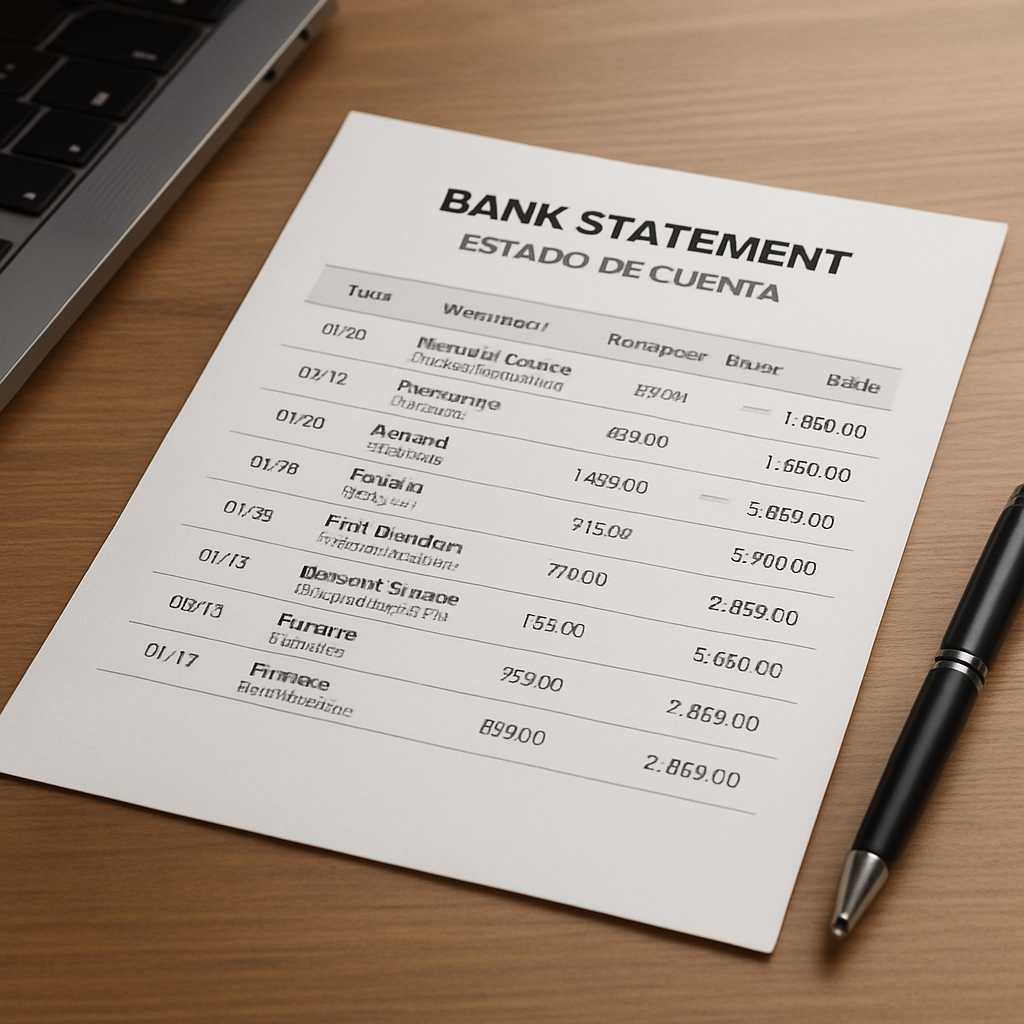
Bank statements are not ordinary paragraphs; they are structured evidence. A reviewer is usually looking at several things at once:
- account holder details
- statement dates
- opening and closing balances
- incoming and outgoing transactions
- running balance logic
- payment references
- notes, warnings, or bank-generated labels
When those elements are translated without preserving the structure behind them, the document becomes slower to review. That is when questions start appearing:
- Does this translated line match the original row?
- Is this amount a debit or a credit?
- Did the balance change correctly after this transaction?
- Is this note part of the bank statement or part of the translator’s wording?
- Has anything been merged, shortened, or omitted?
A clean layout removes that friction. It helps the receiving party focus on what the statement proves, rather than on whether the translation itself can be trusted.
The four parts of a bank statement that must stay intact
1. Account and statement header details
Before the table even begins, the header carries essential identifiers. These often include:
- account holder name
- bank name
- account or IBAN details
- statement period
- branch information
- account type
- currency
These details should stay in the same logical order as the source document. If the statement begins with identity information, the translation should not bury it at the bottom.
2. The transaction table itself
This is the core of the document. In most statements, each row contains a fixed logic:
- transaction date
- value date
- description
- debit or credit amount
- running balance
That logic must survive translation. Even if the exact visual style changes, the order and relationship between those fields should stay stable from row to row.
3. Totals and balance checkpoints
This is where many avoidable problems surface. A good translation makes it easy to confirm:
- opening balance
- total credits
- total debits
- closing balance
If those figures are not easy to spot, the whole statement becomes harder to verify.
4. Footnotes, codes, stamps, and side notes
Bank statements often include abbreviated payment references, service notes, exchange warnings, system-generated labels, or footer text. These should not disappear just because they are not part of the main transaction rows. If they affect meaning, context, or traceability, they belong in the translation.
The clean-formatting rule
The best bank statement translation formatting follows one rule: Mirror the logic of the source, not every decorative feature of the source. That distinction matters.
A useful translation does not need to imitate every font, icon, line thickness, or branding detail. It does need to preserve:
- page order
- section order
- row order
- column logic
- numeric clarity
- document hierarchy
That is the difference between a translation that is visually busy and one that is genuinely usable.
What to preserve, what to simplify
- Preserve exactly in meaning and order:
- dates, amounts, balances, row sequence, labels, notes, bank references
- Simplify where needed for clarity:
- fonts, spacing style, box styling, purely decorative lines
- Never change:
- transaction order, totals, currency, source meaning, missing or unclear text status
Column alignment: the small detail that prevents big confusion
Column alignment is one of the most important parts of bank statement translation formatting, especially when the file contains many rows. A reviewer should be able to scan down each column without guessing which figure belongs to which line.
Best practice for column alignment
- keep the same column order throughout the document
- align numerical amounts consistently
- separate debit and credit columns clearly where the source does
- keep balances in their own stable column
- repeat column headers on new pages if the statement runs long
- avoid squeezing translated descriptions so tightly that amounts appear to belong to the wrong row
A common mistake is trying to force long translated descriptions into the same visual width as the source language. That often creates a ripple effect across the row. A better approach is controlled wrapping that keeps the numbers locked in place.
When wrapping is unavoidable
Some languages expand in English. Transaction descriptions that were short in the source file can become longer after translation. When that happens:
- wrap only the description field
- keep the amount and balance fields fixed
- indent continuation lines so they clearly belong to the same row
- avoid splitting one transaction into multiple visual records unless clearly labelled
The row should still read as one transaction, not as three fragments.
Transaction descriptions: translate for clarity, not guesswork
Transaction descriptions often contain abbreviations, merchant references, location markers, salary labels, transfer notes, or machine-generated codes. These are rarely elegant even in the original language.
The wrong response is to rewrite them into polished prose. The right response is to preserve the underlying meaning while staying close enough to the source for comparison.
A safer approach to transaction descriptions
- translate understandable banking wording directly
- retain source references where they help traceability
- leave proper names unchanged unless standard transliteration is necessary
- identify unclear abbreviations carefully rather than inventing meaning
- use brackets sparingly when a brief explanation improves clarity
For example, a transaction line should still feel like banking data, not like a paraphrased summary. Good principle: make the line readable in English without hiding how it appeared in the original statement.
Totals checks: the fastest way to catch layout-driven errors
A useful translated statement is not only linguistically correct. It is mathematically reviewable. One of the strongest quality checks is a simple totals check:
Opening balance + credits – debits = closing balance
If the translation layout makes that check easy, trust rises quickly.
The four checks that matter most
Opening balance check
Confirm that the opening balance matches the first balance shown for the statement period.
Credit and debit consistency
Make sure incoming and outgoing amounts remain in the correct columns after translation and reformatting.
Running balance sequence
Spot-check the balance movement across several rows, especially near page breaks.
Closing balance confirmation
Check that the final balance matches the end-of-period figure in the source statement. This is where table integrity becomes more than a visual issue. A messy layout can hide the fact that a value has slipped into the wrong column or attached itself to the wrong transaction.
Table integrity on multi-page bank statements
Longer bank statements create extra formatting risk. Problems often appear when:
- a table continues across multiple pages
- the original repeats headers but the translation does not
- a page begins mid-transaction
- the running balance is separated from its row
- totals appear only at the end without earlier context
How to preserve table integrity across pages
- keep page order identical to the source
- repeat column headers where the source structure naturally restarts
- carry over balances clearly
- preserve section breaks such as monthly summaries or account sub-sections
- mark page numbers consistently if the source uses them
A multi-page translation should feel like one coherent document, not a stack of disconnected pages.
What should never be edited in a translated bank statement
Certain shortcuts make a bank statement easier to typeset but weaker as evidence. Do not:
- reorder transactions for readability
- combine similar rows into one summary line
- round amounts
- convert currencies unless the source already provides a converted figure
- rewrite vague transaction descriptions into assumed explanations
- remove repeated labels just because they look repetitive
- omit notes, headers, or footer warnings that appear to be minor
A bank statement is not marketing copy. Repetition, codes, and routine labels are part of how the document proves itself.
A simple “messy vs clean” example
Here is the difference in practice.
Messy version
- description wraps into amount space
- credit and debit figures sit too close together
- running balance appears detached from the row
- monthly total is shown without clear label
- second page starts with figures but no column headers
Clean version
- description wraps neatly under the same transaction
- debit, credit, and balance columns remain fixed
- each row still reads as one event
- totals sit in clearly labelled balance lines
- new page repeats the headers for quick comparison
The second version does not need to be prettier. It only needs to be easier to verify.
The reviewer-first model: a better way to format bank statement translations
The most useful way to handle financial tables is to think like the person checking them. A caseworker, lender, solicitor, compliance officer, or HR reviewer usually wants three things:
- quick orientation
- clear row-by-row comparison
- confidence that the totals still make sense
That is why the strongest formatting decisions are often the simplest ones:
- clear labels
- stable columns
- complete rows
- visible totals
- consistent pagination
- full translation of relevant notes
- no unnecessary redesign
This reviewer-first model is where many weaker pages on the topic fall short. They talk about “accuracy” as if it sits only in the words. In reality, financial document accuracy also lives in structure.
Official use: what different reviewers tend to care about
For UKVI and immigration files
The translation needs to be complete, independently verifiable, and easy to compare against the original. Bank statements are often reviewed alongside passports, sponsor letters, employment evidence, and other financial records, so consistency matters.
For lenders and mortgage underwriters
The emphasis is usually on readability, financial traceability, and quick cross-checking. A lender does not want to decode a cluttered English version while assessing source of funds or transaction history.
For solicitors and legal teams
The translation needs to sit cleanly inside a wider evidence pack. Page sequence, exhibit consistency, labels, notes, and visual order matter more than people expect.
For corporate compliance teams
The key issue is controlled clarity. They want translated financial data that can be reviewed without uncertainty, especially where the statement supports onboarding, due diligence, or audit-related checks.
Common reasons bank statement translations get queried
Even when the language itself is correct, problems still arise from presentation. The most common triggers are:
- broken column alignment
- incomplete translation of transaction notes
- missing balance labels
- unclear debit and credit separation
- removed or unmarked stamps and notes
- inconsistent date formatting
- poor scan quality at source
- descriptions translated too freely
- totals that are hard to match back to the original
- missing certification details on the final package
Most of these are preventable before the file is delivered.
What to send before translation starts
Good formatting begins with good input. Before ordering, send:
- a complete scan of every page
- pages in the correct order
- uncropped headers and footers
- clear visibility of balances and transaction rows
- any page that contains notes, stamp marks, or end-of-period totals
- the exact purpose of the translation if known
It also helps to say whether the file is for:
- UKVI
- a lender
- a solicitor
- an employer
- a university
- internal compliance
- overseas submission
That lets the final format match the real use case from the beginning.
Why “submission-ready” is better than “looks identical”
People often assume the ideal translation is a perfect visual clone of the original statement. That is not always true. A better target is submission-ready clarity:
- easy to compare
- easy to verify
- easy to file
- easy to trust
Sometimes that means tightening spacing. Sometimes it means repeating headers. Sometimes it means labelling notes more clearly than the source did. The best formatting decisions are the ones that keep the evidence strong without distorting it.
Final thought
Bank statement translation formatting is not about making a document look polished for its own sake. It is about protecting meaning, preserving table integrity, and making official review easier. When the layout is handled properly, the translation does its job quietly. The reviewer can see the account details, follow the transaction history, check the totals, and move on with confidence.
That is the standard worth aiming for: not just translated, but clearly usable.
Need a bank statement prepared for official review, a solicitor’s file, lender checks, or UK submission? Send a clear scan and get it formatted for accuracy from the first line to the final balance.
FAQs
Does a bank statement translation need to keep the same table layout?
It should keep the same table logic, even if the exact design changes. The order of columns, the relationship between each transaction and its amount, and the running balance structure should remain easy to compare with the source.
Do all transaction descriptions need to be translated?
Yes, where they form part of the statement being relied on. Transaction descriptions, payment references, notes, and labels can all affect meaning, context, and traceability.
How do you check totals in a bank statement translation?
Start with the opening balance, total credits, total debits, and closing balance. Then confirm that the balance movement shown in the translated table still matches the original statement logic.
Can transaction descriptions be shortened to save space?
They should not be casually shortened. A description can be formatted more neatly, but the meaning should stay intact and traceable to the source line.
What is the biggest formatting mistake in a translated bank statement?
Broken column alignment. Once amounts, balances, and descriptions stop lining up clearly, the whole document becomes harder to verify.
Do stamps, footnotes, and handwritten notes need to be translated on a bank statement?
If they appear on the source and affect meaning, identity, authenticity, or review context, they should be accounted for in the translation.

