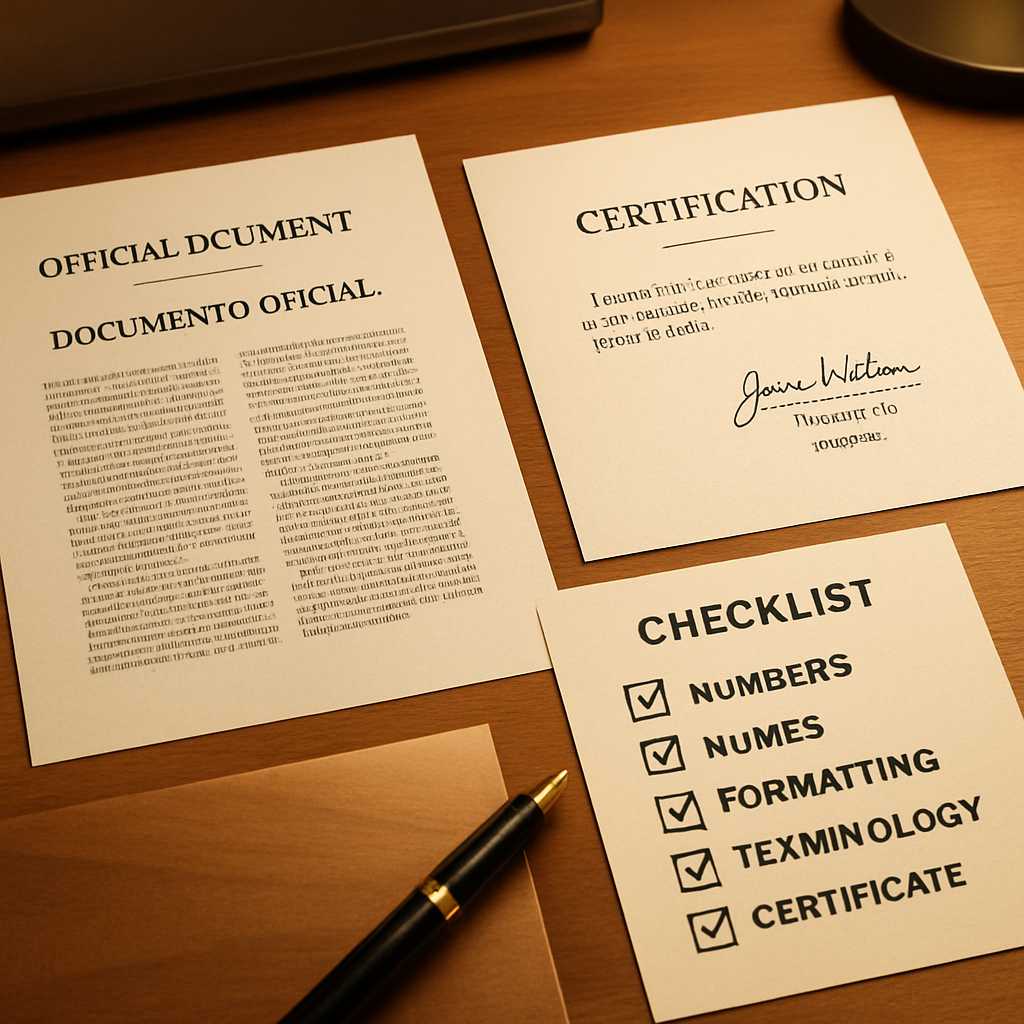
Urgent Translation Quality Checks: Minimum Checks That Should Always Happen
When deadlines are tight, urgent translation quality checks matter even more, not less. A fast translation that misses a date, mistranslates a number, drops a name variation, or carries the wrong certification can create delays that are far more expensive than the rush itself.
That is why the best urgent translation work is not simply faster. It is more disciplined. The goal is not to run every file through a long, ideal-world process. The goal is to make sure the right minimum checks always happen before the document leaves the translator’s desk.
If you need a document for a visa application, court matter, bank review, university deadline, employer request, or official submission, speed only helps when the translation is still accurate, complete, and ready to be accepted the first time.
A good urgent workflow focuses on five things first: numbers, names, formatting, terminology, and certificate verification. Get those right and most last-minute submission risks drop sharply.
Fast Should Mean Prioritised, Not Unchecked
People often assume urgent translation quality means cutting corners carefully. In practice, that is exactly what causes avoidable problems.
A rushed file can still be reliable when the work is structured around risk. In official and certified translation, the biggest failures are rarely poetic language issues. They are practical, submission-stopping issues such as:
- a passport number entered incorrectly
- a date switched into the wrong format
- a surname spelt two different ways in one pack
- a table total that no longer matches
- a certificate page with missing details
- a stamp, note, endorsement, or side annotation left untranslated
These are not “small” mistakes. They are the mistakes that trigger questions, rework, and missed cut-offs.
The Minimum Check Sequence That Should Never Be Skipped
Below is the non-negotiable review sequence for urgent work.
| Check | What Must Be Reviewed | Why It Matters |
|---|---|---|
| Number checks | Dates, ID numbers, reference numbers, amounts, totals, page counts | One wrong digit can change the meaning of the whole document |
| Spelling consistency | Names, places, institutions, recurring terms | Inconsistent spelling makes documents look unreliable |
| Formatting review | Headings, tables, labels, seals, stamps, footnotes, signatures | A clean structure helps the recipient compare source and translation |
| Sense and terminology review | Key legal, financial, medical, or academic terms | Literal wording can still be wrong for the context |
| Certificate verification | Accuracy statement, date, signature, contact details, credentials where needed | A correct translation still fails if the certification page is incomplete |
1) Number Checks Come First
If the document is urgent, numbers should be checked before almost anything else. This includes:
- dates of birth
- issue and expiry dates
- passport and ID numbers
- case numbers
- invoice amounts
- account balances
- percentages
- addresses and postcodes
- document reference numbers
- article, clause, or exhibit numbers
Why start here? Because numbers are where fast work most often breaks. A translator can produce excellent wording and still lose the submission if 03/04 becomes 04/03, if a court exhibit reference is shifted, or if a bank statement total is mistyped. Official recipients often scan documents quickly. If the numbers do not align, trust disappears immediately.
What a Proper Number Check Looks Like
A real number check is not just a glance. It means comparing the translated document against the source and confirming:
- every number appearing in the source appears in the translation where expected
- date format is handled consistently
- totals and balances are preserved accurately
- repeated numbers match every time they reappear
- handwritten or low-resolution digits have been interpreted carefully
Example
A bank statement translation may look polished, but if the closing balance differs from the original by one digit, the document can raise questions even when the rest is correct. The same applies to passport pages, degree certificates, tax documents, and court records.
If your deadline is today, send the clearest version of the document you have and flag any critical dates or reference numbers at the start. That gives the project team the right points to double-check first.
2) Spelling Consistency Protects Credibility
The second core part of urgent translation quality checks is spelling consistency. This is especially important for:
- personal names
- parent names
- institution names
- cities, regions, and addresses
- document titles
- repeated terms such as “certificate”, “judgment”, “statement”, or “ministry”
In urgent work, inconsistency often appears when the same name is written differently across multiple pages or when a translator follows the source on one page and a passport transliteration on another.
For example:
- Mohamed / Mohammed / Muhammed
- Aleksei / Alexey
- Ministry of Interior / Ministry of the Interior
- Faculty of Law / School of Law
Sometimes the source document itself is inconsistent. That does not mean the translation should guess. It means the inconsistency should be handled carefully and, where necessary, reflected or clarified in the right way.
Why This Matters for Official Submissions
Reviewers compare documents across a pack, not just page by page. If a surname is spelt one way on a birth certificate, another on a bank statement, and a third on the translation certificate, the result can look careless even if the source documents caused the variation. That is why urgent jobs need a quick consistency sweep before delivery, especially where multiple documents are submitted together.
3) Formatting Review Is Not Cosmetic
Formatting review is often mistaken for a “nice to have.” It is not. A clean formatting review helps the receiving authority understand the document faster and reduces the chance of important information being overlooked.
This check should cover:
- page order
- headings and subheadings
- tables and columns
- line breaks in names and addresses
- stamps and seals
- handwritten notes
- footnotes
- marginal notes
- endorsement pages
- signature labels
- document labels such as “issued on”, “authority”, “holder”, “place of birth”
The purpose is not to redesign the document. It is to preserve the structure clearly enough that a reader can follow what belongs where.
Where Formatting Errors Cause Real Problems
Formatting issues become serious when:
- a bank statement table no longer lines up clearly
- a certificate field is attached to the wrong value
- a passport observation is separated from the relevant page
- a court order loses paragraph numbering
- an academic transcript breaks module names from marks or credits
Urgent jobs should always include a final visual pass. Even a short one catches problems that word-by-word reviewing can miss.
4) A Spelling Check Is Not a Quality Check
Spellcheck is useful. It is not enough. One of the biggest myths around urgent translation quality checks is that a quick proofreading pass means looking for typos. In reality, the most important review questions are:
- Does the term fit the subject area?
- Does the sentence preserve the legal or administrative meaning?
- Has a standard phrase been translated in a way the recipient will recognise?
- Has an abbreviation been expanded, retained, or explained correctly?
- Has the translator preserved the distinction between labels, notes, and body text?
This matters in every specialist area.
Legal Documents
A legal translation can fail even with perfect grammar if clause references, procedural wording, or evidential labels are softened, broadened, or over-explained.
Financial Documents
A financial translation can become unreliable if account types, debit or credit wording, or statement labels are translated too literally.
Academic Documents
An academic translation can create confusion if grading terms, institutional labels, or award classifications are normalised too aggressively.
Medical Documents
A medical translation can become risky if abbreviations, dosage units, or diagnosis wording are guessed rather than checked. The right urgent process is not “translate fast and hope the language sounds natural.” It is “translate accurately and review the terms that carry the most risk.”
5) Certificate Verification Must Happen Before Delivery
For official documents, certificate verification is one of the most important urgent translation quality checks. This is where many otherwise accurate translations fail. The translation may be perfectly usable, but the certification page is incomplete, inconsistent, or missing information the receiving body expects.
A final certificate review should confirm that the certification page includes the required accuracy wording and the correct supporting details for the intended use.
Certificate Review Checklist
Before sending an urgent certified translation, confirm:
- the certificate states the translation is true and accurate
- the translation date is present
- the translator’s or company representative’s name is present
- signature details are included where required
- contact details are included
- any required credentials or company details are included for the submission type
- the client name, document title, and file pack match the actual job
This is also where delivery problems happen. A file may be translated correctly, but the wrong certificate is attached, an old template is used, or a name is carried over from another project. That is why certificate verification belongs at the end of every urgent workflow.
The Documents That Need This Discipline Most
Urgent translation quality checks are especially important for documents that are short, formal, and packed with sensitive details. These include:
- birth certificates
- marriage certificates
- passports
- driving licences
- bank statements
- payslips
- court orders
- witness statements
- police certificates
- academic transcripts
- diplomas
- medical letters
- immigration evidence
- notarised and apostilled records
Short documents are deceptive. Because they are compact, every detail matters more. A small error is easier to spot and harder to excuse.
What Clients Can Do in the First 10 Minutes to Improve Quality
Speed and quality improve dramatically when the client provides the right information upfront. If the deadline is tight, send:
- the clearest scan available
- all pages, including blank backs if they contain stamps or numbering
- the target language
- the submission country
- the receiving authority, if known
- the required delivery format
- any name spelling that must match a passport or existing application
- the exact deadline
- a note confirming whether certification, notarisation, or hard copy is needed
This helps the team prioritise the right checks immediately instead of losing time to preventable clarification. If you are ordering today for an official submission, upload the file together with the recipient details from the start. That is often the difference between a fast clean delivery and a fast avoidable correction.
When the Deadline Should Be Challenged
Not every deadline can be met safely. A good urgent provider should say so when necessary. Red flags include:
- poor scan quality
- cut-off edges
- handwritten amendments
- long multi-document packs
- rare language pairs
- multiple certificates in one order
- heavy table formatting
- source inconsistencies across pages
- unclear seals or stamps
- last-minute changes after translation has started
The right response is not to promise everything. It is to protect the client from a bad submission. Sometimes the best urgent solution is staged delivery: first, the highest-priority pages; then, the rest of the pack; then, printed or legalised copies if needed. That approach keeps the essential deadline moving without sacrificing the parts that still need careful review.
A Better Way to Think About Urgent Translation Quality
The real standard for urgent work is not perfection at any cost. It is controlled risk. A well-run urgent translation process asks:
- Which details would cause rejection, confusion, or rework?
- Which sections carry legal or administrative weight?
- Which checks can never be skipped?
- Which questions must be answered before delivery?
That is why the strongest urgent teams work from a minimum viable quality model: check what can break acceptance first, review the terms that carry the most meaning, verify the format, verify the certificate, and deliver only when the document is ready to be used.
Final Thought
Urgency does not remove the need for quality. It makes quality more targeted. When a document is needed for a same-day or next-day submission, the safest approach is not to chase speed blindly. It is to make sure the right minimum checks always happen: number checks, spelling consistency, formatting review, terminology review, and certificate verification. That is the difference between a translation that arrives quickly and a translation that can actually be used.
If your deadline is close, send the clearest copy you have, mention who the document is for, and ask for the file to be checked specifically for names, numbers, formatting, and certification before delivery. That simple step can save far more time than a rushed correction later.
FAQs
What are urgent translation quality checks?
Urgent translation quality checks are the minimum review steps that should happen before a fast translation is delivered. They usually include number checks, spelling consistency, formatting review, terminology review, and certificate verification.
Can a same-day translation still be accurate?
Yes, a same-day translation can still be accurate if the job is scoped properly and reviewed in the right order. Fast delivery becomes risky when key checks are skipped, especially for names, dates, totals, and certification details.
Which mistakes matter most in urgent certified translations?
The biggest risks are usually incorrect numbers, inconsistent names, broken formatting, mistranslated key terms, and incomplete certification. These are the mistakes most likely to delay or weaken an official submission.
Why is certificate verification important in urgent translation?
Certificate verification matters because an accurate translation can still be rejected if the certification page is incomplete or does not match the submission requirements. The certificate should always be checked before delivery.
How can I reduce errors in an urgent translation request?
Send a clear scan, include all pages, state the target language, name the receiving authority, confirm whether certification is needed, and point out any names or numbers that must match another official record.
Do urgent translation quality checks differ by document type?
Yes. A passport translation needs close attention to personal data, numbers, and endorsements. A bank statement needs careful layout and totals checks. A court document needs paragraph numbering, references, and precise terminology. The core checks remain the same, but the risk focus changes by document type.

