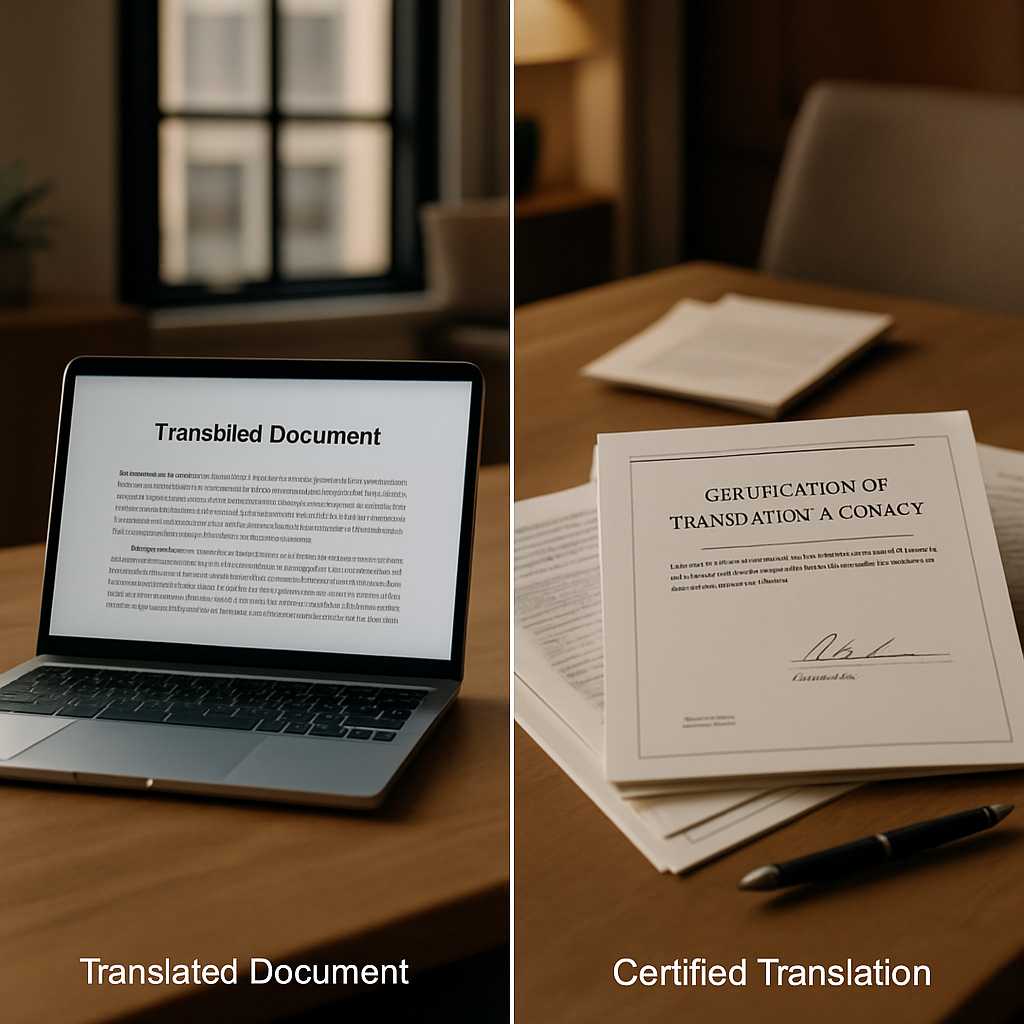
Machine Translation Not Accepted? Why Official Submissions Can Fail Even If They Look Fine
A machine-translated document can look polished, fluent, and perfectly readable on screen. That is exactly why people get caught out. The problem is not whether the text “sounds right” at first glance. The problem is whether it meets the standard an authority, court, university, employer, or caseworker expects when they review it as evidence.
For official submissions, readable is not enough. Reviewable is what matters.
In the UK, official guidance commonly expects a full translation that can be independently verified and includes specific translator details such as accuracy confirmation, date, name, signature, and contact information. In some immigration contexts, if the translation is missing or cannot be verified, the document may effectively be treated as not provided. (GOV.UK)
That is why the phrase machine translation not accepted keeps surfacing in real-world submission problems. The issue is rarely just grammar. It is usually one of five things:
- there is no certificate or signed declaration
- there is no accountable translator behind the wording
- names, dates, numbers, and registry details are mishandled
- stamps, notes, or layout elements are missed
- the receiving body cannot independently verify what was submitted
When that happens, a translation that looked “fine” stops being useful the moment it reaches a formal review desk.
Fluent is not the same as filing-ready.
A document can read smoothly and still fail because the acceptance test for official use is stricter than the readability test for casual use.
Why Official Bodies Reject Machine-Translated Documents
1. There is No Certification Page or Accountable Person Behind It
This is the biggest gap.
Machine translation tools produce text. Official submissions usually require a translation package. That package often needs a declaration that the translation is accurate, plus the translator’s or translation company’s identifying details. UK guidance for visa and immigration evidence spells this out clearly, and UK court rules also require signed or verified translations in relevant contexts. USCIS similarly requires a full English translation with certification that it is complete, accurate, and produced by a competent translator. (GOV.UK)
A machine cannot sign a statement of truth. A machine cannot confirm professional credentials. A machine cannot answer a follow-up query from an authority. A machine cannot stand behind the document if something is challenged later.
That is why a fluent output without certification is still weak evidence.
2. Accuracy Risk Shows Up in the Parts People Check Last
Most people focus on sentences. Reviewers often focus on the details around the sentences.
Official problems usually come from small, high-impact elements such as:
- surnames and middle names
- dates in different country formats
- document numbers
- seals, stamps, and embossed text
- handwritten notes
- side notes and registry annotations
- footers, headers, barcodes, and references
- page numbering and attachments
Machine output may produce something that reads well while quietly dropping one of those details, simplifying it, or rendering it inconsistently. That is especially risky when the submission involves identity, chronology, qualifications, civil status, court evidence, or financial proof.
3. Formatting is Part of Meaning
With official records, layout is not cosmetic. It often carries evidential value.
A birth certificate is not just a block of words. A court order is not just a paragraph. A bank statement is not just a list of transactions. Their structure tells the reviewer what is original text, what is a stamp, what is a handwritten amendment, what is an issuing authority note, and what belongs on a second page rather than the first.
If the translation flattens everything into plain text, several problems appear at once:
- the reviewer cannot easily compare source and target
- important annotations can disappear into the wrong line
- signatures and seals can be left unexplained
- attachments may be omitted
- the document becomes harder to verify quickly
That is one reason official translation work is a document-handling task, not just a language task.
4. Authorities Assess Verifiability, Not Just Readability
A common mistake is assuming acceptance depends on whether the reviewer personally understands the English wording.
It usually does not.
Authorities are looking for a document they can trust as part of a formal process. That means they want to know:
- who translated it
- whether the whole document was translated
- whether the translator or company can be identified
- whether the translation follows the source faithfully
- whether the submission can survive later scrutiny
That is why UK guidance uses language around independent verification and why court rules require the translation to be signed or formally verified in certain proceedings. (GOV.UK)
5. “Good Enough” is the Wrong Threshold for Official Use
The American Translators Association describes generic machine translation as useful for getting an approximate idea of what a foreign-language message says. That is helpful for casual understanding, triage, and low-stakes reading. It is not the same as a final document prepared for formal reliance. USCIS decisions show the practical difference: a Google-translated exchange was not treated as sufficient, and the absence of proper certification meant the agency could not meaningfully rely on it. (American Translators Association (ATA))
That is the real divide:
- casual use: “What does this roughly say?”
- official use: “Can this be accepted, verified, filed, and relied on?”
Those are two different jobs.
The Acceptance Test That Matters More Than Fluency
A useful way to think about this is to stop asking, “Does it read well?” and start asking, “Would this survive a formal review?”
For official submissions, a translation usually needs to pass five checks.
The Five-Part Acceptance Test
1. Completeness
Every relevant part of the source is covered, including stamps, notes, references, and marginal text.
2. Accuracy
The wording is correct in context, not just dictionary-correct in isolation.
3. Accountability
A real translator or translation company is identified and stands behind the output.
4. Certification
The package includes the declaration or certification the receiving body expects.
5. Presentation
The translated document is laid out clearly enough for a reviewer to compare and trust.
Machine translation can sometimes help with the first ten seconds of understanding. It usually struggles with the full five-part acceptance test.
Where People Get Caught Out Most Often
Visa and Immigration Submissions
This is where many rejections begin. Applicants see a readable translation and assume the job is done. But immigration reviewers look for specific supporting details, and the UK guidance is explicit that documents not in English or Welsh must be accompanied by properly certified translations with named, dated, verifiable information. (GOV.UK)
Typical failure points include:
- missing certification wording
- no translator signature
- no contact details
- partial translation of a multi-page document
- inconsistent spelling of names across different documents
- untranslated stamps or issuing authority notes
Court and Legal Use
Legal settings are even less forgiving.
Civil and family procedure rules in England and Wales require translated affidavits or statements to be handled in a formally compliant way, including signed or verified translations depending on the context. (Government Justice)
A translation that merely sounds correct is not enough where:
- wording affects legal meaning
- evidence must be filed formally
- the opposing side may challenge the document
- the court needs to know exactly what was translated and by whom
Universities, Employers, and Professional Bodies
Academic transcripts, diplomas, police records, licences, and employment records often look straightforward. They are not.
These documents commonly contain:
- abbreviations that require judgment
- institutional terminology
- grading language
- registry codes
- issuing authority notes
- official stamps and reference numbers
A machine may translate the obvious lines while mishandling the parts that actually establish authenticity.
Banking, Compliance, and Due Diligence
When a submission supports source of funds, corporate ownership, identity, or compliance checks, the tolerance for ambiguity is low. Reviewers are not trying to admire the English. They are trying to confirm facts quickly, safely, and defensibly.
That is why accuracy risks around numbers, dates, names, and formatting matter so much here.
What a Safer Workflow Looks Like
If a document is going to be submitted, relied on, or attached to an application, the safer route is a human-led workflow built for official use.
Step 1: Start with the Complete Source File
Use a clean scan or clear photo set. Include every page, stamp, reverse side, annex, and handwritten addition.
Step 2: Match the Translator to the Document Type
Legal, academic, financial, and civil records are not interchangeable. The translator needs document familiarity, not just language ability.
Step 3: Translate the Whole Record, Not Just the Obvious Text
That includes titles, seals, notes, references, headings, and page-level context.
Step 4: Add the Certification Package
For many official uses, this is the part that turns text into a submission-ready document.
Step 5: Check Names, Dates, and Numbers Separately
This should be a dedicated quality step, not a casual skim.
Step 6: Deliver in a Format the Reviewer Can Work With
Usually that means a clean PDF, clear page order, and a presentation that makes source-to-target comparison easy.
This is also where a professional provider adds real value: not by making the English prettier, but by reducing submission risk.
A Simple Example of How “Looks Fine” Can Still Fail
Imagine a birth certificate translated by a free tool.
At first glance, it reads smoothly. The child’s name is there. The parents’ names are there. The place of birth is there.
But then the reviewer notices:
- the registry annotation in the margin is missing
- the issue date is presented in the wrong order
- the issuing office stamp is not translated
- the certification page is missing
- there is no signature, no contact information, and no way to verify who produced it
That document may look fine to the applicant. To the reviewing authority, it is incomplete and unsupported.
That is the real danger with machine translation in official submissions: it can hide risk behind fluency.
When Machine Translation Can Still Be Useful
Machine translation does have a place.
It can help when you need to:
- get the gist of a document quickly
- decide whether a file is relevant
- sort large volumes of non-critical material
- understand an informal message before taking the next step
That lines up with ATA guidance describing machine translation as useful for approximate understanding in casual situations. (American Translators Association (ATA))
But there is a clear line between previewing a document and submitting a document.
Use machine translation to understand. Use professional certified translation to submit.
What to Ask for If You Need a Submission-Ready Translation
Before you order, ask for all of the following:
- full translation of every relevant page
- certification or statement of accuracy
- translator or company details
- date and signature where required
- faithful treatment of stamps, seals, notes, and annotations
- consistency check for names, dates, and numbers
- delivery in a clear PDF format suitable for review
- urgent turnaround options if a deadline is close
That short checklist prevents a surprising number of avoidable problems.
Why Many Clients Choose TS24London for Official Document Translations
For people who need formal document translations rather than rough machine output, TS24’s certified translation pages position the service around accountable, human-led handling: certified translations from £30 + VAT, ATC membership, CIOL and ITI-qualified translators, urgent options, and a process built around quality control. TS24 also states it has 15+ years in business, a network of 8,000+ qualified translators, and service to over 25,000 companies. Its certified translation page shows a 4.9/5 review score, while Trustpilot lists a 4.9 score from 176 reviews. (translationservices24.com)
Clients repeatedly highlight the same points that matter for official use: fast turnaround, responsive amendments, careful formatting, and confidence that the translation meets the required standard. (Trustpilot)
If your documents are for UKVI, court use, university enrolment, employment checks, banking, or another formal process, the safer move is to have them reviewed and prepared properly before you submit. A fast quote is useful, but the bigger win is avoiding delay, rework, and avoidable rejection.
Upload your file, get a proper assessment, and make sure the document you submit is built for acceptance, not just readability.
A Quick Submission Checklist
Before sending any translated document, confirm all of this:
- The original-language document is complete.
- Every page has been translated where needed.
- Stamps, notes, seals, and handwritten additions are covered.
- Names match the spelling used across your wider application.
- Dates and numbers have been checked separately.
- The translation includes certification wording.
- The translator or translation company can be identified and contacted.
- The final PDF is clean, readable, and easy to compare with the source.
If any one of those is missing, the document may still look fine while being weaker than it appears.
FAQs
Is machine translation not accepted for official documents in the UK?
It is often not enough on its own for official use. What authorities typically want is a full, certified, verifiable translation prepared by a professional translator or translation company, not just readable English text. (GOV.UK)
Why is machine translation not accepted even when it looks accurate?
Because official review is not based on fluency alone. Reviewers look for certification, accountability, completeness, formatting fidelity, and the ability to verify who produced the translation.
Can I use Google Translate for visa or Home Office documents?
It is a poor choice for final submission. UK guidance expects a full translation that can be independently verified and includes named translator details, date, and signature information where required. (GOV.UK)
What is missing from a machine-translated document?
Usually the missing pieces are the certificate, translator identity, signature trail, formatting treatment of stamps and notes, and a documented quality check for names, dates, and numbers.
Are formatting issues a real reason documents get questioned?
Yes. In official records, formatting carries meaning. Missing stamps, misplaced annotations, omitted side notes, and flattened layouts can all reduce trust in the submission.
When is machine translation acceptable?
It is useful for rough understanding, internal triage, and getting the gist of non-critical text. It is much less suitable as the final version of a document that will be formally submitted or relied on. (American Translators Association (ATA))

