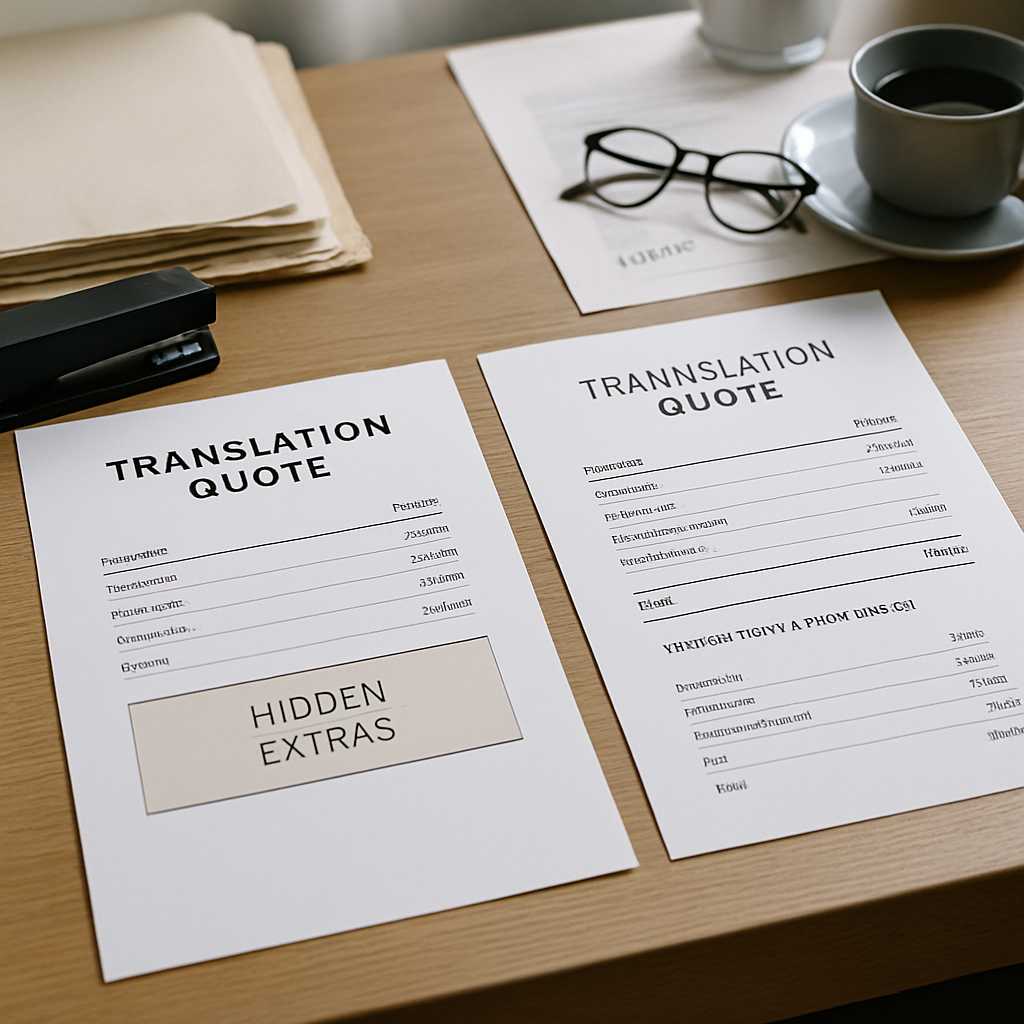
The simple rule: compare like with like
Before you compare two prices, make sure both quotes are based on the same brief. That means checking whether both providers are quoting for:
- the same document set
- the same source and target language
- the same level of certification
- the same turnaround
- the same delivery format
- the same number of pages or words
- the same formatting expectations
- the same revision policy
If one quote includes certification and the other adds it later, those are not comparable. If one quote is for digital delivery only and the other includes a printed hard copy, those are not comparable. If one quote assumes a 3-day turnaround and the other is priced for same-day delivery, those are not comparable.
A useful way to think about it is this: A translation quote is only comparable when the scope, speed, output, and accountability are the same.
Why translation quotes vary so much
Translation pricing is not fixed across the industry. Providers may charge by page, by word, by document type, or by project. Some bundle their service. Others split everything into separate line items. That is why a quote can look cheaper at first glance, then become more expensive once certification, formatting, urgent handling, or hard-copy delivery is added.
In most real-world cases, quote differences come from five things:
1. Certification is included or excluded
For official documents, this is one of the biggest price separators. A quote may cover:
- translation only
- translation plus certification statement
- translation plus certification plus stamp or hard copy
- translation plus notarisation support or additional formalities
If you are submitting documents to a UK authority, do not assume certification is automatically included. Ask directly.
2. Turnaround is different
Fast work changes price. A same-day quote, a 12-hour quote, and a 24-hour quote are not interchangeable, even for the same document. If your deadline is tight, compare the urgency window carefully rather than just the total.
For example, a provider may quote low for standard turnaround, while another prices for next-day submission readiness. Those are different services.
3. Revisions may or may not be included
One quote may include a reasonable correction round for translator-side issues. Another may treat every amendment as billable. This matters more than people think. If a name spelling needs aligning with a passport, or a delivery format needs adjusting for the receiving authority, a rigid revision policy can turn a lower headline price into a higher final cost.
4. Delivery method changes the quote
Digital PDF delivery is different from printed hard copy delivery, wet signature requests, courier dispatch, or multiple copies for different authorities. If one provider is quoting email delivery only and the other includes physical dispatch, compare the outputs, not just the number.
5. Formatting and file condition affect effort
A clean certificate scan is faster to process than a poor phone photo, a cut-off page, a multi-document bundle, or a layout-heavy file. If the quote is based on unclear source files, expect either delay, revision, or repricing later.
The 10-point checklist for comparing translation quotes properly
Use this checklist before approving any quote.
1. Is certification included?
Do not settle for vague wording like “official” or “valid for use” without asking what is actually included. Look for a clear answer on whether the quote includes:
- the translation itself
- a certification statement
- translator or company details
- signature or authorised certification format
- final submission-ready file preparation
2. Is the turnaround realistic?
A quote should state when delivery starts and what “same day” or “24 hours” actually means. Ask:
- Does the clock start when I send the enquiry, or when I approve the quote?
- Is the time based on working hours only?
- Is the file ready for submission by that deadline, or only translated by then?
3. Is the quote based on the full document set?
Many comparison errors happen because one supplier saw all pages and another only saw one sample. Always send the complete file pack before comparing prices.
4. Is the service human translated and reviewed?
For official use, clarity matters. Ask whether the document is translated and checked by a qualified human linguist, and whether quality review is part of the quoted service.
5. What exactly counts as a revision?
Ask whether the quote includes:
- corrections for translator-side errors
- minor formatting adjustments
- transliteration alignment with passport spelling
- update charges if you resend a new or cleaner scan
6. Is delivery digital, printed, or both?
The cheaper quote may simply be missing the format you need. Ask whether the provider will deliver:
- certified PDF by email
- printed copy
- same-day dispatch
- multiple hard copies
7. Are there rush or after-hours surcharges?
Some quotes look competitive until the job is approved, then a rush fee appears separately. Always ask whether urgency, evening handling, or weekend work changes the final price.
8. Are formatting and document layout included?
For official documents, layout clarity matters. A provider who returns a plain block of translated text may not be giving you the same outcome as one who formats the file to follow the original structure clearly.
9. Is there a named company or accountable provider behind the quote?
A quote should tell you who is responsible for the work and how they can be contacted. Accountability matters when the document is going to an authority, court, or institution.
10. Is the quote matched to the purpose of the document?
A birth certificate for UKVI is not the same as a marketing brochure. A contract for legal review is not the same as an internal memo. Choose a provider whose quote reflects the actual use case.
A quick side-by-side quote comparison framework
Here is the fastest way to compare two quotes without missing the details that matter.
| Comparison point | Quote A | Quote B | What matters |
|---|---|---|---|
| Translation included | Yes / No | Yes / No | Basic starting point |
| Certification included | Yes / No | Yes / No | Essential for official use |
| Turnaround | Same day / 12h / 24h / standard | Same day / 12h / 24h / standard | Must be truly equivalent |
| Review / QA | Included / extra | Included / extra | Affects reliability |
| Revisions | Included / limited / extra | Included / limited / extra | Prevents surprise costs |
| Delivery method | PDF / hard copy / courier | PDF / hard copy / courier | Must match your requirement |
| Formatting | Included / extra | Included / extra | Important for submission-ready files |
| Provider accountability | Clear / unclear | Clear / unclear | Matters for trust and traceability |
| Total final price | £ | £ | Compare only after all extras |
| Fit for purpose | Strong / weak | Strong / weak | Best-value decision |
What a good quote should look like
A strong quote is not just a price. It is a clear scope summary. A professional quote for an official document should usually tell you:
- what documents are covered
- which language pair is being translated
- whether certification is included
- when delivery will happen
- whether the delivery is digital, printed, or both
- whether revisions are included
- whether any additional services are excluded
- what you need to do next to start the job
The best quotes remove uncertainty. They do not leave you guessing whether the certificate page, delivery method, or quality check is extra.
The most common “cheap quote” traps
A low quote is not a problem by itself. Hidden exclusions are the problem. Watch for these:
“Certification available”
This often means certification is not included in the quoted price.
“From” pricing
This may be based on a simple document type, ideal scan quality, or standard turnaround that does not match your real case.
No mention of delivery format
If you need a hard copy and the quote only covers email delivery, the final cost may rise later.
No mention of revisions
If the quote is silent on corrections, every small change can become chargeable.
Very fast promise, no process detail
If the provider promises speed but says nothing about review, certification, or final delivery format, ask more questions before accepting.
A practical example: why the cheaper quote may not be cheaper
Imagine you receive two quotes for the same marriage certificate and passport translation.
Quote A
£68 total
digital file only
certification extra
no hard copy
no stated revision policy
standard turnaround
Quote B
£92 total
certification included
quality checked
certified PDF included
hard copy available
24-hour delivery
clear provider details
At first glance, Quote A looks cheaper. But if certification adds £20, a hard copy adds £12, and you need priority handling, the cheaper quote is no longer the cheaper quote. It was simply incomplete. That is the entire point of comparing translation quotes properly. You are not comparing numbers. You are comparing delivered outcomes.
What to ask before you approve a translation quote
Send these questions in one message and compare the answers directly:
- Does this quote include certification?
- Is the translation fully human completed and reviewed?
- What turnaround does this price cover exactly?
- Is digital delivery included?
- What are the extra charges, if any, for hard copies or courier delivery?
- Are revisions included if there is a spelling or formatting issue?
- Is the price based on all pages I uploaded?
- Are there any rush, weekend, or formatting surcharges?
- Who is responsible for the final certified document?
- Is this quote suitable for my intended use?
Those ten questions will usually tell you more than the headline price ever will.
The quote comparison method we recommend
When clients come to us with multiple estimates, the best comparison method is simple:
Step 1: Fix the purpose
Are you submitting to UKVI, a court, a university, a solicitor, or a business counterparty?
Step 2: Fix the output
Do you need:
- certified translation
- digital PDF
- printed copy
- urgent turnaround
- multiple copies
Step 3: Fix the file set
Make sure every provider is quoting on the same pages.
Step 4: Fix the deadline
Compare same day with same day, 24 hours with 24 hours, and standard with standard.
Step 5: Compare the full service, not the opening figure
Only then does the price mean anything. If you want a straightforward comparison based on your real documents, upload the full file pack and ask for a quote that states certification, turnaround, delivery method, and revision terms clearly from the outset.
When the lowest quote is still the right choice
Sometimes the lower quote really is the better option. That can happen when:
- the provider has correctly scoped the file
- certification is included
- turnaround matches your real deadline
- delivery format is sufficient
- revisions are clear
- the provider is transparent and accountable
The goal is not to avoid lower prices. The goal is to avoid misleading comparisons.
Why official document buyers should be especially careful
When the document is going to an authority, the cost of getting it wrong is usually higher than the cost difference between two quotes. A rejected file can mean:
- missed appointments
- delayed applications
- repeat translation costs
- urgent resubmission fees
- avoidable stress close to deadline
That is why people ordering certified translation for official documents should compare for completeness first and price second.
Final thought
The best way to compare translation quotes is to stop asking, “Which one is cheapest?” and start asking, “Which one actually covers what I need?” That small shift changes everything. When the document is important, the right quote is the one that is clear about certification, realistic about turnaround, fair about revisions, and honest about delivery.
If you want a quote you can compare properly the first time, request it on the full document set and ask for the scope in plain language. That makes the decision faster, safer, and far less frustrating.
Ready to move forward? Get a clear certified translation quote based on your actual documents, required turnaround, and delivery format.
FAQs
How do I compare translation quotes fairly?
Compare translation quotes fairly by checking whether both providers are quoting for the same document set, certification level, turnaround, delivery method, revision policy, and formatting scope. A fair comparison only works when the service level is equivalent.
Should certification be included in a translation quote?
If the document is for official use, certification should be confirmed clearly in the quote. Never assume it is included unless the provider states it directly.
Why is one translation quote much cheaper than another?
A cheaper translation quote may exclude certification, hard-copy delivery, review, formatting, or revision support. It may also be based on a slower turnaround or a partial document set.
Does turnaround affect how I compare translation quotes?
Yes. A same-day quote should only be compared with another same-day quote. A standard quote and an urgent quote are different services, even for the same document.
What should be included in a certified translation quote?
A certified translation quote should state the documents covered, language pair, certification inclusion, turnaround time, delivery format, and whether revisions or formatting are included.
Is the lowest translation quote usually the best option?
Not always. The best option is the quote that gives you the correct outcome for your intended use without hidden extras or avoidable risk.

