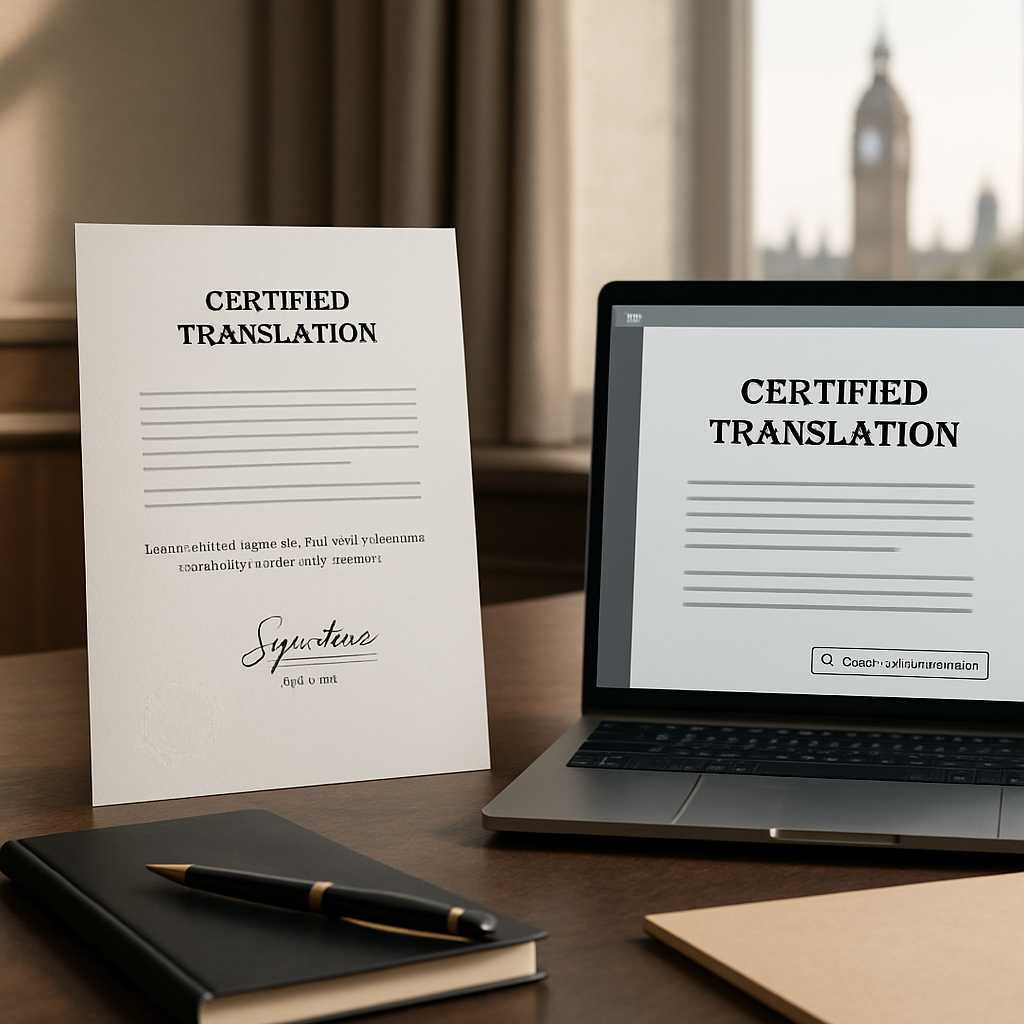
What People Mean by Wet Signature Certified Translation
When individuals search for “wet signature certified translation,” they are typically not inquiring about ink for its own sake. Instead, they are concerned about avoiding rejection from UK authorities. They want to understand whether a paper certified translation with an original pen signature is necessary, if a signed PDF suffices, and whether they should order hard-copy delivery upfront or only if requested later.
In practice, this phrase often points to a larger concern: will the translation appear official, be easy to verify, and be accepted on the first attempt? Therefore, the best answer is rarely just “wet signature” or “digital signature.” The actual requirements depend on the destination of the document, how it will be submitted, and what the receiving body expects to see on the certificate page.
In many UK submissions, the certificate page, the signature, and the ability to verify the translator or translation company are more critical than the ink itself. However, when the receiving body operates with paper bundles, postal files, or in-person checks, a wet-signed hard copy can still be the safer choice.
Why This Phrase Causes Confusion
The term “wet signature certified translation” is often used loosely, leading to different interpretations:
- A handwritten ink signature on the certificate page
- A posted hard copy, not just a PDF
- A translation that appears more formal due to being signed and stamped
- Reassurance that the document will be accepted by a cautious caseworker, admissions team, or legal office
These interpretations are not interchangeable. A client may request a wet signature when they actually need a hard copy, while another may ask for a digital signature when they mean a signed PDF via email. Additionally, some clients may focus solely on the signature when the real issue lies in an incomplete certificate page or the need for a document that can be independently verified. This miscommunication can lead to ordering the wrong format for the intended translation.
The Short Answer
For many UK certified translation jobs, the key question is not whether the signature is physically written in ink. Instead, the focus should be on whether the translation is:
- Complete
- Properly certified
- Signed
- Dated
- Traceable to the translator or translation company
- Provided in a format that the receiving body will accept
If the submission route is digital, a professionally prepared PDF may suffice. Conversely, if the submission is paper-based, a wet-signed hard copy may be the better choice from the outset.
What People Usually Mean by “Wet Signature” in the UK
“I Need an Original Signed Certificate Page”
This is the most straightforward interpretation. The client desires a printed certification page with a handwritten signature, often accompanied by a stamp or seal, attached to the translation.
“I Need Something I Can Post or Carry to an Appointment”
In this case, “wet signature” is shorthand for hard-copy delivery. The client is concerned about practicality rather than technicalities, preferring not to arrive with a self-printed PDF if the receiving body expects an original document.
“I Need It to Feel Official”
This is common among first-time applicants who worry that a PDF may seem too informal, even if it is acceptable. Here, the request is more about confidence and presentation.
“I Need a Signed PDF That Is Clearly Authentic”
Sometimes, clients use the term “wet signature” when they are actually looking for a signed PDF delivered via email, but in a format that still appears official and can be verified later if necessary.
Wet Signature, Scanned Signature, and Digital Signature Are Different Things
Understanding the distinctions among these terms is crucial:
Wet Signature
A handwritten signature made in ink on a physical page. In certified translation work, this typically appears on the certificate page rather than on every page of the translation.
Scanned Signature
An image of a handwritten signature inserted into a digital file. While it may be acceptable in some workflows, it does not equate to a technically verifiable digital signature.
Digital Signature
An electronically applied signature that may offer verification, integrity checks, or tamper evidence. This is a technical category, not merely a visual one. A file can appear signed without being digitally signed in the more robust sense that some clients may assume.
This distinction is important because a client may request a “digital signature” when they only want a signed PDF via email, or they may be dealing with an institution that requires a more secure, verifiable electronic signing method.
The Acceptance Triangle: What Matters More Than Ink
The strongest certified translations are built around three essential elements:
1. Content
The translation must be complete, clear, and faithful to the original. Omissions of notes, seals, annotations, names, dates, or document references can create issues even if the signature is acceptable.
2. Verification
The receiving body needs to know who certified the translation and how that person or company can be verified. A proper certificate page handles most of this verification.
3. Format
Even a well-certified translation can face challenges if it arrives in the incorrect format. A PDF-first workflow is effective for digital submissions, while a paper-first workflow is safer for receiving bodies that still handle physical files.
When clients focus solely on the signature, they often overlook the larger acceptance criteria.
The Certificate Page: The Part Clients Underestimate
In many instances, clients desire more than just a wet signature; they want a robust certificate page. A well-constructed certificate page should clearly indicate:
- What document was translated
- Who certified the translation
- When it was certified
- How to contact the translator or company
- That the translation is linked to the attached source material
- That the certifier stands behind its accuracy
A strong certificate page minimizes questions and is often more valuable than debating whether the signature was written in blue or black ink.
When a Digitally Delivered Certified Translation Often Works Best
A digital certified translation is typically the best choice when:
- The submission is through an upload portal
- The document will be sent via email
- The deadline is tight
- The client requires the translation quickly for review
- The same translation may be reused across multiple submissions
- There is no explicit request for a paper original
This is why digital delivery has become a practical first step for many certified translation orders. It reduces waiting time, simplifies document transmission, and allows clients to act swiftly.
For urgent cases, a PDF-first approach is often the most efficient workflow, keeping the project moving while leaving room for hard-copy delivery later if needed.
When Hard-Copy Delivery Is the Safer Option
A wet-signed hard copy is often worth ordering from the outset when:
- The receiving body has requested originals
- The translation will be included in a physical court bundle
- The document will be reviewed in person
- The file may be circulated among several departments
- The authority outside the UK tends to prefer paper originals
- The case may later require notarisation or legalisation
- The consequences of rejection are significant and the requirements are unclear
In these situations, paper still holds practical value. Even if a digital version could theoretically be accepted, a physical original can eliminate uncertainty in practice.
The UK Reality: Written Rules and Office Habits Are Not Always Aligned
This is a crucial point often overlooked. There is frequently a gap between:
- What the formal requirements state
- What the receiving team typically accepts
- What is safest for a time-sensitive submission
A department may outline what a translation must include, but the staff handling the paperwork may still feel more comfortable with a paper original. A university may initially review documents digitally, then request originals later. A solicitor may accept a PDF for preliminary review but require a wet-signed paper for the final hearing bundle.
This discrepancy is why the term “wet signature certified translation” persists. It reflects both rules and submission habits.
A Better Way to Order: The Three-Question Check
Before placing an order, consider these three questions:
1. Where Is the Translation Going?
Identify the destination: Home Office, court, university, employer, notary, overseas authority, or another institution.
2. How Will It Be Submitted?
Determine the submission method: upload portal, email, post, in-person appointment, or physical hearing bundle.
3. What Will the Receiving Body Want to Verify?
Consider what needs verification: the translator’s identity, the company’s credentials, the wording of the certificate, the physical originality of the document pack, or the integrity of the digital file.
Once these questions are addressed, selecting the appropriate format becomes much clearer.
Common UK Scenarios and the Safest Choice
Visa or Immigration Upload with a Close Deadline
A certified PDF with a proper certificate page is often the fastest route. If a paper original is later required, arrange for hard-copy delivery once that need is confirmed.
Court or Solicitor-Led Bundle
Inquire early whether the final file will be used in paper form. If the answer is affirmative, a wet-signed hard copy is typically the safer option.
University Admissions or Qualification Checks
A PDF may suffice for the initial review stage, but some institutions later request originals or formally certified copies. It is wise to prepare for both scenarios.
Employer or HR Compliance Checks
Many employers prioritize speed, clarity, and a credible certificate page over paper for its own sake. A clean PDF often works well, although hard copies can be beneficial when documents circulate among various teams.
Notarised or Legalised Pathway
If the translation may later require notarisation or legalisation, mention this at the outset. It is much easier to establish the correct document chain from the beginning than to retrofit it after delivery.
The Mistakes That Cause the Most Rework
Ordering “Wet Signature” Without Defining the Real Requirement
This often leads to the wrong format for the actual submission route.
Assuming Every Signed PDF Is a Digital Signature
A visible signature image and a technically verifiable digital signature are not the same.
Focusing on the Signature and Ignoring the Certificate Page
A strong signature on a weak certificate page does not resolve the acceptance issue.
Leaving Hard-Copy Questions Until the Last Minute
If paper turns out to be necessary, courier timing becomes the real concern, not the translation itself.
Not Informing the Provider Where the Document Is Going
A visa upload, a court bundle, and a notarised pack may all require slightly different handling, even if the source document is identical.
The Rule That Saves Time and Money
Order by destination, not by buzzword. If the destination is digital, prioritize a submission-ready PDF. If the destination is paper, prioritize a wet-signed hard copy. If the destination is unclear, prepare for both options. This approach is typically faster and safer than debating terminology after the translation has been completed.
Why This Matters for Acceptance
The cost of making mistakes in this area is rarely limited to the translation fee. It can result in:
- A missed appointment
- A delayed filing
- A rejected upload
- A second certification run
- An avoidable courier charge
- A rushed notary step
- Unnecessary stress right before a deadline
This is why the best providers do not treat certification wording, signature format, and delivery method as separate afterthoughts. They consider them as part of one submission decision.
If you want the safest route, send the file along with the destination and deadline. This makes it much easier to receive the correct format on the first attempt.
What to Ask For When You Order
To minimize back-and-forth communication, include the following details in your request:
- The document itself
- The target language
- The receiving body
- How the document will be submitted
- The deadline
- Whether you need a PDF, hard copy, or both
- Whether notarisation or legalisation may follow
A message such as “This is for a UK visa upload now, but I may need a hard copy later” is far more informative than simply stating, “I need a wet signature.”
Why Clients Choose TS24 for This Kind of Order
TS24 is particularly well-suited for these types of projects where format is as important as wording. Clients can benefit from:
- Certified translations in over 200 languages
- ATC-accredited standards
- Recognized professional-body linguists
- Urgent turnaround options
- Notarised support when necessary
- Clear pricing
- Hard-copy delivery when paper originals are genuinely needed
For clients facing time constraints, this is crucial. Instead of guessing whether the safest route is digital first, paper first, or both, they can provide the destination details upfront and receive a format that aligns with the actual submission route.
A recent client experience on the TS24 site illustrates this point well: their translated documents were accepted by the Home Office without issues. This is what most individuals are truly seeking when they search for “wet signature certified translation” — not just a signature, but confidence.
Final Word
In the UK, “wet signature certified translation” typically does not refer to a single, straightforward rule. Instead, it serves as practical shorthand for a broader concern: will this translation be accepted, and does the format align with the receiving body’s workflow?
Sometimes, a signed PDF is sufficient, while other times, a couriered hard copy is the safer option. Often, the most prudent approach is to begin with the submission route, then select the certificate page, signature style, and delivery method accordingly. When terminology is ambiguous, clarity prevails every time.
FAQs
Does a wet signature certified translation mean every page must be signed in ink?
Usually, no. In most cases, the signature appears on the certificate page rather than on every page of the translation. What matters is that the certification is clear, complete, and attached to the translated document set.
Is a digital signature accepted for certified translation in the UK?
It can be, depending on the receiving body and how the document is being submitted. A signed PDF may be sufficient for many digital workflows, but some institutions still prefer or request hard-copy originals.
Is a scanned signature the same as a digital signature?
No. A scanned signature is typically just an image of handwriting placed into a document. A digital signature can involve stronger verification and tamper-evident controls. Clients should not assume the two are interchangeable.
Do I need hard-copy delivery for a certified translation?
Not always. If the document is being uploaded or emailed, a PDF may suffice. Hard-copy delivery is more beneficial when the receiving body requests originals, uses paper bundles, or is likely to be cautious about printed copies.
What should a certified translation certificate page include?
It should clearly confirm that the translation is accurate, identify who certified it, show the date, include contact details, and make it easy for the receiving body to connect the certificate to the translated document.
What is the safest way to order a wet signature certified translation?
Inform the provider where the document is going, how it will be submitted, and whether you may later need a hard copy, notarisation, or legalisation. This makes it much easier to choose the right format from the start.

