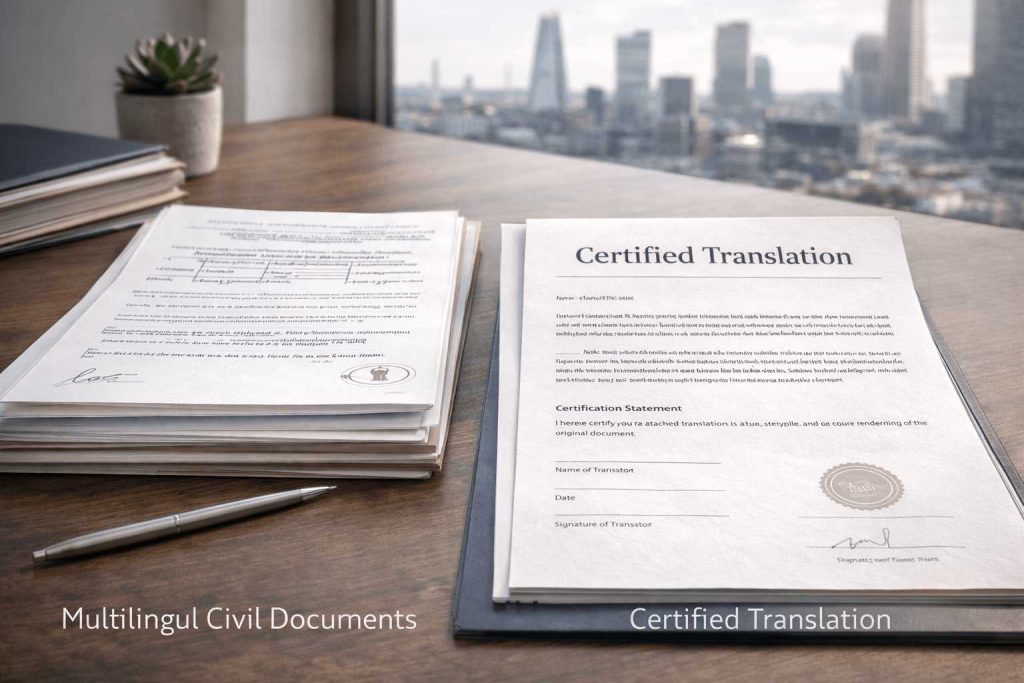
If you are preparing an immigration application in the capital, ukvi translation london usually comes down to one simple question: will your translated document pack look clear, complete, and easy for a caseworker to trust?
That is where many applicants get caught out. The translation itself may be accurate, but the submission still feels risky because the certification wording is incomplete, the contact details are missing, the scan quality is poor, or parts of the original have been left untranslated. In practice, the strongest submissions are rarely the most complicated ones. They are the ones that are easy to verify, easy to read, and consistent from the first page to the last.
This guide walks through what UKVI usually expects from translated documents, what “Home Office compliant” normally looks like, which mistakes cause avoidable delays, and how applicants in London can prepare a cleaner, stronger document pack before submission.
If you already know you need an official translation, our certified translation services and immigration document translation pages are a useful next step for getting your documents checked quickly.
Why this checklist matters
When a caseworker reviews a translated document, they are not only reading the translated text. They are also looking for signs that the translation can be trusted.
That usually means the document should feel:
- complete rather than selective
- professionally prepared rather than improvised
- traceable to a real translator or translation company
- consistent with the original file
- easy to match to the rest of the application
A strong translation helps the reader move forward. A weak one creates friction. And in immigration matters, friction is what applicants want to remove.
What UKVI usually expects from translated documents
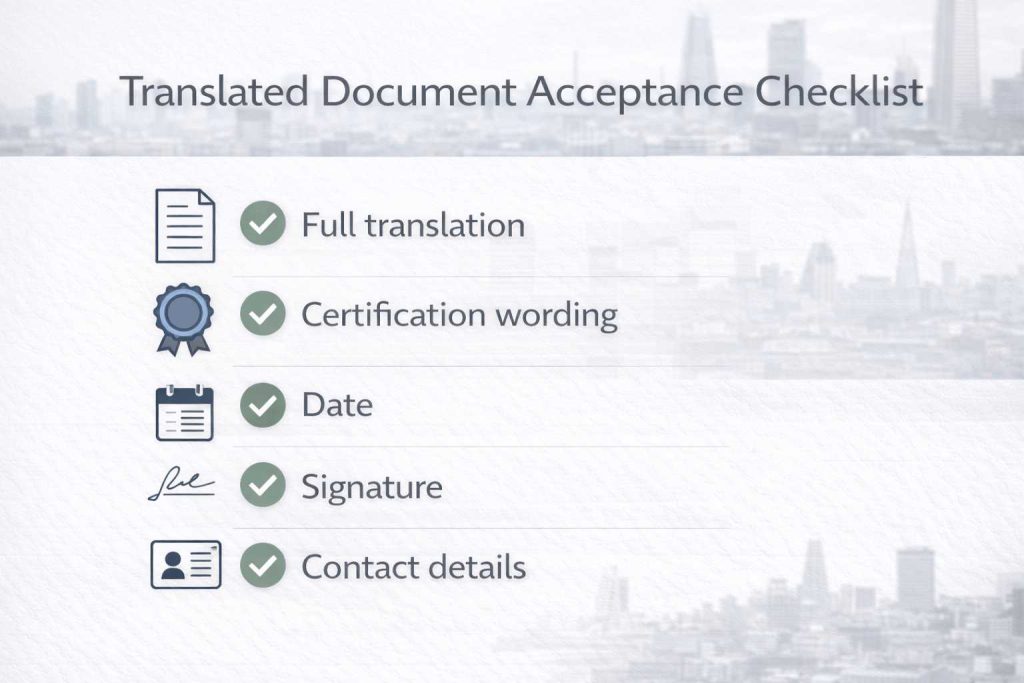
For most UK immigration and Home Office-facing submissions, the safest working assumption is that a translated document should include the following:
- A full translation of the original document
Not a summary. Not selected sections. Not only the “important bits.” - A statement confirming the translation is accurate
The certification wording should clearly say the translation is a true and accurate rendering of the original. - The date of translation
This helps show when the certified version was produced. - The translator’s full name and signature, or the signature of an authorised official from the translation company
The document should feel attributable, not anonymous. - Contact details for the translator or translation company
The translation should be independently verifiable.
That is the core checklist. If those basics are missing, the translation immediately looks weaker.
What “Home Office compliant” usually looks like in practice
The phrase home office compliant translation gets used a lot, but in practical terms it usually means the translated document has been prepared so that it is easy for the receiving authority to verify and accept.
In real terms, that often includes:
- a clear title showing the document is a translation
- faithful translation of names, dates, places, headings, stamps, and visible annotations where relevant
- a certificate or declaration attached to the translation
- company letterhead, stamp, or project reference where appropriate
- consistent spelling of the applicant’s name across all documents
- readable formatting that mirrors the source closely enough to follow the original structure
A compliant translation does not need to be theatrical. It does not need legal jargon for the sake of it. It needs clarity, accountability, and traceability.
The five things applicants miss most often
1. They translate only the main body and skip the small details
This is one of the most common issues. A document may have the main paragraphs translated while leaving out:
- stamps
- seals
- side notes
- handwritten notes
- registry references
- footers
- marginal comments
- page numbers
- issue references
Those details can matter more than applicants think. If a date stamp or issuing authority appears on the original, it should usually be reflected in the translation as well.
2. They assume “certified” just means adding a stamp
A stamp can help presentation, but it is not a substitute for the actual certification details. What matters is whether the translation clearly states who prepared it, when, how it is being certified, and how the provider can be contacted.
3. They ignore name consistency
Immigration files often contain passports, certificates, academic records, police documents, and financial evidence from different countries. Name order, spelling, hyphenation, and patronymic usage can vary.
A translation should not create new inconsistency. If your passport says one thing and your translated certificate appears to say something slightly different, that can cause unnecessary questions.
4. They order too late
A short birth certificate may be straightforward. A bundle of civil records, police certificates, bank statements, and supporting letters in multiple languages is not.
Delay often comes from:
- poor scan quality
- missing pages
- urgent print requirements
- uncommon language pairs
- layout-heavy originals
- additional notarisation or apostille requests
If you have a deadline, it is sensible to review timing early. For urgent cases, our urgent translation services page explains the faster options available.
5. They ask for the wrong level of certification
Many applicants use the words certified, notarised, sworn, legalised, and apostilled as if they mean the same thing. They do not.
That confusion leads people to over-order, under-order, or pay for the wrong process entirely.
Certified vs notarised vs apostilled: what usually matters for UKVI
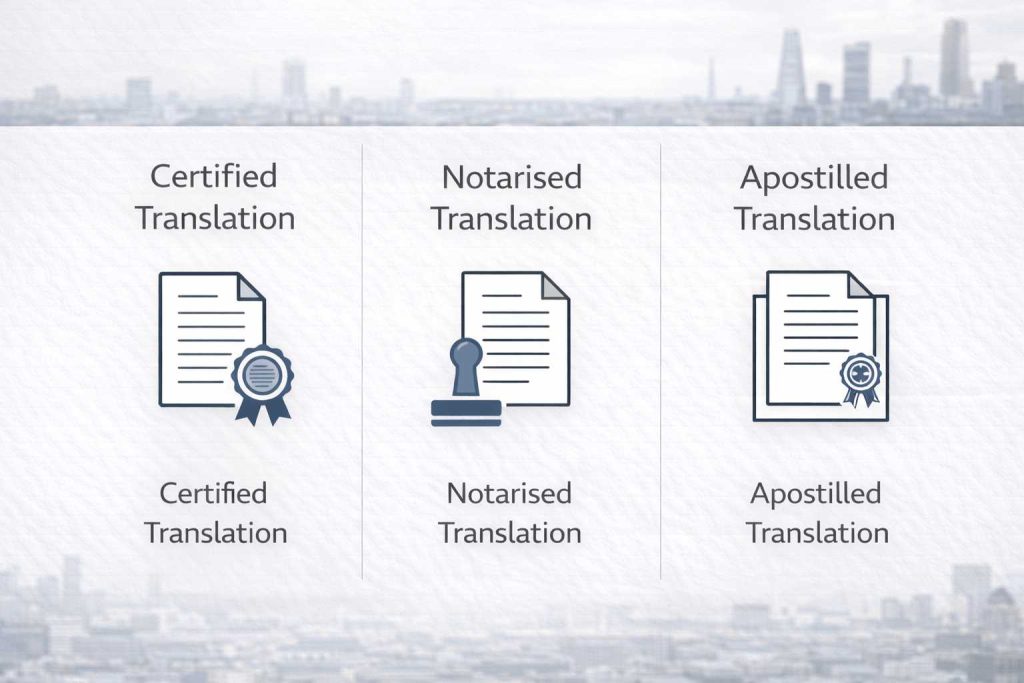
For a London immigration application, the key question is not “what sounds most official?” It is “what has actually been requested?”
Certified translation
This is the usual requirement for non-English or non-Welsh documents in UK immigration contexts. It confirms the translation is accurate and identifies the responsible translator or company.
Notarised translation
This adds a notary’s involvement. It can be useful for certain legal or international uses, but it is not automatically required just because a document is important.
Apostilled translation
This is normally relevant when a document is being prepared for use abroad and a receiving authority has specifically asked for legalisation.
For most UKVI-facing submissions, the starting point is a properly prepared certified translation, not a more complicated chain of authentication. If another authority has asked for a higher level of formalisation, our notarised translation services team can help you judge what is actually needed.
What good certification wording looks like
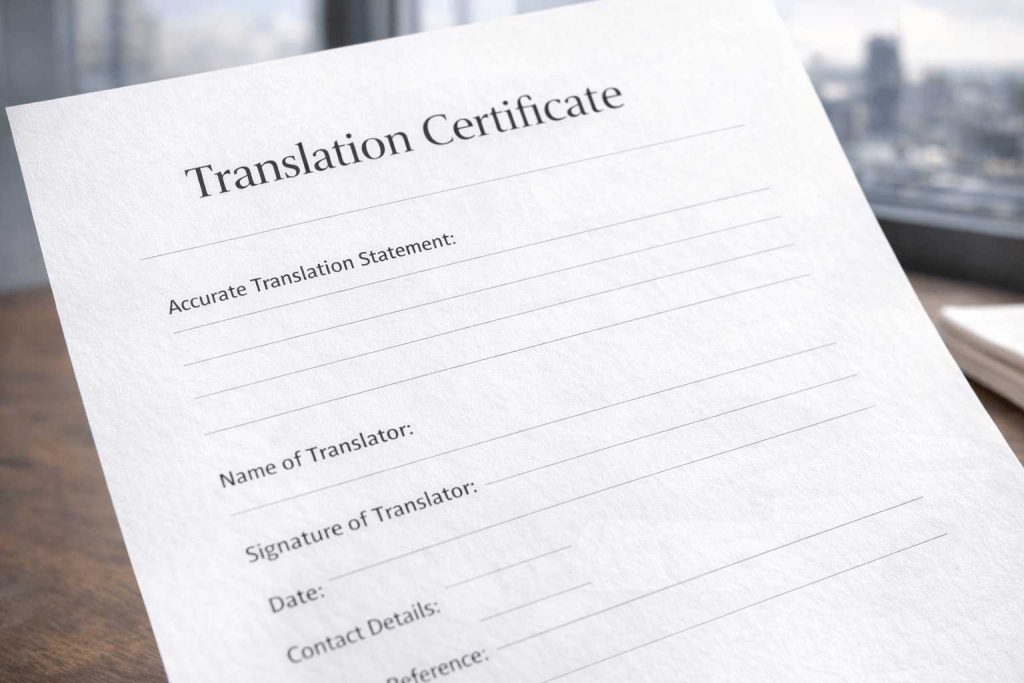
The safest certification wording is clear and plain. It should confirm accuracy and identify responsibility.
A simple format often looks like this:
Certificate of Translation Accuracy
I certify that this document is a true and accurate translation of the original document.
Translator / Company Name:
Date:
Signature:
Contact Details:
Reference Number:
Some providers also add company letterhead, stamp, language pair, and document title. That can strengthen presentation, but the essential point is that the certificate must make the translation attributable and verifiable.
Which documents most often need UKVI translation in London
Applicants searching for ukvi translation london are usually dealing with one or more of the following:
- birth certificates
- marriage certificates
- divorce certificates
- passports and ID pages
- police clearance certificates
- criminal record certificates
- bank statements
- payslips
- employment letters
- tenancy agreements
- academic certificates
- transcripts
- court documents
- adoption papers
- death certificates
- residency records
If your application includes civil status records, our birth certificate translation, marriage certificate translation, and passport translation services pages cover some of the most common document types.
A practical London submission checklist
Before you upload or post anything, run through this quick review:
Document checklist
- Is every non-English or non-Welsh page translated?
- Are page sequences complete?
- Are scans sharp, uncropped, and readable?
- Are stamps, seals, handwritten notes, and issue references visible?
Certification checklist
- Does the translation confirm it is accurate?
- Is the translation dated?
- Is the translator or company clearly named?
- Is there a signature?
- Are contact details present?
Consistency checklist
- Does the spelling of your name match your passport?
- Do dates follow a clear format?
- Do document numbers and registry references match the original?
- Are place names rendered consistently across the pack?
Delivery checklist
- Do you need digital delivery only?
- Do you need a hard copy with wet signature or stamp?
- Do you need extra copies for another authority?
- Has any authority specifically requested notarisation or apostille?
That short review can prevent the kind of small administrative weakness that causes disproportionate stress later.
Common mistakes that make a translation look weaker than it is
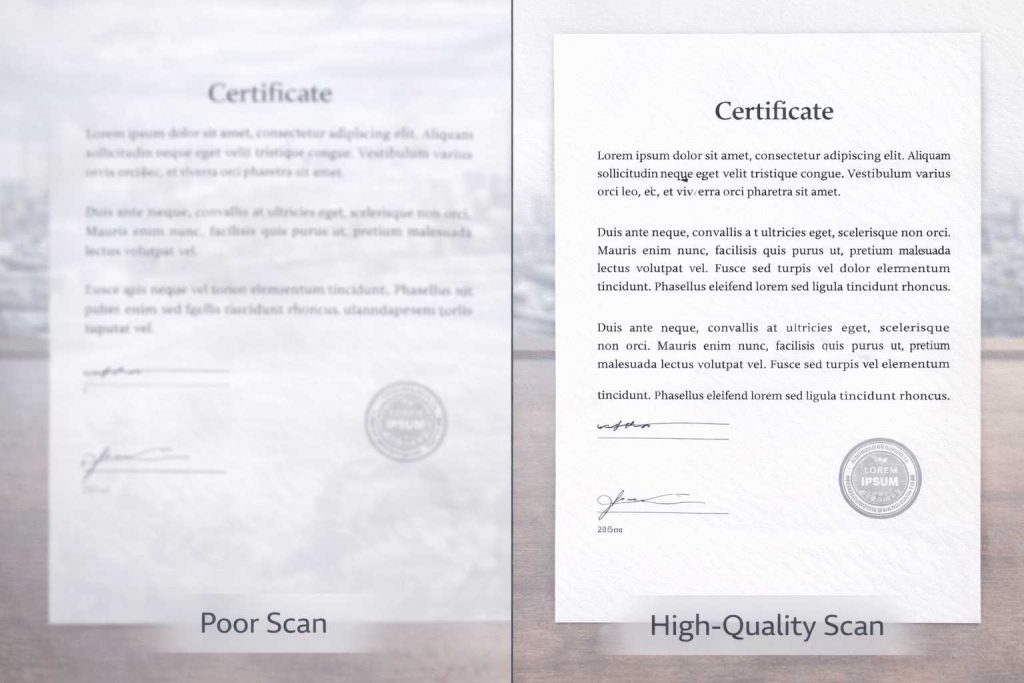
Even a professional translation can lose impact if the document pack is messy. The following problems tend to undermine confidence fast:
- blurred phone photos taken in low light
- missing reverse pages
- cut-off seals or corners
- mixed files with no clear naming
- pages sent out of order
- original documents edited or compressed too heavily
- translations submitted without the corresponding original
- certification page separated from the translated file
A useful rule is this: if the original is hard to read, the translation process becomes harder, slower, and riskier too.
Do digital copies work, or do you need a printed translation?
Many applicants now submit digitally, but not every authority handles supporting documents in the same way.
For standard immigration-related use, a high-quality digital certified translation is often sufficient. That said, there are still situations where a printed version is sensible, especially when another organisation wants a physical pack, original signature, or stamped copy.
This is why the best approach is not to assume. It is to confirm what the receiving body wants and order the correct format first time.
A smarter way to plan turnaround
People often ask for “same day” because the deadline feels urgent. But the right turnaround depends on the document set.
Same day usually makes sense when:
- the file is short
- the scan quality is excellent
- the document type is standard
- the language pair is common
- no extra certification layer is required
24 hours is often more realistic when:
- there are multiple short documents
- the formatting needs careful matching
- the file needs review across several pages
- you may need both digital and hard copy output
Longer lead time is usually wiser when:
- the bundle is large
- the source file is poor
- the language is less common
- the matter is legally sensitive
- notarisation or legalisation may be needed
If your deadline is tight, it helps to send the full pack at the start rather than one document at a time. That gives the translator a clean picture of what has to match across the application.
What applicants in London really want from a translation provider
In theory, applicants want a certified translation. In practice, they want reassurance.
That usually means:
- a fast response
- clear pricing
- someone who understands immigration documents
- a translator or company that can be verified
- a certificate that looks professional
- no confusion about delivery format
- confidence that the translation will be accepted for its intended use
That is why many applicants prefer working with a provider that can handle both standard certified work and higher-level requests where needed.
At TS24, clients can move from a straightforward certified translation service to urgent turnaround or notarised translation support without having to restart the process with a different supplier.
Final thought
The strongest UKVI submission packs are rarely the fanciest ones. They are the ones that remove doubt.
A good translation does not leave the caseworker guessing who produced it, when it was prepared, whether it reflects the original fully, or how the provider can be verified. It answers those questions before they are asked.
That is the real London checklist.
If your documents are ready, get a quote, upload your file, and have the pack reviewed before submission. A short check now is usually far easier than fixing avoidable issues after the fact.
FAQs
Does UKVI require certified translation in London?
Yes. If a supporting document is not in English or Welsh, it should normally be submitted with a certified translation that clearly identifies the translator or translation company and confirms the translation is accurate.
What should a home office compliant translation include?
A home office compliant translation should usually include a full and accurate translation, certification wording, the date, the translator’s full name and signature or authorised company signatory, and contact details that allow the translation to be independently verified.
Do I need a notarised translation for UKVI documents?
Not usually. In most immigration-related situations, a properly prepared certified translation is the key requirement. Notarisation is generally only needed when another authority specifically asks for it.
Can I use a digital UKVI translation in London?
In many cases, yes. A digital certified translation is often suitable, but some authorities or related processes may still ask for a printed, signed, or stamped version. It is best to confirm the required format before ordering.
How fast can I get ukvi translation london support?
Turnaround depends on the file type, number of pages, language pair, and whether the scans are clear. Short standard documents may be completed urgently, while larger or more complex packs need more time for proper review and certification.
What are the most common mistakes with UKVI translated documents?
The most common mistakes are partial translation, missing certification wording, absent contact details, poor scan quality, inconsistent spelling of names, and ordering the translation too late for proper checking.

