If you are searching for 24 hour translation London support, speed is only half the story. A smooth next-day submission depends on preparation, document quality, certification details, and delivery format just as much as the translation itself. In practice, the fastest projects are not always the simplest ones, but they are almost always the best organised.
That matters whether you are submitting documents for immigration, a passport application, university enrolment, a legal matter, or a business deadline. One missing page, one unclear scan, or one wrong assumption about what “certified” means can turn a next-day plan into a stressful delay. The good news is that most of these problems are avoidable.
This guide explains how to prepare for a fast turnaround properly, what tends to slow urgent jobs down, and how to give yourself the best chance of making a next-day submission without compromising quality or acceptance.
What 24-hour delivery really means
When people hear “24-hour translation,” they often imagine a document being sent over instantly and returned the next morning ready for any authority. Sometimes that happens. Sometimes it does not. The difference usually comes down to what needs to be translated, how it is supplied, and what form of certification is required.
A genuine next-day workflow usually includes:
- file review
- quote approval
- translator assignment
- translation
- checking and formatting
- certification
- digital delivery, and sometimes
- printing, stamping, or courier dispatch
That is why the smartest urgent translation planning starts with one question:
What exactly needs to be delivered by tomorrow?
For some submissions, a certified PDF is enough. For others, you may need a signed hard copy, a notarised version, or extra legalisation. If you only discover that at the end of the day, the timeline changes immediately.
The real deadline is earlier than you think
A next-day deadline is rarely just “tomorrow.” It is usually:
- tomorrow at 9:00 am
- tomorrow before an appointment
- tomorrow before a portal closes
- tomorrow before a courier cut-off
- tomorrow before a solicitor or caseworker reviews the file
That means your operational deadline is often today.
A smooth priority workflow starts by fixing five details at the beginning:
- Who is receiving the translation
- What kind of certification they expect
- Whether digital delivery is acceptable
- Whether the document pack is complete
- What time the submission must actually happen
If those five points are clear, urgent translation planning becomes much more realistic. If they are unclear, even a fast provider may spend valuable time clarifying basics instead of moving the job forward.
The four things that decide whether next-day delivery is realistic
1. Document type and volume
A standard civil document is not the same as a long contract bundle.
A birth certificate, marriage certificate, passport page, or diploma is often more suitable for urgent turnaround because the format is familiar and the word count is manageable. A contract with appendices, handwritten notes, seals, and mixed language sections takes longer because it requires more checking, more formatting, and often more subject knowledge.
As a rule, next-day work is easier when the file is:
- short
- complete
- clearly scanned
- in a familiar official format
- free from handwritten additions or cut-off text
2. Scan quality and completeness
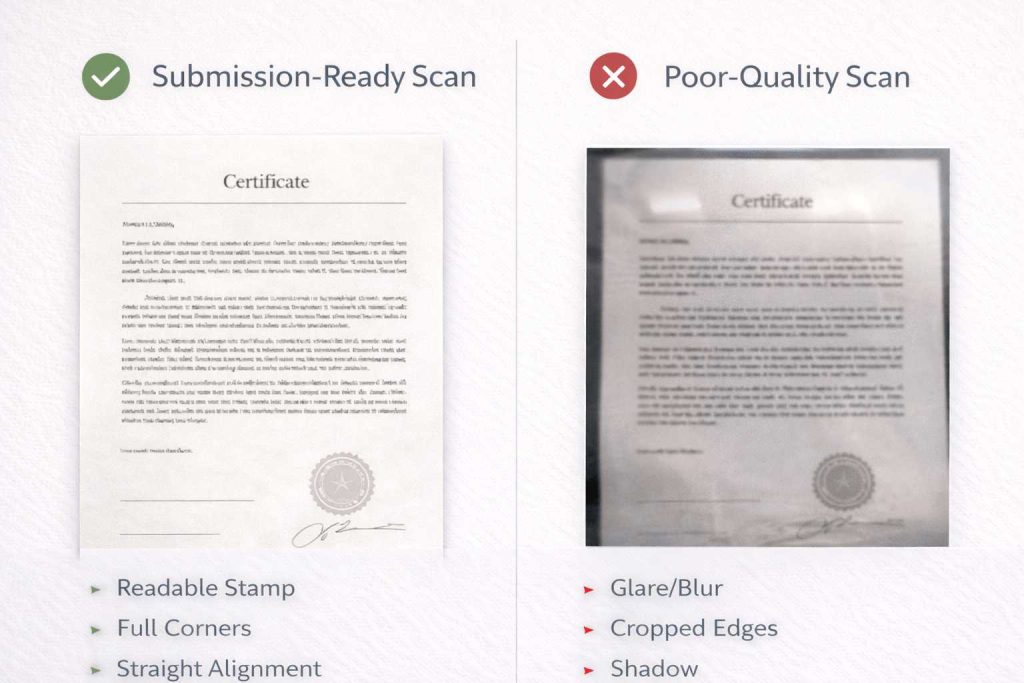
Poor scans are one of the biggest reasons urgent submissions stall.
If names, dates, stamps, signatures, serial numbers, or marginal notes are unclear, the linguist or project manager has to stop and ask for a better copy. That pause can cost more time than people expect.
Before sending an urgent file, check that:
- every corner is visible
- no text is cropped
- pages are in order
- stamps and seals are readable
- there is no glare, shadow, or blur
- the final version is being sent, not a draft or older scan
A clean PDF almost always moves faster than several phone photos sent one by one.
3. Certification requirements
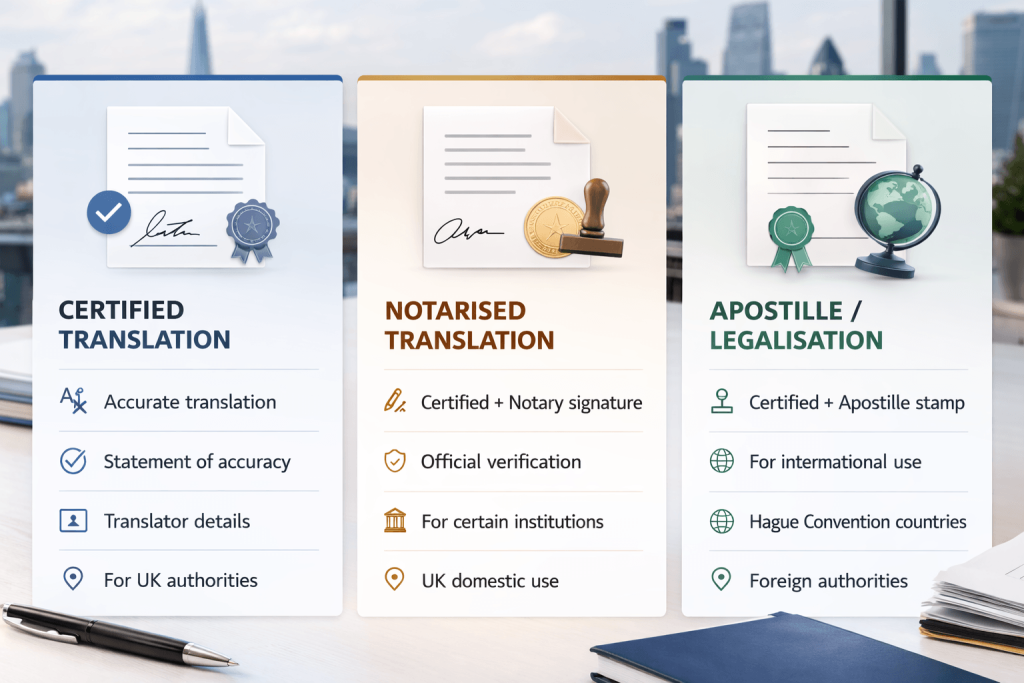
Not every receiving body wants the same thing.
For many UK uses, a standard certified translation is enough. For some overseas uses, a notarised or apostilled document may be needed as well. For certain applications, the receiving body may care about exact wording, signature details, contact information, or whether the translation can be independently verified.
This is where people lose time. They assume “official translation” means one fixed format, but acceptance rules can vary depending on the authority and country.
Before you place an urgent order, confirm:
- whether a standard certified translation is sufficient
- whether a physical stamp or signed copy is needed
- whether notarisation is required
- whether legalisation or apostille will be required afterwards
- whether the translation must match the layout closely
4. Delivery format and handover
A next-day submission may fail for logistical reasons, not linguistic ones.
There is a major difference between:
- a certified PDF delivered by email
- a printed certified copy delivered locally
- a notarised pack
- a pack that must then be legalised for overseas use
If the authority accepts a digital certified translation, your timeline is far easier to protect. If a hard copy must arrive physically, you need to factor in printing, handling, dispatch, address accuracy, and courier timing.
A practical deadline checklist before you request a quote
When the clock is tight, a vague enquiry creates its own delay. A strong enquiry allows the project to be assessed and scheduled properly from the start.
Send these details in your first message:
- source language and target language
- clear copy of every page
- exact deadline with time
- name of the receiving authority or institution
- whether digital delivery is acceptable
- whether a hard copy is needed
- whether certification, notarisation, or apostille is required
- whether the file must keep the original layout
- your full name as it should appear on the order
- a contact number for fast approval
A short, complete brief can save a surprising amount of time.
What to do today if you need to submit tomorrow
Here is the most practical workflow for a smooth next-day submission.
Step 1: Gather the final document pack
Do not send pages gradually if you can avoid it. Urgent work runs better when the provider sees the full scope immediately.
Create one folder or PDF containing:
- all pages
- both sides where relevant
- supporting pages that explain stamps or notes
- any reference spelling for names and places
- any previous approved translation, if available
Step 2: Identify the receiving body
Say exactly where the translation is going.
For example:
- Home Office or visa submission
- passport application
- university admissions office
- solicitor or court bundle
- employer or HR department
- overseas civil registry
This helps the project team assess the right certification path quickly.
Step 3: Confirm the delivery format
Ask one direct question:
Will a certified PDF be accepted for the first submission, or do you need a physical signed copy?
That answer often determines whether your deadline is comfortable or tight.
Step 4: Approve quickly
Fast turnaround depends on fast instruction. If you wait hours to approve a quote, the practical start time moves later, even if the deadline stays the same.
For urgent jobs, keep these ready:
- approval from the person paying
- invoicing details if needed
- phone availability
- clear delivery address if any hard copy is required
Step 5: Check the finished file before submission
Even on urgent work, always do a final review before you send it onward.
Check:
- your name is consistent across pages
- dates are correct
- page order is correct
- certification page is present
- any stamp, signature, or statement required is included
- the delivered format matches what the authority expects
A next-day submission timeline that works
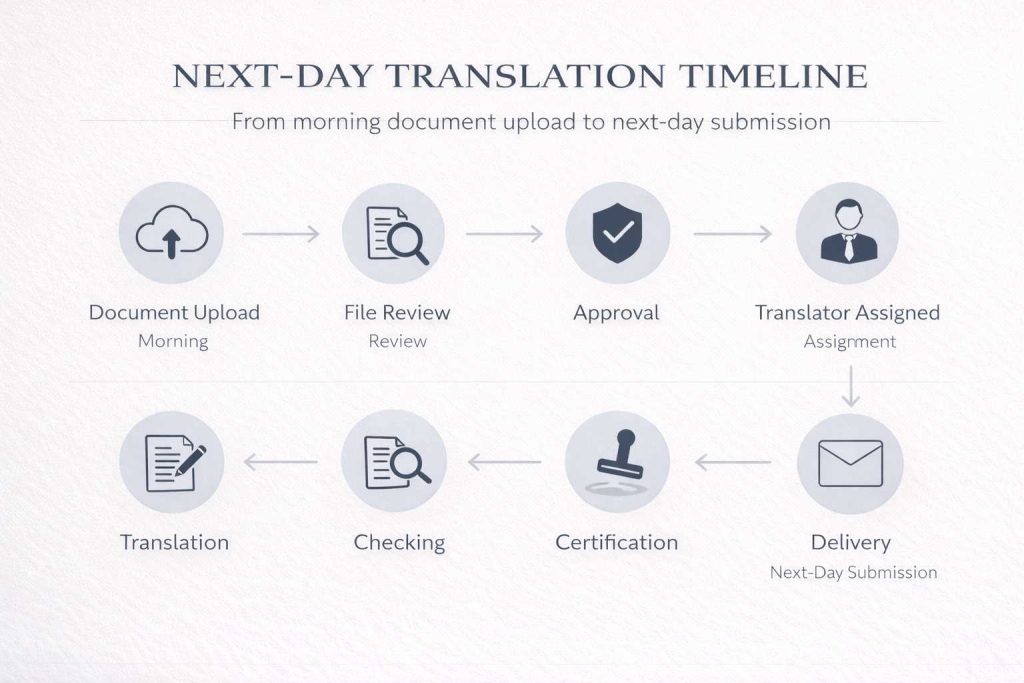
Below is a realistic example of how an urgent document submission can stay on track when planned properly.
Example: one standard document pack for a morning deadline
8:30 am
The client sends a complete PDF, target language, authority name, and deadline.
9:00 am
The project is reviewed, quoted, and approved.
9:30 am
The linguist is assigned with the correct subject expertise.
Midday
Translation is in progress, with any terminology or legibility questions resolved early.
3:00 pm
Checking, formatting, and certification are completed.
4:00 pm
Certified PDF is delivered for review.
Same evening or next morning
If needed, the printed copy is prepared for collection, dispatch, or onward legalisation.
This is not a guarantee for every file. It is an example of what becomes possible when the job is standard, the scans are clear, and the delivery requirements are settled from the beginning.
Where urgent jobs usually go wrong
The most common delays are surprisingly predictable.
Incomplete files
A client sends page 1, then page 2, then a better version of page 1, then a separate photo of the stamp. The project has to be stopped and restarted mentally each time.
Better approach: send one final pack once.
Unclear acceptance rules
The client asks for a “certified translation,” but the authority actually expects a signed physical copy or later notarisation.
Better approach: confirm the receiving body’s requirement first.
Last-minute format changes
The project is prepared for digital delivery, then a paper original is requested late in the day.
Better approach: settle handover format at the quote stage.
Poor scans
The dates are clear on one page but the serial number is blurred on another.
Better approach: re-scan before ordering, not after the translator has started.
Underestimating business or legal content
A short-looking contract may include annexes, clauses, and defined terms that require careful consistency.
Better approach: flag anything legal, technical, or high-risk from the start.
When 24-hour translation in London is realistic — and when it is not
Usually realistic
- birth certificates
- marriage certificates
- passports and IDs
- police certificates
- standard academic certificates
- short immigration document packs
- short business letters or statements
Possible, but needs early review
- multi-page academic transcripts
- contracts with schedules
- files with stamps, annotations, and mixed formats
- multiple documents across several family members
- specialist medical or legal texts
Unlikely without a phased plan
- long contracts with annexes
- bundles of court evidence
- handwritten historical records
- poor-quality scans needing reconstruction
- cases requiring notarisation, legalisation, and physical handover all at once
In those more complex cases, the smartest route is often not “Can this be done by tomorrow?” but:
What can be delivered tomorrow in a form the receiving body will accept?
That may mean a phased plan, with certified digital delivery first and follow-up handling for the physical or legalised version.
A smarter way to brief an urgent translation provider
A strong brief is not long. It is precise.
Use something like this:
I need these documents translated from Spanish into English for a UK visa submission by 10:00 am tomorrow. A certified PDF is needed first. Please confirm whether the certification page will include the translator or agency details and the date. The attached pack has 4 pages and is the final version.
That single message does three useful things:
- it defines the deadline
- it defines the purpose
- it defines the expected output
That is much better than simply writing, “Need this urgently, please help.”
Why “avoid delays” is really an admin problem, not just a translation problem
Many rushed submissions fail long before the translation itself becomes the issue.
In urgent cases, the real pressure points are usually:
- admin readiness
- document clarity
- certification fit
- delivery planning
That is why the best urgent providers do more than translate words. They triage the file, check feasibility, spot likely acceptance issues early, and tell you what needs to happen first.
For clients, this is reassuring because it replaces guesswork with a clear route.
For the receiving body, it improves the chance that the file arrives complete, coherent, and ready to be reviewed without follow-up questions.
A quick comparison: fast translation vs smooth submission
| Situation | Fast translation only | Smooth next-day submission |
| File arrives quickly | Yes | Yes |
| Pages checked for completeness | Not always | Yes |
| Certification matched to purpose | Not always | Yes |
| Delivery format confirmed | Not always | Yes |
| Risk of authority rejection reduced | Not necessarily | Much more likely |
| Client knows what happens next | Sometimes | Yes |
This is the key difference. Speed matters, but planning is what makes speed useful.
Example scenarios that show the difference
Scenario 1: Personal document submission
A client needs a birth certificate and passport page translated for a passport or visa-related process. The scans are clear, the authority accepts a certified PDF, and the request comes in early with the full pack attached.
This is the kind of case that often moves smoothly.
Scenario 2: University admissions deadline
A student sends a diploma and transcript late in the afternoon, but one page is missing and the institution name is partly cut off in the scan. The missing page is only discovered after the job has been assessed.
The issue is not translation speed. It is pack quality.
Scenario 3: Business contract deadline
A company needs a contract translated by the next day for review in London. The main agreement is short, but the schedules and defined terms are not. A phased delivery plan may be more practical than forcing a full end-to-end sign-off too late in the day.
This is where priority workflow and expectation setting matter.
How to protect a next-day submission when the stakes are high
If the document is important, treat the translation stage as part of a wider submission chain.
That means thinking about:
- who needs to sign off internally
- whether the authority portal is open when you need it
- whether there is a courier deadline
- whether the document may later need notarisation or apostille
- whether any spelling discrepancies across documents need to be explained
Even ten minutes of checking these points can prevent a day of delay later.
Need an urgent translation in London without the panic?
When the deadline is close, the fastest move is to send the final document pack, state the exact purpose, and ask for confirmation of the required certification and delivery format in the first reply. That gives the project team something real to work with and gives you a clearer answer on what is achievable.
If your submission is tomorrow, do not wait until every uncertainty feels resolved. Send the documents, identify the receiving body, and get a feasibility check while there is still room to act. A well-managed urgent project is not just about fast output. It is about making sure the translation you receive is the one you can actually use.
Final thought
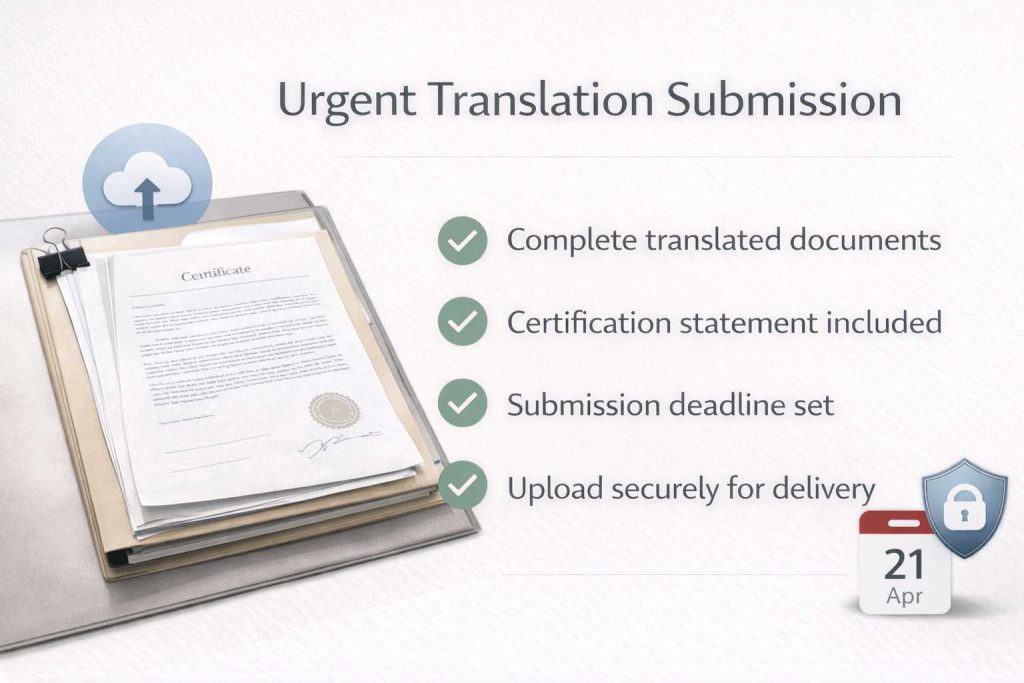
A next-day submission goes smoothly when three things line up:
- the file is ready
- the requirements are clear
- the workflow starts early
That is the real lesson behind urgent translation planning. The deadline may say “tomorrow,” but the result is shaped by what you do today.
If you need a fast, submission-ready translation, act early, brief clearly, and make sure the certification and delivery format are right before the job begins. That is how you avoid delays, protect the deadline, and give yourself the best chance of a calm, successful submission.
FAQs
How quickly can 24 hour translation in London be completed?
For standard documents such as certificates, passports, and short official records, a certified translation can often be completed within the same day or within 24 hours. The actual timing depends on the language pair, file quality, number of pages, certification needs, and whether digital or physical delivery is required.
What is the best way to plan urgent translation for a next-day submission?
The best approach is to send the complete final file early, name the receiving authority, confirm the exact deadline, and state whether you need a certified PDF, a printed copy, or additional legalisation. Clear instructions reduce back-and-forth and help avoid delays.
What usually causes delays in a priority translation workflow?
The most common causes are blurred scans, missing pages, unclear certification requirements, late quote approval, and last-minute changes to delivery format. Urgent translation planning works best when everything is settled at the start.
Can a certified translation be delivered digitally for official use?
Often yes, but it depends on the receiving body. Some authorities accept a certified PDF for initial submission, while others may require a signed and stamped hard copy. Always confirm this before placing an urgent order.
Is 24 hour translation in London suitable for legal and business documents?
It can be, but legal and business files need careful assessment. Short agreements, letters, and standard documents are more suitable for next-day turnaround than long contracts, annexes, or multi-document bundles with technical terminology.
How do I avoid rejection when submitting an urgent translated document?
Make sure the translation is complete, clearly formatted, and certified correctly for the authority receiving it. Check names, dates, page order, certification wording, and delivery format before submitting the final pack.

